I built my first deliberate plant corner around a mature Philodendron gloriosum that had outgrown its shelf, and the exercise taught me more about styling than any Pinterest board ever did. One plant, one chair, one lamp, one rug, and a wall that was allowed to stay mostly empty. Every time I tried to add a second plant to keep it company, the corner got noisier and the gloriosum somehow looked smaller. So I took the second plant back out. That corner has held its shape for almost three years now, and the plant has put out eleven new leaves in it.
Quiet corner plant styling is really just the discipline of subtraction. You are not decorating around a plant; you are giving one plant enough room to be the entire subject of a small scene. The goal is a spot in the room that lowers your shoulders when you walk past it. Everything below is what I actually check before I commit a corner to a single specimen, and what I do afterwards to keep it looking intentional rather than tired.
Why a single-plant corner works better than a grouping
Groupings are wonderful, but they demand constant editing. Leaves overlap, colors compete, one plant sulks and the whole shelf looks off. A single-plant corner asks less of you. The plant is the composition. Your job shrinks to keeping that one specimen healthy and choosing three or four supporting objects that do not argue with it.
There is also a perceptual trick at play. When a viewer walks into a room and sees six plants in a corner, the eye counts. When they see one large plant with an obvious pool of empty floor around it, the eye rests. Interior designers call this negative space, and houseplant styling almost never gets enough of it. I aim for the plant to occupy roughly one third of the corner’s visual volume and to leave the other two thirds as breathing room: floor, wall, air.
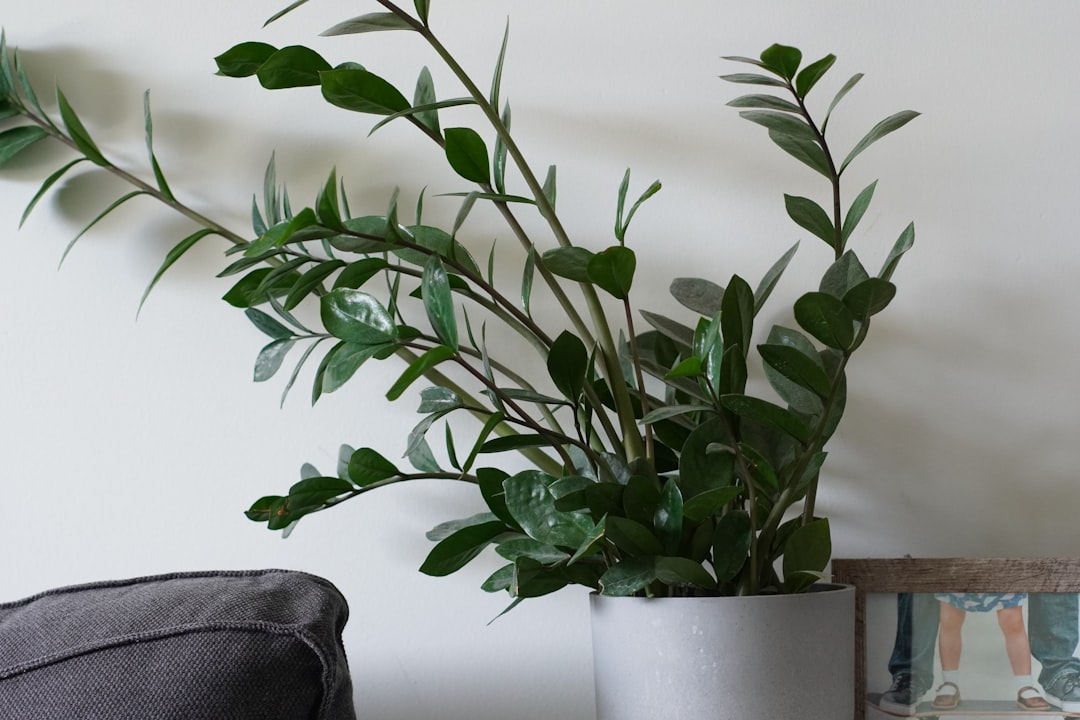
Reading the light before you choose the plant
The most common mistake I see, and one I made twice before I learned, is choosing the plant before measuring the light. A corner that looks bright to your eye at 2 pm can measure under 100 foot-candles at the leaf, which is starvation light for anything with patterned foliage. A cheap lux meter or the free lux app on a phone (held flat where the plant’s crown will sit) tells you the truth in about thirty seconds.
Here is the rough shorthand I use when I pick a specimen for a corner. Numbers are what the meter actually reads at leaf height on an overcast late morning, not at the window.
| Reading at leaf height | What I place there | What I avoid |
|---|---|---|
| 50-150 foot-candles | Cast iron plant, ZZ, mature pothos | Any patterned aroid, any calathea |
| 150-400 foot-candles | Philodendron gloriosum, Monstera adansonii, most anthuriums | Alocasias with dark leaves |
| 400-800 foot-candles | Alocasia Frydek, larger Monstera deliciosa, Ficus lyrata | Shade-adapted calatheas that will bleach |
| 800+ foot-candles with some direct sun | Bird of paradise, Ficus audrey, Euphorbia trigona | Anything you love that has thin, tender leaves |
If your corner reads below 100 foot-candles and you still want something patterned or dramatic, a small clip-on grow light does the work quietly. I use a single 15 watt full-spectrum bar clipped behind a piece of art, angled at the crown, on a timer running 8 am to 4 pm. Nobody who visits has ever noticed it.
Choosing the plant like you are casting a role
Once the light is known, the plant almost picks itself, but there is still a casting decision. A corner plant needs a silhouette that reads from across the room. Fussy, small-leaved plants disappear into the wall. I look for one of three shapes:
- A tall vertical: a climbing philodendron or monstera on a two-meter moss pole, reading like a slim green column.
- A wide horizontal fan: a mature gloriosum, an alocasia with three or four full leaves, a bird of paradise.
- A weeping mound: a large staghorn on a plaque, a mature rhipsalis, a hanging philodendron on a bracket.
Only one of those shapes belongs in the corner. If you cannot say out loud whether your plant is a column, a fan, or a fall, it is probably not ready to carry a corner yet, and it will look better on a shelf while it grows into itself.
Pot, floor, and the three supporting objects
The pot is where most quiet corners get loud. Glossy white plastic, terracotta orange, a bright glazed cobalt: any of these pulls attention off the leaves. I stick to matte, muted, and heavy-looking. Concrete, unglazed stoneware in oatmeal or charcoal, aged brass, dark stained wood. The pot should be roughly one third the height of the plant’s foliage mass, no more. Anything taller starts to compete.
Under the pot, a small change of floor surface anchors the whole scene. A jute or wool rug about 90 by 150 cm, placed so the pot sits on the near third of it and the chair on the far third, ties the corner together without adding pattern. On a hard floor with no rug, a simple round riser or a flat stone the pot sits on will do the same job.
Then, and only then, three supporting objects. My rule is one to sit in, one to read by, one to look at. A low armchair or a floor cushion, a small lamp with a warm 2700 K bulb, and a single piece of art or a stack of two books on a low table. That is the whole corner. Resist the fourth object. It is almost always the one that breaks the calm.
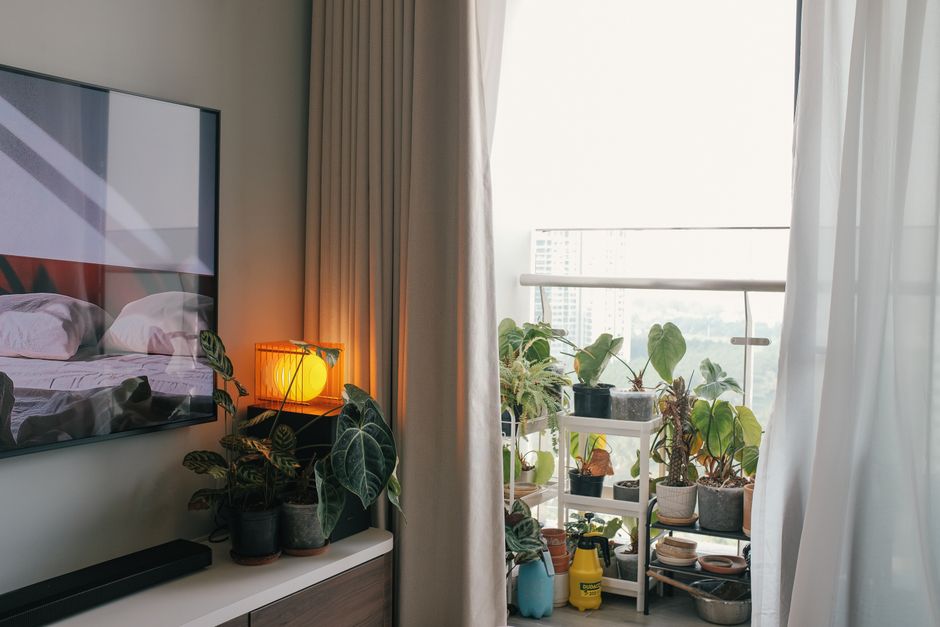
A step-by-step build I actually use
When a client or a friend asks me to help set up a corner, I do it in this order every time. The order matters because each step constrains the next and prevents second-guessing.
- Measure the corner’s light at three times of day (morning, midday, late afternoon) with a lux app held at the intended crown height. Write the lowest number down.
- Choose a plant that thrives at or below that lowest reading. Not the aspirational plant, the honest one.
- Decide the silhouette: column, fan, or fall. Confirm the plant you chose actually has that shape now, not in two years.
- Pick a pot in matte concrete, stoneware, or aged metal, sized so its height is roughly one third of the foliage height.
- Place a neutral rug or riser under the pot to define the floor zone.
- Add exactly one seat, one warm light source, and one visual anchor (art, book, small sculpture).
- Live with the corner for a week. Move nothing. On day eight, remove one thing. Almost every corner improves after that removal.
Keeping the corner quiet for months, not weeks
Styling is the easy part. The corner falls apart when the plant starts to lean toward the window, when dust dulls the leaves, or when a lower leaf yellows and hangs on for three weeks looking sad. Quiet corners survive on a boring maintenance rhythm.
- Rotate the pot a quarter turn every Sunday. Prevents the plant from leaning and keeps the silhouette symmetrical.
- Wipe the largest three or four leaves with a damp microfiber cloth once a fortnight. Doubles the apparent brightness of the corner.
- Remove any yellowing lower leaf the day you notice it. Do not wait for it to fully fail.
- Check moisture with a wooden skewer to the bottom of the pot, not with a finger at the surface. Water only when the skewer comes out clean and dry from the lower third.
- Every three months, empty the decorative outer pot and check for standing water, root escape, and any fungus gnat activity in the top inch of substrate.
The University of Minnesota Extension has a plain, useful guide to general houseplant care that I still send to friends when they get their first serious specimen, and the Missouri Botanical Garden’s Plant Finder is where I check the light and humidity range of anything I am about to commit to a corner.
What to do when the corner stops working
Sometimes a corner that felt right for a year suddenly feels off, and you cannot name why. Nine times out of ten it is one of three things. The plant has outgrown its pot and the proportions have drifted. The light has changed with the season and the leaves have started to reach. Or you have quietly added a fourth object over the months, usually a laundry basket or a phone charger, without noticing.
The fix is almost never to buy something new. It is to size up the pot by exactly one nursery size, to add or move a grow light so the crown gets 400 foot-candles again, or to remove whatever crept in. I keep a small photograph of the corner on the day it first felt right, taped inside a cupboard door. When something feels wrong, I compare the room to the photograph and the answer is usually visible within a minute.
Frequently asked questions
How big does a plant need to be to anchor a corner?
In a room with 2.4 to 2.7 meter ceilings, the plant’s foliage mass should reach at least 90 cm off the floor to read as a subject rather than an accessory. Under that, it will feel like it is waiting for company. If your favorite plant is smaller, raise it on a low, matte plant stand of 20 to 40 cm until it grows into the space, or accept that the corner is really a shelf composition for now.
Can I put a large plant in a corner with no windows at all?
Yes, but only with supplemental light. A single 15 to 30 watt full-spectrum LED bar on a timer running 10 to 12 hours a day will support most low-to-medium light plants. Without any light source, even a cast iron plant will decline visibly within four to six months. I would rather commit to the small electricity cost than watch a specimen slowly lose leaves.
What is the biggest mistake people make when styling a single-plant corner?
Choosing the plant first and hoping the corner will support it. The corner’s light, humidity, and traffic pattern are fixed facts; the plant is the variable. Measure the space honestly, then shop. This one reversal of order has saved me hundreds of dollars in returned or dying plants.
How often should I restyle the corner?
Almost never. A quiet corner earns its calm by being predictable. I make one deliberate change per season: a heavier throw on the chair in winter, a lighter book on the table in spring. The plant itself provides all the change the corner needs, growing a new leaf every few weeks. If you feel the urge to restyle monthly, the corner is probably too busy and wants one object removed rather than several rearranged.
Does a moss pole ruin the aesthetic of a styled corner?
Not if you commit to it visually. A moss pole wrapped tightly in fresh sphagnum, kept damp, and topped with healthy aerial roots reads as intentional structure. A dry, bare, or plastic-visible pole reads as scaffolding. If you are going to use one, treat it as part of the plant’s silhouette and maintain it: mist it in the morning, refresh the moss annually, and let the plant actually attach to it rather than tying it on with visible twine.
Frequently asked questions
What is slow plant living?
It is the practice of caring for plants on their own terms — not forcing growth or optimizing for maximum output, but accepting their natural pace and developing consistent attention.
How is this different from regular plant care?
Regular plant care is often task-oriented and outcome-focused. Slow plant living is practice-oriented and relationship-focused. Both can produce healthy plants, but the experience and meaning differ.
Will this approach mean my plants grow slower?
Not necessarily slower — but you stop trying to push beyond what plants want. The growth pace becomes the plant's natural pace, which is usually fine and sustainable.
Can I combine slow plant living with serious collecting?
Yes. The two are compatible. Serious collectors often practice slow plant living because it produces better outcomes than aggressive optimization.