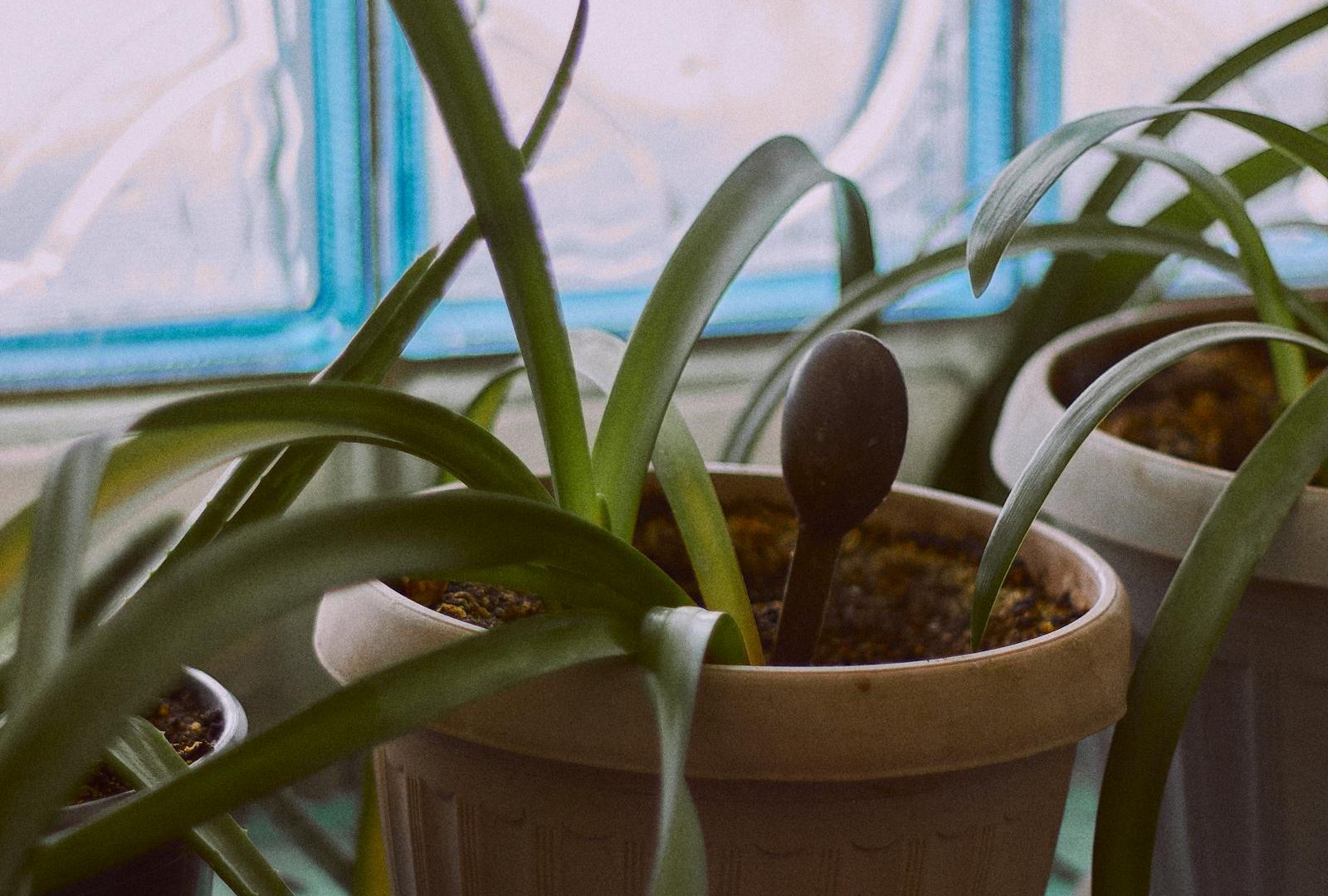
My first plant journal was a receipt from a garden center with a repot date scrawled on the back in pencil. It lived in the pot for about six weeks, curled up under a Philodendron gloriosum, and by the time I noticed the leaf was pushing me was well past the point where the note would have helped me. That receipt is the reason I keep a real journal now, and it is the reason I tell every new collector who asks that the point of writing things down is not to be tidy. The point is to catch the pattern you cannot see when you are only looking at today.
A journal turns a room of plants into a small, honest dataset. You stop guessing why the Alocasia dropped a leaf in February. You stop repotting on vibes. You start noticing that the north window loses two hours of usable light between October and April, and that the humidifier tank empties in three days when the furnace runs and five when it does not. None of that arrives in a flash. It arrives because past-you wrote it down for present-you to read.
Why I stopped trusting my memory
I used to believe I knew my plants. I had maybe forty of them at the time, which felt like a lot until I tried to answer a simple question: when did I last fertilize the Anthurium warocqueanum? I thought two weeks. I checked the calendar photos on my phone and it had been closer to nine. That gap, the one between what I remembered and what actually happened, is where most beginner mistakes live. Overwatering is often just “I forgot I watered on Sunday.” Root rot is often “the pot never actually dried between drinks and I never noticed because I was going by feel.” A journal is the cheapest, least glamorous fix for both.
The other thing memory hides is slow change. Plants do not decline in one dramatic scene. They fade over eight weeks while you tell yourself the leaves have always looked like that. Written notes are the friend who visits after a long absence and says, plainly, that something is different.

The seven fields that actually earn their space
Beginner journal templates on the internet want you to record twenty things per plant per week. You will not do it. I stopped doing it inside a month. After years of trimming, these are the seven fields I still write down for every plant, every time I make a real entry.
- Date and plant ID. Not “the big Philodendron.” A tag number or the botanical name. I use small numbered plant tags from a stationery shop, 1 through however many I own.
- Water event. Watered fully, top-watered lightly, bottom-watered, or skipped. I add roughly how many ounces if I remember, which is maybe half the time.
- Substrate feel. One of four words: soaked, damp, drying, bone. This is the single most useful field I keep.
- New growth. A new leaf pushing, a spathe forming, a root poking out of the drainage hole. Presence or absence, not a paragraph.
- Problems seen. Yellowing, crisping, pests spotted, edema bumps, a snapped petiole. If nothing, I write “clean.”
- Environment. Room temperature and humidity from a cheap hygrometer, and whether the humidifier or grow lights ran that day. I only capture this when it has changed meaningfully.
- Action taken. Fertilized at quarter strength, wiped leaves, rotated pot, moved shelves, treated for thrips. The verb, the concentration, the tool.
Seven fields sounds like a lot until you realize most entries take under thirty seconds. A row in a notebook might read: “3/14, #17 Monstera dubia, top-water 4oz, damp, no new growth, clean, 68F 55%, rotated pot quarter turn.” That row is worth more in six months than an entire paragraph of “she looks happy today.”
How often to write
The honest answer is: whenever you touch the plant. I tried daily journaling and abandoned it in two weeks. I tried monthly and lost the resolution I needed. The rhythm that stuck for me is transactional, not calendared. If I water, I write. If I fertilize, I write. If I notice something odd on a walk-past, I write. On weeks I do nothing, I write nothing, and that itself becomes data, because a plant I have not touched in three weeks is a plant I need to look at closely on Saturday.
Once a season, usually the first weekend of March, June, September and December, I sit down with tea and do a longer entry per plant. Twenty minutes for the whole collection. I read back the previous season, look at the plant, and write a paragraph about what I think it needs next. Those four entries a year are the ones I reread most.
Notebook, app, or spreadsheet
People agonize over the format. I have used all three and they all work. What matters is that the tool is within arm’s reach when you have wet hands and a watering can. Here is how the three shake out in practice.
| Format | Best for | Where it fails | My verdict |
|---|---|---|---|
| Paper notebook | Fewer than 30 plants, sensory pleasure, no friction | Searching back, cross-plant comparison | Great starter, hits a ceiling around 50 plants |
| Notes or dedicated app | Photo-heavy tracking, quick tag-based entries | Trend analysis, exporting your data later | Fine, but pick one you will still have in five years |
| Spreadsheet (Sheets or Excel) | Over 40 plants, spotting patterns, filtering | Adding a note while your hands are wet | What I use now, backed by a paper scratch page |
I keep a Google Sheet with one row per event and one tab per plant, and a small paper notebook on the plant shelf for capture. Every Sunday I take five minutes to move the paper notes into the sheet. That two-step system is the only one that has survived four years. If you are just starting, do not build the sheet yet. Start with the notebook and let your own frustrations tell you what the sheet needs to hold.
What to review, and when
A journal you never reread is a diary. A journal you reread is a tool. I use three review moments and no others.
- Before every watering round. Thirty seconds. What did I do last time, and how did the substrate feel? This alone prevents most overwatering.
- When a plant is in trouble. Read the last eight weeks of its entries before you diagnose. Nine times out of ten the cause is written there already, usually as a change you made and forgot.
- At the seasonal turn. March and September especially. Light shifts, heating and cooling systems change, and what worked in July stops working in October. The journal tells you when to react instead of waiting for the plant to.
The trap here is retrospective tidying. Do not go back and edit past entries to be more informative. Sloppy honest notes are worth more than clean rewritten ones, because the sloppiness is often the signal. The week you only wrote “watered, tired” is a week you should probably pay attention to when it repeats.
What a real week of entries looks like
Here is a week from my own sheet, lightly cleaned up, from a March a couple of years ago. I include it because template articles never show the mess, and the mess is the point.
Mon: #7 Philo gloriosum, skipped, drying, no new growth, clean, no reading. #23 Alocasia zebrina, top-water 3oz, bone, tiny new leaf tip, clean, 66F 48%, ran humidifier.
Wed: #17 Monstera dubia, full water 8oz, bone, no new growth, one lower leaf yellowing at petiole, 68F 52%, moved off cold windowsill.
Fri: #7 Philo gloriosum, full water 10oz, drying, spathe visible, clean, 67F 55%, first fertilizer of the season quarter strength.
Sun: Walk-past, #23 Alocasia zebrina, damp, new leaf unfurled overnight, tiny thrip damage on old leaf, wiped with soapy cloth, ordered predatory mites.
Nothing in there is beautiful. All of it is useful. Six months later, when the Alocasia was struggling in September, I opened this week and found the pattern: it always slowed in the cold snap, always rebounded, and I had been about to repot it in a panic for nothing.
Frequently asked questions
Do I need to journal every plant, or just the expensive ones?
Start with the ones you care about most and the ones giving you trouble. That is usually five to ten plants. Trying to journal a full collection from day one is how you quit in three weeks. Once the habit is real, adding a new plant to the system takes maybe two minutes and stops feeling like work.
Should I take photos as part of my journal?
Yes, but treat them as a separate track. A weekly photo of each mature or interesting plant, always from the same angle, catches slow decline and slow growth in a way words cannot. I keep a phone album per plant and shoot every Sunday morning while the coffee brews. It takes about ten minutes for forty plants.
What if I miss a week or a month?
Nothing happens. Pick it back up on the next watering. Do not backfill from memory, because you will invent details that were not there. A gap in the journal is honest data too, and it usually correlates with a stretch when life was busy and the plants got less attention. That correlation is useful to see.
How long before journaling actually pays off?
About one full season, so twelve to fourteen weeks. Before that, you are just building the habit. After that, you start rereading and finding answers to questions you did not know you had. By the second year the journal quietly runs your care schedule and you barely notice you are consulting it.
Is there a template I can download?
Plenty exist, and the University of Minnesota Extension houseplant care resources and the RHS beginners’ guide to houseplants are good starting points for the fields worth tracking. I would still encourage you to build your own after one season, because the fields that matter to your collection are not the same as the fields that matter to mine.
Frequently asked questions
What is slow plant living?
It is the practice of caring for plants on their own terms — not forcing growth or optimizing for maximum output, but accepting their natural pace and developing consistent attention.
How is this different from regular plant care?
Regular plant care is often task-oriented and outcome-focused. Slow plant living is practice-oriented and relationship-focused. Both can produce healthy plants, but the experience and meaning differ.
Will this approach mean my plants grow slower?
Not necessarily slower — but you stop trying to push beyond what plants want. The growth pace becomes the plant's natural pace, which is usually fine and sustainable.
Can I combine slow plant living with serious collecting?
Yes. The two are compatible. Serious collectors often practice slow plant living because it produces better outcomes than aggressive optimization.