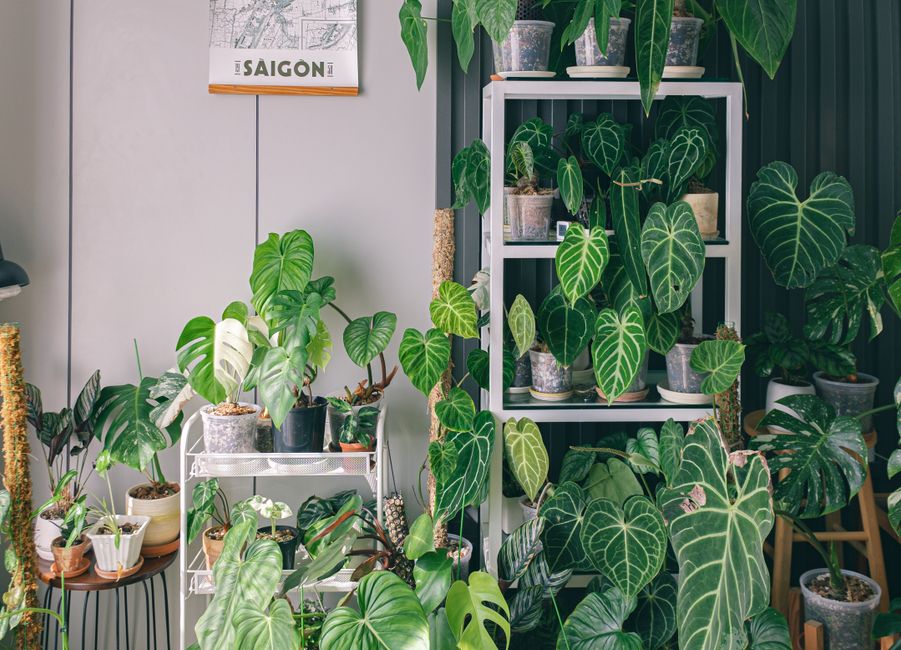
My first serious fungus gnat outbreak happened after I brought a nursery-fresh Alocasia zebrina into a shelf already crowded with anthuriums. Within about ten days I was seeing four or five small dark flies rise every time I bumped a pot. I did what most people do at first: I bought a bottle of something, sprayed the tops of the soil, and felt vaguely better for a week. Then they came back, worse. That failure taught me that fungus gnats are not really an adult-fly problem. They are a substrate problem, a watering problem, and a life-cycle problem, and unless you attack all three at once you are just mowing the lawn while the roots keep growing.
This is the routine I now run whenever the flies show up, refined across roughly six years of keeping humidity-loving houseplants in a small city apartment. It is not glamorous, and it takes about three weeks of consistency, but it works without fogging the whole room in pyrethrins.
Why the adults you see are the least important part
A female Bradysia gnat lays 100 to 300 eggs in the top half inch of damp, organic-rich substrate. Those eggs hatch in 4 to 6 days into translucent larvae with shiny black heads, and it is the larvae that do the real damage, chewing on root hairs and, in seedlings, tunneling into stem tissue. The larvae pupate for another 3 to 4 days, then emerge as adults that live only about 7 to 10 days. The whole cycle at normal room temperature (roughly 70°F) runs 17 to 21 days. Kill every adult you see and you have addressed maybe 5% of the population.
This is why the sticky-trap-only approach fails on anything larger than a windowsill. Yellow traps are useful, but as a monitoring tool, not a control. When I see the trap catch drop from 20 flies a week to 2, I know the larval generation in the pots is actually collapsing.
The three-week protocol I actually run
Every ingredient below is cheap and available at a general garden center. The order matters more than the brand.
- Day 0, triage. Move every affected pot to one location. Count adults on a fresh yellow sticky trap placed horizontally on the soil surface. Write the number down. You need a baseline.
- Day 0, top-dress. Add a half-inch layer of horticultural sand, fine pumice, or LECA over every pot. This is the single highest-leverage step. Adult females will not lay eggs through a dry mineral cap, and emerging adults have a much harder time chewing out.
- Day 1, drench with Bti. Dissolve a Bacillus thuringiensis israelensis product (Mosquito Bits work; crumble a heaping tablespoon per quart of water and steep for 20 minutes) and water every affected pot thoroughly with the strained liquid. Bti is a bacterial toxin selective for fly larvae. It is harmless to plants, pets, pollinators, and adult gnats, which is exactly the point.
- Day 4 and Day 8, repeat the Bti drench. Because Bti only kills larvae currently feeding, you have to catch the next hatch cycle.
- Day 10, stretch watering. Let every pot dry back further than usual. Most of my aroids can lose the top 2 inches of substrate before I water; during a gnat protocol I let them go to 3 inches, tolerating slightly droopier leaves for a week.
- Day 14, recount. New sticky trap. Compare the number to Day 0. A 70 to 90% reduction is normal.
- Day 21, one final Bti drench and remove the sand cap only if you want to. I usually leave it, it does not harm anything and it keeps the next infestation from establishing.
What each tool actually does, and what it does not
People mix these up constantly, buy the wrong one for their situation, and then decide “nothing works.” Here is the honest breakdown from my shelf.
| Tool | What it kills | When to use it | Real limitation |
|---|---|---|---|
| Yellow sticky traps | Flying adults | Always, as monitoring | Never a standalone control |
| Bti (Mosquito Bits) | Larvae in substrate | Primary weapon, drench 3x over 2 weeks | Must contact feeding larvae; degrades in 48 hours |
| Horticultural sand or pumice top-dress | Nothing directly | Prevents egg laying, blocks emergence | Only works if layer is truly dry and 1/2 inch thick |
| Hydrogen peroxide 3% (1:4 with water) | Larvae on contact, some fungi | Emergency spot treatment, one pot | Kills beneficial soil life; not a program |
| Beneficial nematodes (Steinernema feltiae) | Larvae | Chronic infestations, large collections | Expensive, needs cool moist soil, short shelf life |
| Neem soil drench | Larvae, slowly | Backup if Bti unavailable | Can burn tender roots at high dilution |
The habits that keep them from returning
Killing an outbreak is easy compared to not restarting one. Most of my repeat problems traced back to the same handful of habits I had to unlearn.
- I stopped watering on a fixed weekly schedule. Every pot now gets checked with a finger to the second knuckle, and only the ones that read dry get watered. Gnats need consistently moist upper substrate; break the moisture and you break the cycle.
- I quarantine every new plant for 14 days on a separate shelf with its own sticky trap. This one habit has caught three infestations at the source in the last two years.
- I switched away from peat-heavy nursery mixes for anything that will stay in my collection long term. My standard aroid mix is roughly 40% chunky orthophosphate-free bark, 20% perlite, 20% pumice, 15% coco chips, and 5% worm castings. It drains fast enough that the top inch dries within 36 hours.
- I keep saucers dry. Standing water in a saucer creates a saturated wick that gnats love. I empty every saucer within 30 minutes of watering.
- I do not compost old potting mix indoors. Spent substrate goes straight into an outdoor bin or the trash.
When the “gnats” are not actually gnats
Twice I have chased a fungus gnat problem for weeks before realizing I was actually looking at something else. Shore flies are darker, faster, and thrive on algal films on saucers and pots rather than in the substrate. Fruit flies are stubbier and yellowish, and they come from the fruit bowl, not the philodendron. Springtails, which many collectors welcome, are tiny wingless jumpers that live in moist substrate but do not fly and do not damage roots. Identify before you treat. A cheap 10x loupe pays for itself the first time it saves you a Bti drench you did not need.
If you want a sanity check on which insect you are looking at, university extension services publish decent photo guides; the UC IPM page on fungus gnats is the one I return to, and the University of Minnesota extension has a plain-language write-up on identification and control that lines up with what I have seen at home.
What a solved collection actually looks like
A “solved” collection is not one with zero flies. It is one where the sticky trap catches 0 to 2 gnats a week, a number so low that any new nursery plant announces itself immediately. My 34-plant shelf has been at that steady-state baseline for about 18 months. When I brought in a new variegated Monstera last spring, the trap on its quarantine shelf caught 11 adults in five days; the rest of the collection stayed at baseline. That is the whole point of the discipline. You are not aiming for sterile. You are aiming for a system quiet enough that trouble is visible early.
Frequently asked questions
How long until Bti actually stops the flies?
You will usually see the adult population begin to drop between days 7 and 10 of the protocol, because that is when the first larval cohort you killed would have emerged as flies. Expect the sharpest decline between days 14 and 21. If your trap counts have not fallen at all by day 14, the most likely reasons are that your Bti crumble was too old (buy fresh; potency drops after a year), your drench did not saturate deep enough, or the eggs are being laid somewhere other than the pots you treated, like a nearby saucer or a bag of open potting mix.
Will hydrogen peroxide hurt my plant?
At the standard 1 part 3% peroxide to 4 parts water dilution, no, most aroids and calatheas tolerate a single drench without leaf response. It fizzes, kills larvae on contact, and breaks down into water and oxygen in a few hours. What it will do is wipe out beneficial microbes and mycorrhizae in the substrate, which is why I treat it as a spot tool for one badly infested pot rather than a whole-collection program.
Do sticky traps work on their own for small collections?
Only if the collection is genuinely tiny, maybe three or four pots, and you catch the problem in the first week. Even then you are betting that no eggs got laid before the traps went up, which is optimistic. For any collection larger than a windowsill, treat traps as a diagnostic instrument, not a control.
Can I skip the sand cap if I use Bti?
You can, and Bti alone will end the infestation, but you will likely see a rebound within 4 to 6 weeks because nothing is preventing the next female that wanders in from laying. The half-inch mineral cap is cheap insurance and it keeps the surface looking tidy under bright shelf lighting.
Are fungus gnats a sign of root rot?
Not directly, but they share a cause. Both flourish in substrate that stays too wet for too long. If you have a serious gnat problem in one specific pot, unpot it and check the roots. In my experience roughly a third of the time I find early root softening as well, and correcting the watering and substrate solves both problems at once.
Frequently asked questions
How do I make my plant corner look natural?
Vary plant heights, use different pots, allow asymmetry, leave negative space, and let the arrangement evolve over time rather than being designed in one session.
Should all my pots match?
No. Different pots — terracotta, glazed, vintage, modern — create visual depth and feel more authentic than matching sets. Buy what you love.
How many plants for a good corner?
5-7 is the sweet spot. Too few feels sparse; too many feels crowded. Vary heights and forms.
How do I balance aesthetics with plant care?
Design for sustainable care, not just looks. Plants you can't easily water won't thrive. Consider access when arranging.