My oldest Philodendron gloriosum lived in the same nursery pot for almost three years before I finally worked up the nerve to lift it out. The rhizome had climbed over the rim, the substrate had collapsed to something the texture of wet coffee grounds, and I had convinced myself that any disturbance would set it back six months. When I did the repot, on a humid Sunday morning with the blinds drawn, the plant pushed a new leaf within twelve days. That was the moment I stopped treating repotting as a hazard and started treating it as a scheduled piece of maintenance, done on my terms rather than the plant’s crisis timeline.
Mature aroids are not fragile in the way beginner care sheets suggest. What they are is expensive to stall. A shocked anthurium can sit in stasis for four months, and during that time you learn nothing about whether your light or your watering was the actual problem. The protocol below is what I have settled on after repotting maybe two hundred aroids over the years, most of them without incident, a handful with lessons I would rather not repeat.
Reading the plant before you touch the pot
I never repot on impulse. Before I lift anything, I run through a short list of signals that tell me the plant is ready to accept the disruption. New leaf emergence in the last three to four weeks is the biggest green light, actively pushing tissue means the roots are working and the plant has energy reserves to spend on rebuilding. Firm turgor across mature leaves matters too; a plant that is already borderline dehydrated will read a repot as a second stressor stacked on the first.
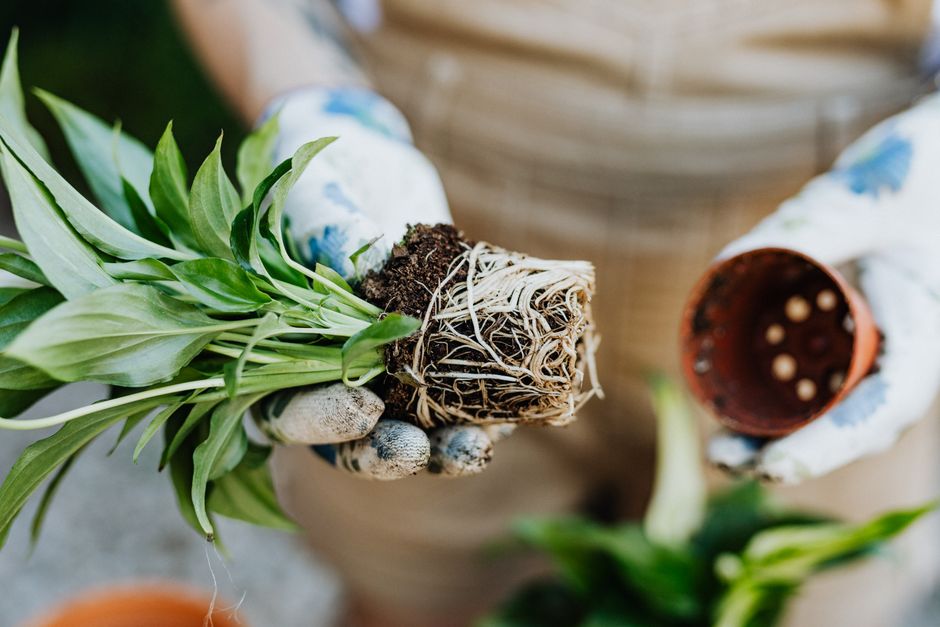
I check root pressure by tilting the pot. If the root ball slides out as a coherent brick with white or cream tips visible along the outside, the plant has outgrown its container and will benefit from more room. If it comes out as a wet mush with dark, hollow roots, I am not repotting, I am doing triage, and that is a different article.
Timing: why I stopped worshipping spring
Every guide I read as a beginner told me to repot in spring. That advice is fine for temperate deciduous plants and largely irrelevant for tropical epiphytes living under artificial light in a climate-controlled room. My aroids do not know it is April. What they respond to is the light, humidity, and temperature stability I provide, which in my apartment holds within a narrow band year-round: 68 to 74 degrees F, 60 to 70 percent relative humidity in the grow area, roughly 200 to 300 PPFD at leaf height for 12 hours a day.
Under those conditions I repot whenever a plant tells me it needs it, with two caveats. I avoid the two weeks before I travel, because I want to be present to watch recovery. And I avoid repotting a plant that just finished pushing a leaf, I wait until that leaf hardens off, usually 10 to 14 days, so the plant is not simultaneously building new tissue and rebuilding roots.
The substrate I actually mix
After trying premixed “aroid soil” from three different sellers, I went back to blending my own. The results are more consistent and cost per liter is roughly a third of the branded mixes. My default recipe for climbing philodendrons and monsteras, by volume:
- 40 percent orchid bark, medium grade (roughly 1/4 to 1/2 inch pieces), rinsed to remove dust
- 20 percent coarse perlite, size 3, also rinsed
- 20 percent coco coir chips, soaked and drained twice to leach salts
- 15 percent horticultural charcoal, small chunks
- 5 percent worm castings, mixed through evenly
For anthuriums and crawling rhizomatous philodendrons like gloriosum, I drop the coir to 10 percent and add 10 percent sphagnum moss teased loose. The moss holds moisture against the surface-running rhizome without waterlogging the deeper mix. Alocasias get the same base but with an extra 10 percent perlite because their tuberous root systems rot faster than any other genus in my collection.
I mix a full bucket at a time and let it rest damp for a day. Fresh mix, particularly when the coir is bone dry from the bag, sheds water for the first few irrigations and can leave the root ball dry even when the surface looks wet. Pre-moistening solves this. The Missouri Botanical Garden’s general repotting guide makes the same point about pre-wetting soilless mixes, and it holds especially true for chunky aroid blends.
The actual repot, step by step
I set up on a plastic tray with the new pot, the mix, a clean pair of pruners, and a spray bottle of dilute hydrogen peroxide (about 3 percent solution cut 1:3 with water) for any suspicious cuts. The whole session for a single plant runs 20 to 40 minutes depending on how tangled the roots are.
- Water the plant thoroughly 24 hours before. A hydrated root system is more elastic and less prone to snapping.
- Lift the plant out, supporting the base of the stem or the rhizome with one hand. Never pull by a petiole.
- Work old substrate out with your fingers only. I do not spray the roots clean unless I suspect a pest, because bare-rooting adds a full week to recovery.
- Inspect the roots. Healthy aroid roots are white, cream, or pale tan and feel firm. Dark, mushy, or hollow roots come off with a light tug. Cut back to living tissue with sterilized pruners.
- Choose a pot only 1 to 2 inches wider than the current root ball. Oversized pots hold uncolonized wet substrate, and that is where root rot starts.
- Set the plant at the same depth it was growing before. For climbing philodendrons attached to a moss pole, I repot the pole and plant together as one unit whenever possible.
- Backfill with the pre-moistened mix, tapping the pot to settle it. No aggressive tamping. The chunky substrate should feel airy under a gentle finger press.
- Water in lightly, just enough to settle the mix around the roots. Full saturation comes later.
The recovery window nobody talks about
The first 14 days after a repot are when most of the damage I have seen actually happens, and almost all of it is user-inflicted. Owners panic when a leaf droops on day three and start adjusting things: more light, more humidity, a foliar feed, a systemic fungicide “just in case.” Each intervention adds a variable, and the plant now has to negotiate all of them at once.
My rule is: after repotting, I change nothing else for 21 days. Same light, same watering cadence (adjusted only for the new substrate’s moisture retention), same location. If a leaf yellows, I note it and wait. Roots reestablish before the plant can send meaningful signals through the canopy, and premature intervention interrupts that quiet work.
| Days after repot | What I look for | What I do |
|---|---|---|
| 0 to 3 | Slight leaf droop, no new growth | Nothing. Keep humidity stable. |
| 4 to 10 | Turgor returning, no root smell | First real watering when top 1 inch of mix dries |
| 11 to 21 | Petiole firmness, cataphyll movement | Resume normal watering rhythm |
| 22 to 45 | New leaf emergence or root push visible at drainage holes | Resume dilute fertilizer at quarter strength |
When I do bare-root, and how I recover from it
I bare-root only for three reasons: suspected root rot, a confirmed pest (particularly root mealybugs, which the University of California IPM program covers well in their mealybug management notes), or when a plant arrives from an overseas seller and I want to inspect what I actually received.
Bare-rooting adds real stress. I compensate by wrapping the cleaned root ball in damp sphagnum inside a clear humidity dome for the first week, keeping the whole assembly at around 75 percent humidity and out of direct light. Only after I see fresh root tips extending into the moss do I transfer to my standard mix. This “moss transition” trick was the single biggest change that stopped me losing anthuriums after import.
What actually causes repot shock
After enough repots go both well and badly, patterns emerge. The failures cluster around a handful of causes:
- Pot upsized by more than 2 inches, leading to wet uncolonized substrate
- Substrate too fine or over-composted, holding water at the root zone
- Root pruning done with dull or unsterilized tools, introducing pathogens
- Repotting a plant already fighting a pest or nutrient issue
- Dropping humidity or light immediately after the repot
- Fertilizing within the first three weeks, burning newly cut roots
Notice that “the plant is old” is not on that list. Age itself is not a risk factor. A 10-year-old philodendron repots as readily as a two-year-old one, provided its root system is healthy going in.
Frequently asked questions
How often should I repot a mature aroid?
In my collection, most climbing philodendrons and monsteras go 18 to 24 months between repots. Anthuriums stretch to 24 to 30 months because they resent disturbance more. Alocasias, because their tubers multiply and the mix breaks down faster, need attention every 12 to 15 months. The pot size and substrate lifespan matter more than the plant’s age.
Can I repot when my aroid is pushing a new leaf?
I do not. Emerging leaves draw heavily on stored energy, and asking the plant to rebuild roots at the same time doubles the demand. I wait until the new leaf has fully unfurled and hardened off, usually 10 to 14 days after emergence, before disturbing the root ball.
Is terracotta better than plastic for mature aroids?
Neither is universally better. Terracotta wicks moisture and helps me get away with a wetter mix or a heavier watering hand, useful in dry rooms. Plastic and glazed ceramic retain moisture longer, useful under grow lights where evaporation is fast. I match the pot material to the substrate and the room, not to any rule about the plant.
Should I water immediately after repotting?
Only a light settling water, enough to close air pockets around the roots. Full saturation goes in about four to seven days later, once any minor root damage has had time to callus. Drenching a freshly cut root system is one of the most common repot mistakes I see in collector forums.
My aroid dropped a leaf a week after repotting. Did I kill it?
Probably not. Losing one of the oldest, lowest leaves is a common cost-cutting response as the plant reallocates resources to root recovery. If newer leaves stay firm and the growth point looks healthy, hold your nerve for another two weeks before intervening. Multiple leaves collapsing quickly is a different signal and usually points to root damage that predates the repot.
Frequently asked questions
How do I tell overwatering from underwatering?
Check the substrate first. Bone dry + wilting = underwatering. Wet + wilting = overwatering. Then check leaf texture: dry/crispy = underwatering; soft/limp = overwatering.
Can a plant recover from overwatering?
Yes, if root damage is moderate (less than 50%). Cut rotted roots, replant in fresh substrate, water sparingly. Recovery takes 2-6 weeks. Severe overwatering may not be reversible.
My plant looks wilted but the soil is moist. What's wrong?
Usually overwatering with root rot. The plant can't take up water even though it's available. Tip out and check roots. If they're brown and soft, root rot is the issue.
Should I water on a schedule?
No. Plants use water at different rates depending on season, light, growth phase. Schedule-based watering causes both over and under watering. Water by feel of substrate and pot weight.