My first winter with a serious plant collection ended with three crispy Anthurium warocqueanum leaves and a hygrometer reading of 22 percent at the window. That was the year I stopped believing pebble trays did anything and started treating humidity like an engineering problem instead of a vibe. What follows is what actually held my apartment above 60 percent through a Zone 5 heating season, ranked by how much lift each intervention gave me per dollar and per square foot.
Dry apartments are not one problem, they are three overlapping ones: outdoor air with almost no moisture in it, forced-air heat that dilutes what little is left, and building envelopes that leak faster than any humidifier can keep up. You have to attack all three, in that order, or you will spend money on mist and wonder why the leaves still edge brown.
What the hygrometer actually tells you
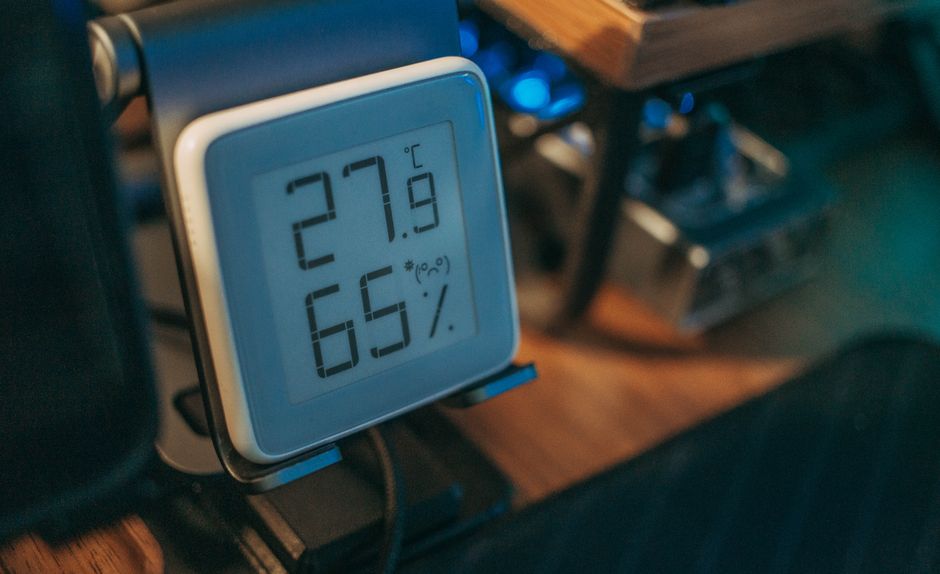
Before buying anything, I want you to spend two dollars on a second hygrometer and put it next to your existing one. Mine disagreed by 14 percentage points out of the box. Cheap capacitive sensors drift, and the ones baked into thermostats are almost always wrong. I now run three Govee bluetooth units on rotation, calibrated once a year with the salt-in-a-baggie method (75 percent RH in a sealed container over saturated table salt, checked at 24 hours).
The number that matters is not the peak. It is the daily minimum, which for most heated apartments happens between 4 and 7 a.m. when the furnace has been cycling hardest and the outdoor dew point is lowest. If your minimum is under 35 percent, thin-leaved aroids and Calatheas will crisp regardless of what your afternoon reading says.
Sizing a humidifier correctly, for once
The single biggest mistake I see collectors make is buying a 1.5-liter tabletop humidifier for a 400 square foot living room and being surprised when it accomplishes nothing. Water output has to exceed the room’s air-exchange rate times the moisture deficit, and in a leaky old apartment that number is larger than the marketing copy suggests.
Here is what my testing produced across three rooms over two winters. Output is manufacturer-rated gallons per day, actual lift is what I measured with the doors shut and the plants in place.
| Unit type | Rated output | Room size | Actual RH lift | Runtime per fill |
|---|---|---|---|---|
| Ultrasonic tabletop | 0.5 gal/day | 150 sq ft | 4-6 points | 10 hours |
| Evaporative tower | 2.5 gal/day | 300 sq ft | 12-15 points | 18 hours |
| Whole-room ultrasonic | 3 gal/day | 300 sq ft | 18-22 points | 22 hours |
| Commercial evaporative | 9 gal/day | 800 sq ft | 25-30 points | 36 hours |
The pattern is not subtle. If you want to move a room from 30 percent to 60 percent, you need something that outputs at least two gallons a day, and you need it to run around the clock. Anything smaller is a mister for one shelf, not a humidity solution for a room. The University of Minnesota Extension has a useful breakdown of household humidity targets that reinforces this: 30 to 50 percent is what the building envelope tolerates, and above 60 percent you start worrying about window condensation on cold nights.
The seven-step winter workflow I actually run
- Place a hygrometer at plant height, not at eye level. Warm air stratifies, and the reading on top of the bookshelf can be 10 points higher than at the pot line.
- Weatherstrip the worst window in the room. A single leaky sash can dump more dry air per hour than a 3-gallon humidifier puts back.
- Install a hygrostat that switches the humidifier at 55 percent. Running open-loop wastes water and grows biofilm.
- Refill with distilled or reverse-osmosis water for ultrasonic units. Tap water throws a white mineral dust that coats leaves and eventually clogs stomata.
- Clean the reservoir every four days with a diluted vinegar rinse, longer intervals grow pink Serratia biofilm that will aerosolize into the room.
- Group thin-leaved plants within three feet of the output nozzle. Humidity falls off with distance faster than intuition suggests, roughly 8 points every meter in still air.
- Add a small clip fan on the opposite side of the plant cluster to keep the humidified air moving. Static high humidity is what breeds Botrytis, moving high humidity is what tropical plants actually experience.
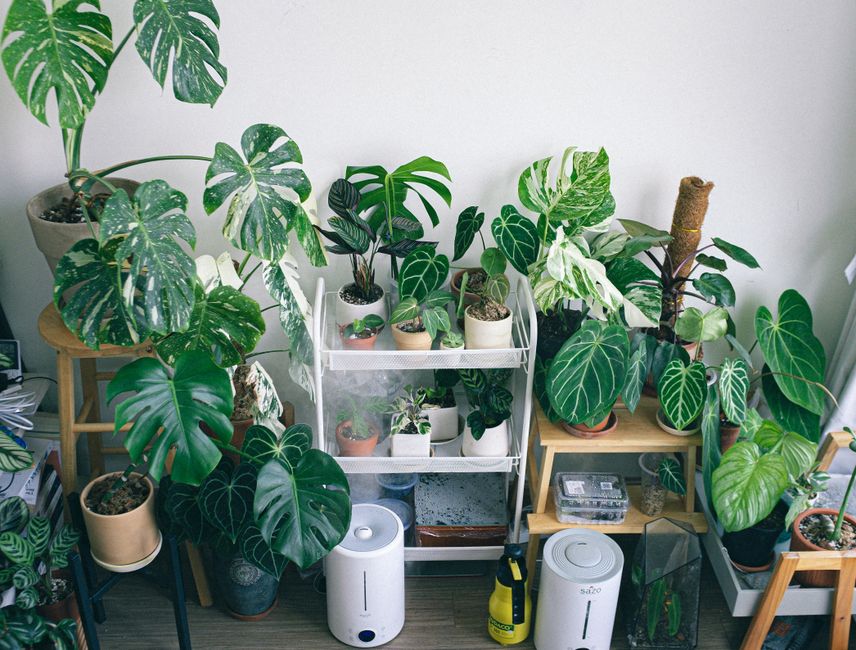
When to give up on the room and build a cabinet
There is a point where humidifying the whole room stops making sense. If you are running two large units, taping the windows, and still watching your Anthurium clarinervium sulk at 45 percent, the room is the wrong container. This is the moment I move from open-room humidification to enclosed spaces.
My working setup now uses an IKEA Milsbo glass cabinet with a small ultrasonic fogger, two USB fans for circulation, and a Inkbird hygrostat holding 75 to 80 percent. The cabinet uses less than a gallon of water per week and holds humidity within a two-point band regardless of what the room does. For velvet-leaved aroids and jewel orchids, this is the honest answer. The Missouri Botanical Garden has good baseline guidance on humidity requirements by plant group that lines up with what I see in practice.
Things that do not work, ranked by how confidently people recommend them
- Pebble trays: measured lift within 6 inches of the tray, 2 to 3 points, gone by 12 inches. Effectively zero for the plant behind it.
- Misting with a spray bottle: lasts about 4 minutes, encourages leaf spot on Calatheas, does nothing measurable to ambient RH.
- Grouping plants without other interventions: the collective transpiration argument is real but tiny, maybe 3 to 5 points in a dense cluster of large-leaved plants, and only if air is still.
- Bowls of water on radiators: I measured this over a week, negligible.
- Boiling a kettle: dramatic short-term spike, back to baseline within 15 minutes.
- Houseplant humidity domes for mature plants: fine for cuttings, useless for a two-foot Philodendron.
What high humidity costs you
Nobody talks about this part. Holding an apartment at 60 percent RH through a Chicago January means water is condensing somewhere, and if it is not on your windows it is inside the wall cavity. I run a small dehumidifier in the bathroom, keep bedroom doors open for airflow, and inspect the coldest window frames weekly for black spotting. In my second winter I found early mold on the north-facing sill and had to drop my target to 55 percent to stop it.
The trade-off is real: your building envelope was probably designed for 30 percent indoor RH, and pushing it to 60 puts stress on materials that were not spec’d for it. Older masonry buildings tolerate this better than tightly sealed new construction, oddly enough, because they breathe more. If you rent, know what you are doing and do not blame the humidifier when the paint peels behind the couch.
Frequently asked questions
Do I really need distilled water in my humidifier?
For ultrasonic units, yes. They aerosolize whatever is dissolved in the water, and hard tap will coat every leaf in your room with a fine white mineral film within a week. Evaporative units are more forgiving because the wick catches most minerals, but the wick then becomes a maintenance item every four to six weeks. I buy distilled by the gallon and it costs me about eight dollars a month per large humidifier.
Will running high humidity damage my hardwood floors?
Sustained readings above 60 percent will cup solid hardwood over a season, especially near the humidifier itself. I keep mine on a small ceramic tile, aim the mist upward not sideways, and accept a slight cupping in the winter that reverses when the heat goes off in April. Engineered floors are more stable. Laminate does not care.
My humidifier says it covers 500 square feet but nothing changes. Why?
Coverage claims assume a sealed room at a modest lift, usually 5 to 10 points. If you want a 25-point lift in a leaky apartment, divide the rated coverage by three or four to get the honest number. This is why the 3-gallon-per-day units genuinely serve a bedroom and the 0.5-gallon tabletops serve a shelf.
Is a humidifier or a grow tent better for rare aroids?
A tent or glass cabinet is dramatically more efficient once you get past about six sensitive plants. You use less water, hold tighter tolerances, and stop fighting the whole apartment. I still run room humidifiers for the general collection, but the fussy velvets live in the cabinet and always will.
How do I keep humidity up when I travel for a week?
I fill the largest reservoir I own, put the unit on a smart plug tied to a hygrostat, and move the most sensitive plants into a closed bathroom with a small fogger on a timer. A week is survivable. Two weeks in January is not, and I have learned to arrange a plant sitter or accept losses.
Frequently asked questions
Is it normal for a new plant to drop leaves?
Yes, especially the first 2-4 weeks. Plants drop leaves to optimize for new conditions (humidity, light, watering). 1-3 leaves dropping is completely normal; 3-5 is moderate but acceptable.
How long does acclimation take?
Typically 2-4 weeks for visible adjustment. Full acclimation may take 1-3 months. The first new leaf in your home is a key recovery indicator.
Should I repot a new plant that's dropping leaves?
Generally no. Repotting adds stress to a plant already adjusting. Wait at least 3-4 weeks unless the substrate is clearly compromised.
When should I worry about leaf drop?
If 6+ leaves drop over 4 weeks, if newer leaves are dropping rather than older ones, if other distress signs appear, or if no new growth has started after 4 weeks.