Every March, without fail, I lose a leaf or two to my own optimism. The sun climbs higher, the light on the east sill sharpens by about 30 percent in a matter of weeks, and something that was thriving in February is suddenly wearing a pale, papery patch on its brightest leaf. That patch is houseplant leaf sunscald, and after enough years of collecting variegated aroids and other light-sensitive tropicals, I can usually name it before I finish my coffee.
The trouble is that sunscald is a masquerader. It gets blamed on spider mites, on fertilizer burn, on a fungus that was never there. Below is the diagnostic I actually walk through in my own plant room, along with the treatment protocol I trust after watching hundreds of leaves either recover, stall, or crisp off entirely.
What sunscald actually is on an indoor leaf
Sunscald is a photo-oxidative injury. When a leaf receives more photon flux than its photosystems can safely process, the excess energy generates reactive oxygen species that bleach chlorophyll and, in worse cases, collapse the mesophyll cells outright. On a houseplant this typically shows up within 24 to 72 hours of a sudden light increase, and the tissue does not grow back. Once a cell is cooked, it stays cooked.
The two conditions that reliably produce it in my home are (1) a plant moved from a shaded corner to a bright window without acclimation, and (2) direct beam sun through a clear pane hitting wet leaves in the morning. Both are entirely preventable, which is the frustrating and hopeful part of the story.
The five-second visual signature
Real sunscald has a specific look. Learn these markers and you will stop misdiagnosing it as disease.
- Location: only on leaves or portions of leaves exposed to the light source. The undersides and shaded neighbors are untouched.
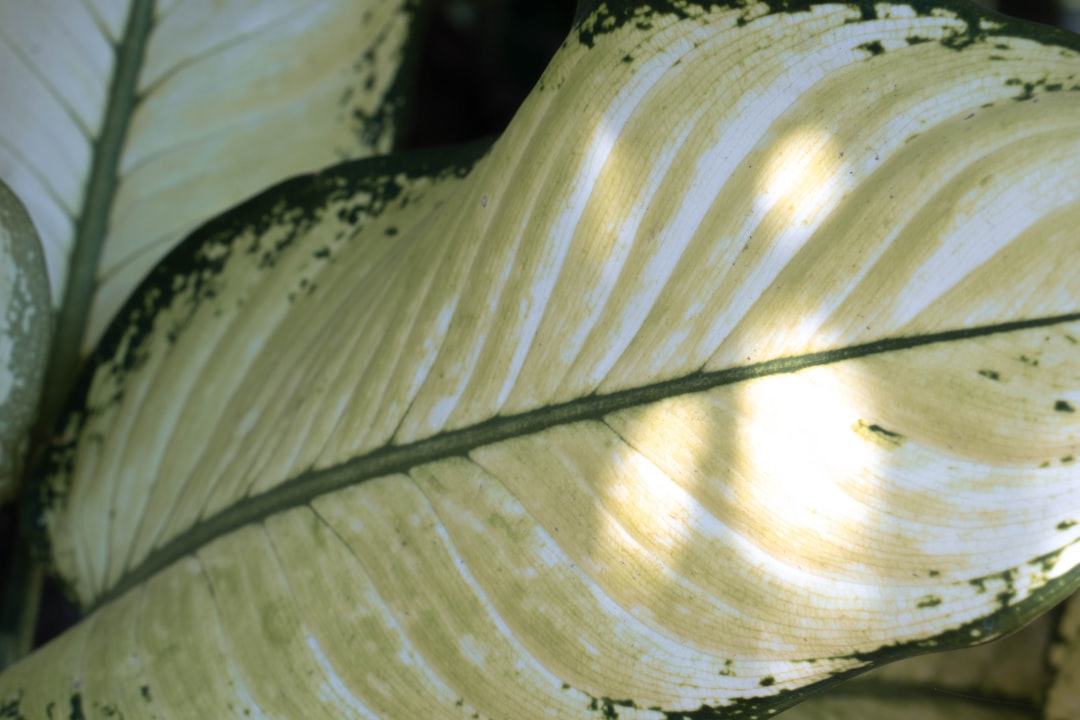
- Color: bleached tan, silver, or bone white in the center, sometimes with a thin brown rim. Not yellow, not black, not fuzzy.
- Texture: dry and papery to the touch, often slightly sunken. The lesion feels different from the healthy leaf around it.
- Shape: irregular, following the geometry of the light beam or the highest points of the leaf, not the vein pattern.
- Speed: appears fast, usually within three days of a change, then stops progressing.
Sunscald versus the four common look-alikes
Here is the differential I run through before I touch a plant. If more than one row fits, I keep investigating.
| Symptom pattern | Sunscald | Spider mites | Fertilizer burn | Fungal leaf spot | Cold damage |
|---|---|---|---|---|---|
| Location on plant | Sun-facing side only | Undersides, whole plant | Leaf margins and tips first | Random, often lower leaves | Whichever side touched cold glass |
| Color of lesion | Bleached white to tan | Fine yellow stippling | Crispy brown edges | Dark spot with yellow halo | Water-soaked then black |
| Texture | Dry, papery, sunken | Sandpapery, webbing present | Brittle at margins | Sometimes moist, expanding | Mushy at first, then dry |
| Onset speed | 24 to 72 hours | Weeks | Days after feeding | Days to weeks, spreads | Overnight |
| Progression after removal of cause | Stops immediately | Continues without treatment | Stops once flushed | Continues without treatment | Stops but tissue dies fully |
The seven-step diagnostic I run at the plant
- Note the date and any recent changes. Did I move the plant, clean a window, remove a curtain, or change a grow light in the last week? Ninety percent of my sunscald cases trace to a change made 2 to 5 days earlier.
- Check exposure geometry. Squat down and look at the plant from the window’s angle. If the damaged leaves are the ones receiving direct beam sun between roughly 10 a.m. and 3 p.m., that is the smoking gun.
- Inspect the undersides. Sunscald leaves the underside clean. If I see stippling, webbing, or tiny moving dots against a white card, I switch tracks to spider mites.
- Feel the lesion. Papery and sunken points to sunscald. Slimy, expanding, or bordered by a yellow halo points to pathogen.
- Check the potting mix and recent feeding. A heavy feed within the last 10 days plus crispy margins suggests salt burn, not sun.
- Measure the light if I can. A cheap lux meter or a phone PAR app is fine for triage. Anything above 25,000 lux of direct sun on a plant rated for medium light will scald it within an afternoon.
- Give it 48 hours. If the lesion stops advancing after I move the plant back, the diagnosis is confirmed. Living tissue that is going to recover will do so by day 7 to 10.
Immediate treatment when you spot it
Sunscald cannot be reversed on a cellular level, but you can absolutely stop it from worsening and prevent the plant from spiraling into secondary problems. Here is what I do in the first hour.
- Move the plant out of the direct beam. Not to a dark room, just back to bright indirect light, roughly 3 to 6 feet from the window or behind a sheer curtain.
- Leave the damaged leaves attached for now. Even a partially bleached leaf is still photosynthesizing on its green portions and feeding the roots.
- Do not fertilize for at least 14 days. A stressed plant cannot use the nutrients, and salts on damaged tissue make things worse.
- Water only when the top inch of mix is dry. Stressed roots rot faster than healthy ones.
- Skip leaf shine, neem oil, and horticultural soaps on the damaged surface for two weeks. Oils on a compromised cuticle can trigger further burn under any light.
Rehab over the following weeks
Recovery is measured in new growth, not old. The scalded leaf will never turn green again, but a healthy plant will usually push a replacement within 4 to 8 weeks in the growing season. My rehab checklist looks like this.
- Wait 10 days before removing any leaf. Only cut what is more than about 50 percent damaged or that has begun to rot.
- Cut cleanly at the petiole with sterilized snips. I wipe blades with 70 percent isopropyl between plants.
- Resume a diluted feed at quarter strength once you see a new leaf spear or root activity.
- Reintroduce brighter light gradually: 30 minutes more per day over 2 weeks is my rule for anything sensitive.
- Rotate the pot a quarter turn weekly so new leaves harden off evenly.
How to prevent it in the first place
Prevention is boring and effective. The two habits that eliminated sunscald from my collection almost entirely are seasonal light audits and proper acclimation.
Twice a year, at the spring and autumn equinoxes, I walk the room with a lux meter and note the peak reading on every shelf between 11 a.m. and 2 p.m. Anything that jumped by more than 40 percent from the last audit gets moved or shaded. A $12 sheer curtain, a strip of frosted window film, or simply pulling a plant 18 inches deeper into the room solves most of it.
For acclimation, the rule I use came from years of trial and error and lines up well with what university extension programs recommend for hardening off transplants. Start any plant coming from lower light at 1 to 2 hours of the brighter exposure per day and add roughly an hour every 2 to 3 days for two weeks. Aroids, Calatheas, and thin-leafed ferns need the slow end of that range. Succulents and Ficus can move faster but still deserve a week.
Two authoritative pieces I return to are the University of Minnesota Extension’s guide on light for indoor plants and the RHS overview of houseplant light levels, both of which give sane, non-marketing numbers for how much light common houseplants actually want.
Species that scald first in my collection
Some plants are essentially canaries. If any of these show damage, I check every other plant in the room the same day.
- Highly variegated Monstera (albo, Thai constellation): the white sectors have no chlorophyll to buffer the light and burn in as little as 90 minutes of direct sun.
- Calathea and Maranta: thin leaves, low light origin, sunscald and bleach quickly at anything over 15,000 lux.
- Anthurium clarinervium and warocqueanum: velvet-leaved anthuriums have poor heat dissipation on the leaf surface.
- Alocasia frydek and reginula: matte leaves that scald cleanly on the top ridges.
- Rhaphidophora tetrasperma in a south window: the classic bleached silver blotch on the newest leaf.
When it is not actually sunscald
Two edge cases catch me every few years. The first is grow-light burn from an LED placed too close to a plant, which produces an identical bleached patch but only on the topmost leaves directly under the fixture. Move the light up by 6 inches at a time until the new growth comes in normal green. The second is chemical phototoxicity, where a leaf-shine or oil residue reacts under bright light. If a treatment preceded the damage by less than 48 hours, that is the more likely culprit than the sun itself.
Frequently asked questions
Will a sunscalded leaf turn green again?
No. The chlorophyll and cells in the bleached zone are permanently destroyed. What you are watching for is whether the rest of the leaf stays healthy and whether the plant produces new, undamaged growth. That is the real recovery signal, not any change in the scarred tissue itself.
Should I cut off a partially sunscalded leaf immediately?
Not usually. Any leaf that is still more than half green is still contributing energy to the plant. I only remove leaves that are more than 50 percent damaged, are actively rotting at the lesion, or are obviously ugly on a display specimen. Waiting 10 to 14 days also tells you whether the damage is stable.
Can houseplants get sunscald in winter?
Yes, and it surprises people. A south-facing window in January can throw very intense light onto a plant that spent months in a shaded corner, especially with snow reflecting up from outside. The angle is lower but the beam is direct. Winter sunscald on Hoya and String of Pearls sitting close to the glass is a case I see every year.
Does misting protect leaves from sunscald?
The opposite, actually. Water droplets on a leaf under direct sun can focus light like tiny lenses and produce localized burns. Mist in the evening if you must, and never on a plant that will see direct beam sun in the next few hours.
How do I know my grow lights are not causing sunscald?
Measure the PPFD at the canopy or use the manufacturer’s chart for hang height. As a rough rule, most home LED panels want to sit 12 to 24 inches above tropical foliage. If the newest leaf opens smaller, paler, and cupped downward, raise the light by a few inches and see if the next leaf normalizes.
Sunscald is one of the few houseplant problems where the diagnosis is easier than the guilt. Once you can name it in five seconds and treat it in an hour, it stops being scary and becomes what it really is: a note from the plant that you got a little ahead of the season. Read it, move the pot, and move on.