My oldest Anthurium vittarifolium hangs from a bracket beside a north-facing window, and the longest leaf now brushes the top of a stack of ceramic planters on the floor. That leaf is 41 inches from petiole to tip, roughly three-quarters of an inch wide, and it took the plant close to two years to push it out. If you are used to the tidy monthly rhythm of a pothos, the strap-leaf anthurium will feel like a different animal entirely. It rewards patience and a specific kind of neglect, and almost nothing else.
This is not a plant I would recommend to someone who wants a fast return on shelf space. It is a plant for people who like to check on the same leaf for eighteen months and notice a slightly deeper vein pattern.
Where this anthurium actually comes from
Anthurium vittarifolium is a pendant epiphyte native to the western Amazon basin, most reliably documented in lowland forests of Peru, Ecuador, and parts of northwestern Brazil. In habitat it grows draped from tree trunks and horizontal branches, often three to eight meters off the forest floor, where the humidity sits high most of the day and air moves constantly through the canopy. The Missouri Botanical Garden’s aroid records classify it within section Porphyrochitonium, the group of narrow-leaved anthuriums that also includes A. pallidiflorum and A. friedrichsthalii, which is worth knowing when you shop, because these three species are routinely mislabeled in trade.
The straps are not decorative. They are a survival strategy. Long, narrow, weight-bearing leaves shed water quickly and vibrate in the slightest breeze, which is how these plants avoid fungal problems in a soaking-wet environment. When we bring one indoors, we take away the breeze and often the drainage, and then we wonder why the tips crisp.
Light that produces new leaves without bleaching old ones
I have grown this species in three different light situations over the years, and only one has consistently produced new leaves longer than the previous ones. Here is what I measured with a cheap lux meter clipped to the leaf surface at midday:
| Placement | Midday light | Result over 12 months |
|---|---|---|
| 4 feet from south window, sheer curtain | 420 to 550 foot-candles | Steady growth, deep green, longest new leaves |
| Directly in east window | 800 to 1100 foot-candles briefly | Yellowing on the upper third of pendant leaves |
| Interior wall under a 24W LED bar | 180 to 240 foot-candles | Two new leaves, both shorter than the previous ones |
The sweet spot, in the units I actually use, is bright indirect light with no direct sun after about 9am. If you rely on grow lights, a full-spectrum LED bar 14 to 18 inches above the crown, running 11 hours a day, has been enough to keep mine pushing new growth through winter.
Humidity is the whole game
Every care sheet says “high humidity.” That is true and useless. What I have found:
- Below 55 percent relative humidity, new leaves emerge crumpled and never fully unfurl.
- Between 60 and 70 percent, growth is normal but slow.
- Above 75 percent, with air movement, new leaves come out longer and the veining is more pronounced.
I run a small ultrasonic humidifier on a shelf below the plant, aimed at the wall, not at the leaves. Direct mist deposits mineral scale on the foliage and I have watched it slowly etch the surface of an older leaf. A small clip fan on the lowest setting, oscillating for ten minutes every hour, has eliminated the two fungal spots I used to get every winter.
Mounting: the setup that changed everything
For the first three years I grew this plant in a plastic pot. It survived. When I finally mounted it on a cedar plank with sphagnum, growth roughly doubled within a season. The exposed root run and the ability to dry between waterings suits the species far better than any pot arrangement I tried.
- Soak a handful of long-fiber sphagnum in room-temperature rainwater for 20 minutes. Squeeze out excess water until it feels like a wrung sponge.
- Cut a cedar or cork plank at least 14 inches long and 6 inches wide. Cedar resists rot for years; pine will disintegrate in a humid room.
- Lay a 2-inch pad of moss on the plank. Position the plant with its rhizome flat against the moss, roots spread outward like a hand.
- Cover the roots with another thin layer of moss and wrap the whole assembly with fishing line, spiraling every half inch. Do not use plastic-coated wire; the coating breaks down and cuts roots.
- Water the mount by dunking the whole thing in a bucket for 3 minutes, then hanging it to drip until it stops. Do this whenever the moss feels dry at a finger-depth push, usually every 4 to 6 days indoors.
Substrate mixes if you must pot it
If mounting is not an option, the mix has to drain within seconds and hold no standing moisture. Regular potting soil kills this species within a season in most homes. The blend I use in a slotted orchid pot:
- 4 parts orchid bark, fine to medium grade
- 2 parts perlite, chunky #3 grade
- 2 parts long-fiber sphagnum, teased apart
- 1 part horticultural charcoal
- 1 part coarse coco chips soaked and rinsed twice
This mix looks alarmingly loose when you first pot up. That is correct. Water should run through and out the bottom within five seconds. If it puddles on top, the mix is too fine, and root rot is coming.
Watering, fertilizer, and the honest pace of growth
I water when the moss or mix reads dry at the top inch. In my apartment that lands somewhere between five and nine days depending on the season. Rainwater or reverse-osmosis water only; the leaf tips brown within weeks on tap water above about 120 ppm total dissolved solids. A cheap TDS meter costs less than a small plant and answers this question in seconds.
Fertilizer is weak and constant. I mix a balanced 20-20-20 at one-quarter of the label strength (roughly 150 ppm nitrogen) and apply it with every second watering from March through October. In winter I dilute further, to about 75 ppm, and skip every third feeding. The University of Wisconsin extension notes on anthuriums back up this general low-and-slow approach for the epiphytic species.
My mature plant produces four to six new leaves per year. That is a normal, healthy pace. If someone shows you a specimen with a dozen fresh straps and claims it grew that way in a living room, ask about the greenhouse.
Common problems I have actually had
Crispy leaf tips have been my most frequent issue, and in every case they traced back to water quality or a humidifier reservoir I had let go stale. Yellowing along the upper surface of pendant leaves usually means the light is too direct; move the plant a foot deeper into the room and the next leaf will come out clean. Black spots that spread along the midrib are almost always a bacterial issue; I isolate the plant, cut back to clean tissue with a flame-sterilized blade, and improve airflow. I have not needed a fungicide in six years of growing this species.
Thrips are the pest I watch for. Silvery streaks along the length of a strap are the tell. A weekly wipe with a soft cloth dampened in dilute neem, plus predatory mites released twice a year, has kept my collection clear.
Frequently asked questions
Is Anthurium vittarifolium the same as A. pallidiflorum or A. friedrichsthalii?
No, though they are sold interchangeably far too often. A. pallidiflorum has slightly wider leaves with a matte finish and a red-flushed petiole. A. friedrichsthalii tends to have shorter, stiffer leaves and a more upright growth habit early on. Vittarifolium is the longest and most pendant of the three, with a subtle glossy sheen and quilted venation on mature leaves. If a seller cannot confirm the source, assume it might be any of the three.
How long does it take to reach full pendant length?
In my experience, four to six years from a rooted cutting with three leaves. The first two years produce short, upright juvenile foliage that looks nothing like the mature form. The transition happens gradually, with each new leaf noticeably longer than the last, and by year three or four you should see leaves passing 24 inches.
Can I grow it in a greenhouse cabinet?
Yes, and this is where the species truly shines. A cabinet at 75 percent humidity with a small fan produces the fastest and most dramatic growth I have seen. The only caution is that pendant leaves need vertical clearance; a two-foot-tall cabinet will bottleneck the plant within a year.
Is this plant safe around pets?
No. Like all anthuriums, it contains calcium oxalate crystals in the sap and tissue, which cause oral irritation and drooling if chewed. I hang mine well above cat height and have never had a problem, but it should not be within reach of a curious dog or a toddler.
Why are my new leaves shorter than the old ones?
Three usual suspects, in order of likelihood: not enough light, humidity below 60 percent, or a root system that has outgrown its mount or pot and is being watered too infrequently as a result. Address them one at a time and give the plant a full growth cycle to respond before changing anything else.
Frequently asked questions
Why are my aroid's veins less visible than they used to be?
Most often this is a sign of insufficient light or declining substrate quality. Improve one or both, and watch what the next new leaf looks like compared to the current ones.
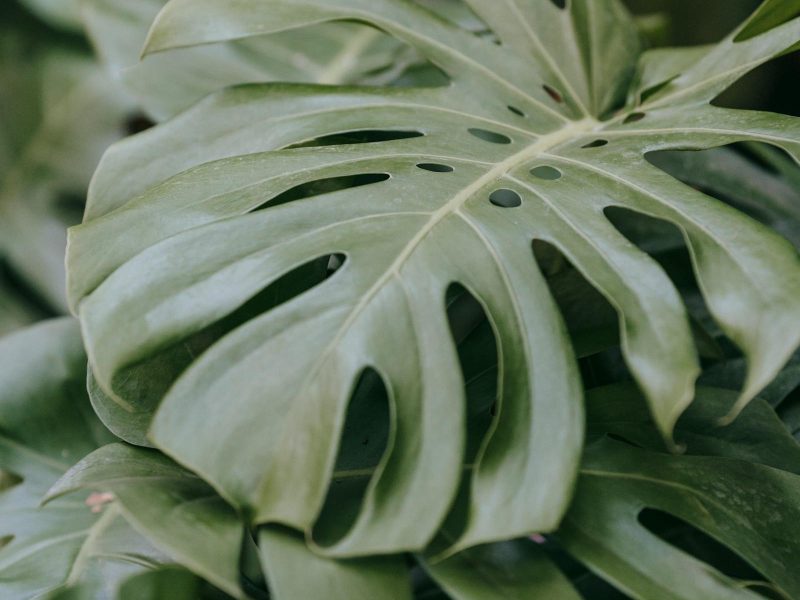
Why are my Monstera leaves not developing fenestrations?
Fenestrations develop as Monsteras mature and climb. Solid leaves on a young plant are normal. On a plant that should be mature, it usually indicates insufficient light or no climbing support to encourage maturation.
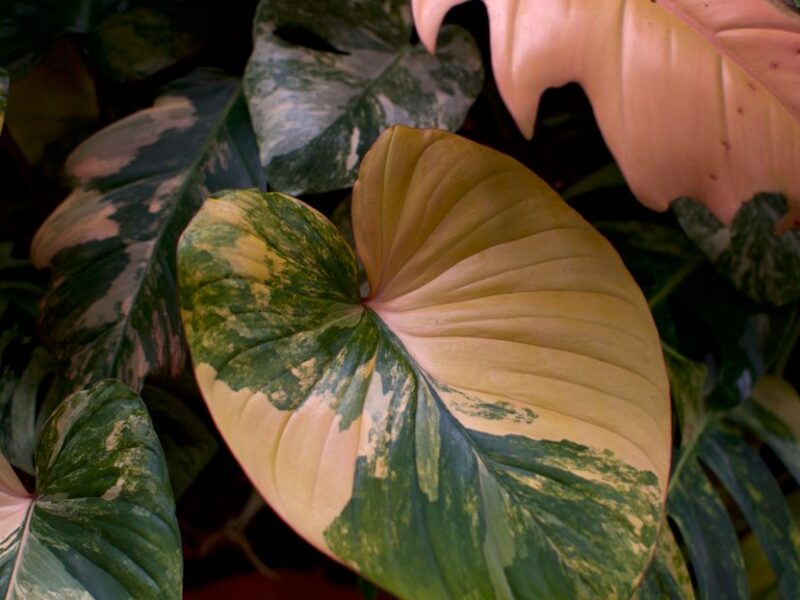
Can a variegated aroid revert?
Yes. Chimeric variegations (Monstera Albo, Philodendron pink princess) can lose variegation over time, especially in low light. Strong light and pruning back to variegated nodes slows reversion.
What does it mean when an aroid leaf is darker than the rest of the plant?
Usually that leaf grew during a period of better conditions — more light, more humidity, or better-quality substrate. Single darker leaves are not a problem; they are a sign of past good growing windows.