My first Anthurium warocqueanum arrived in a shipping box that read 92% inside and 38% outside, and for about three weeks I believed the number on the box was the number I had to hit. I ran two ultrasonic humidifiers day and night, watched water bead on the walls, and slowly turned my north-facing office into a mildew farm. The plant, meanwhile, sat there with the same three leaves it arrived with. That mismatch, between the numbers I was chasing and what the plant was actually asking for, is the whole reason I want to write this down.
Aroid humidity gets talked about like a pass/fail exam. Sixty percent minimum, or your leaves will crisp. Eighty percent or your velvet anthuriums will refuse to grow. I have kept most of the popular aroids at home for years now, in a climate that swings from 22% winter indoor RH to 71% August RH, and the honest version is more interesting than the rules of thumb suggest.
What the number on your hygrometer is actually telling you
Relative humidity is a ratio, not an amount. Air at 70 degrees Fahrenheit holding 60% RH contains roughly half the water vapor of air at 85 degrees Fahrenheit holding the same 60%. That matters because plants do not respond to the ratio, they respond to vapor pressure deficit (VPD), which is the gap between how much moisture the air holds and how much it could hold at that temperature.
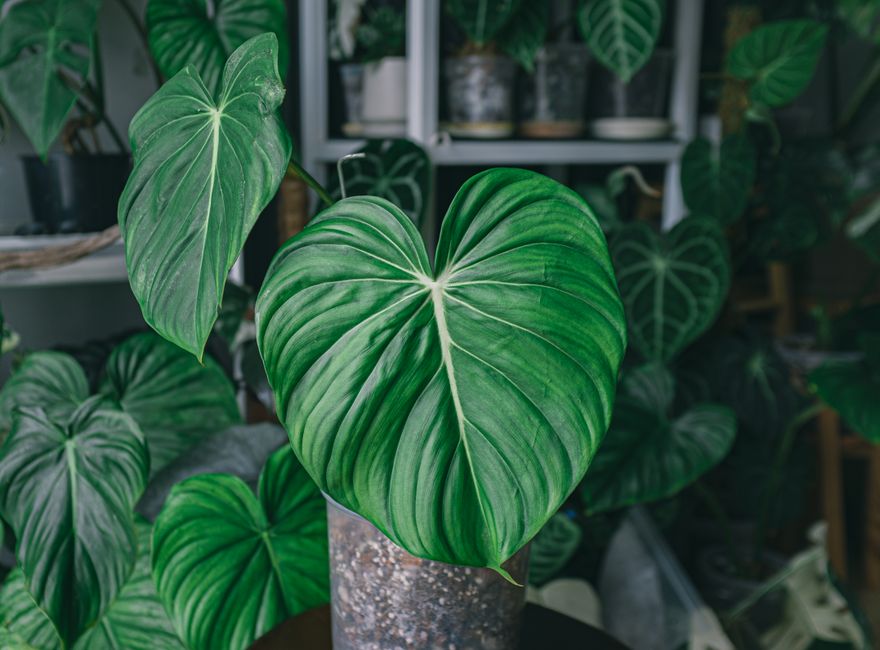
Two rooms at 60% RH but 65 degrees versus 78 degrees are not equivalent for your Philodendron gloriosum. The cooler room is closer to saturated air, so transpiration slows, the plant loses less water through its stomata, and root uptake can lag without punishing the leaves. The warmer room at the same RH is pulling water out of the leaf faster than the roots can push it in, and that is when I see the crispy margins people blame on low humidity when the hygrometer reads a comfortable number.
The Penn State greenhouse extension notes a working target VPD for tropical foliage of 0.4 to 0.8 kPa. I do not measure VPD directly at home, but I keep a cheap thermometer next to every hygrometer, and I have learned to read the pair together rather than the RH alone.
Hygrometer trust, or the lie in your window
The cheap analog dial hygrometer that came taped to my humidity dome was off by 19 percentage points. I only discovered this after buying a Sensirion-based digital unit and running a salt test (a closed jar with a slurry of table salt and water, which stabilizes at 75% RH after about 8 hours at room temperature). The analog read 94%. The digital read 76%. Guess which one was right.
Before you diagnose anything, calibrate. I keep three hygrometers now, one at pot level, one at the highest leaf, and one across the room, and the spread between them is often 12 to 18 points on a still day. That vertical stratification is the thing nobody warns you about when they tell you to hit 70%.
What each aroid group actually asks for
These are the ranges I have settled on after years of adjusting, not the ranges I see repeated in care cards. The differences matter more at the extremes than in the middle.
| Group | Comfortable RH | Will tolerate | Watch for |
|---|---|---|---|
| Common philodendrons (hederaceum, brasil, micans) | 45 to 60% | Down to 30% short term | Slower growth, smaller leaves below 40% |
| Velvet philodendrons (gloriosum, verrucosum, melanochrysum) | 60 to 75% | 50% with good airflow | Bronze speckling on new leaves under 50% |
| Monstera (deliciosa, adansonii, standleyana) | 50 to 65% | 40% indefinitely | Fenestrations fail to open in dry heat |
| Anthurium (warocqueanum, clarinervium, magnificum) | 65 to 80% | 55% with warmth | New leaf hardens before unfurling below 55% |
| Alocasia (frydek, zebrina, cuprea) | 55 to 70% | 45% with warmth | Edema, then dormancy, below 40% cold |
The airflow variable nobody counts
The single change that helped my collection more than any humidifier was a small clip fan on a low speed, running 16 hours a day, moving air across the top of a shelf. Humidity dropped from a stagnant 78% to a moving 64%, and new leaves came out cleaner, larger, and without the bacterial spotting I had been fighting.
Still, saturated air is the fastest route to bacterial and fungal problems in aroids. The genus Erwinia (now Pectobacterium) does its best work at 80%+ RH with no air movement, and once you have it in an anthurium petiole, the leaf collapses in about 36 hours. I would rather run 58% with steady air than 78% with none.
A staged plan for raising humidity that actually works
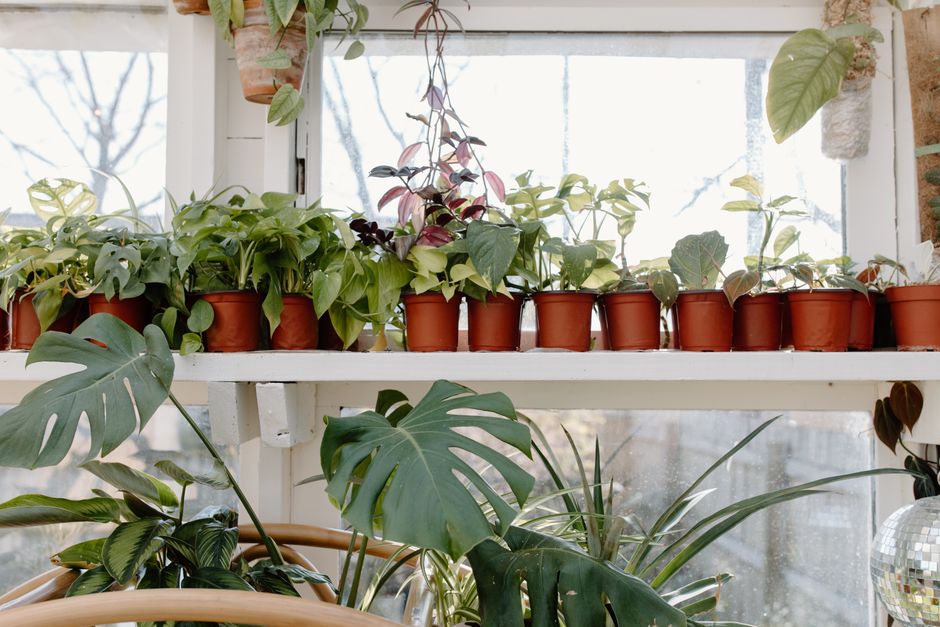
- Group your plants. Cluster the thirsty ones (anthuriums, velvet philos, alocasias) on one shelf or corner. Their combined transpiration raises the local RH by 8 to 12 points before you plug anything in.
- Add a pebble tray with real surface area. Not the sad saucer under one pot, but a large baking tray, half an inch of water, refilled every 3 days. Local bump of 4 to 7 points.
- Introduce a warm-mist humidifier at floor level. Warm mist adds temperature and moisture together, which is closer to what tropical understory air feels like. I run mine at 3.5 liters per 24 hours in a 130-square-foot room.
- Add airflow before you add more moisture. A clip fan on the lowest setting, aimed at the wall not the leaves, moving air across the top of the group.
- Only then consider an enclosure. An IKEA Milsbo or Detolf converted cabinet lets you hold 75 to 85% comfortably, but it also concentrates every mistake you make with airflow and cleanliness.
The order matters. People jump to step 5, add a fogger, and end up with sooty mold on a Monstera adansonii within a month.
Signs I have actually learned to trust
- New leaf emerges pale and stays that way for a week: usually light, not humidity.
- New leaf hardens before it fully unfurls: humidity, almost every time.
- Crispy tips on older leaves with healthy new growth: often salt buildup, not RH.
- Bronze or silver speckling on velvet leaves: dry air during leaf development.
- Guttation droplets in the morning: roots are pushing water faster than the leaf can transpire, which usually means RH is fine or high.
- Petiole collapse with a sour smell: bacterial, not a humidity problem to solve with more mist.
What I stopped doing
Misting, mostly. A spray bottle raises leaf-surface RH for about 4 minutes and does nothing measurable for the air. It does, reliably, leave mineral spots on velvet leaves and seed bacterial colonies in leaf axils. I misted a Philodendron gloriosum daily for six months and gained exactly zero centimeters of leaf size compared to its sibling on the same shelf that I never touched.
I also stopped chasing single-number targets. My office holds 52 to 58% RH in winter with a humidifier running, and every plant on the list above is putting out new leaves. The anthuriums are slower than they would be at 75%, but they are alive, unblemished, and gaining a leaf every 5 to 7 weeks, which is more than I can say for the plants I killed trying to hit 80%.
Frequently asked questions
Do I really need a humidifier for common aroids like Monstera deliciosa or Philodendron hederaceum?
Honestly, no. Both species will grow well between 40 and 55% RH, which is what most heated homes settle at in shoulder seasons. I have kept a M. deliciosa in a 38% winter room for three years with only slightly smaller fenestrations. Save the humidifier budget for the velvet-leaf species and anthuriums, which do notice the difference.
Is a humidity cabinet worth it for a small collection?
For 3 to 5 velvet anthuriums or verrucosum-type philodendrons, yes, because holding a stable 70 to 80% in a whole room is expensive and hard on drywall. For a mixed collection of 20 plants where only 4 are the thirsty ones, no. A grouped shelf with a warm-mist humidifier and a small fan does 90% of the job at 10% of the fuss.
Why do my leaf tips crisp even at 65% RH?
Nine times out of ten it is not humidity, it is either tap water minerals accumulating in the substrate or fertilizer salt buildup. Flush the pot with 3 pot-volumes of distilled water, wait a week, and see if new growth comes in clean. If it does, your RH was never the problem.
How low can I let humidity drop overnight in winter?
Down to 35% for most aroids as long as it climbs back to 50% during the day. Overnight temperatures are cooler, so VPD stays reasonable even at lower RH. I stopped running my humidifier at night after tracking leaf health for a winter and finding zero difference between the 8-hour-off and 24-hour-on rooms.
Are cheap hygrometers usable at all?
Only after you calibrate them. Run the salt test once, note the offset, and either apply the offset in your head or throw the unit out. An uncalibrated hygrometer is worse than none, because it makes you confident about a number that is wrong by 15 to 20 points.
Frequently asked questions
How big do melanochrysum leaves get indoors?
With a well-kept moss pole, steady humidity, and good light, indoor melanochrysum leaves can reach forty to seventy centimeters. Mature wild plants reach a meter, but that is unusual indoors.
Why does my melanochrysum have crispy leaf edges?
Almost always low humidity. Below forty percent humidity, melanochrysum struggles. A humidifier in the room generally resolves it within a month of new growth.
Can I grow Philodendron melanochrysum without a moss pole?
You can, but the leaves will stay small, the stems will weaken, and the plant will never mature. The moss pole is essentially a required piece of equipment for this species to reach its full form.
How much light does Philodendron melanochrysum need?
Bright, filtered, indirect light — never direct sun. An east-facing window with sheer curtains is ideal, or a few feet back from a south-facing window with sheer curtain, or a moderate LED grow light running ten to twelve hours daily.