My gigas arrived in a 4-inch nursery pot with three leaves, the largest about the size of a playing card, dull olive with a faint bronze cast. Three years later the current leaf is 22 inches long, black-green when it hardens off, and heavy enough that I can feel the pole shift when I water. Almost nothing about that arc matched what the seller’s care card said, and very little matched the tidy summaries I found online. What follows is what actually worked, what I got wrong, and the small handful of numbers I now trust.
What Philodendron gigas actually is
Gigas is a climbing hemiepiphyte from lowland Panama, described formally in 1997. In habitat it germinates on the forest floor, races toward the nearest trunk, and does its adult work fifteen or twenty feet up, where light is brighter and airflow is constant. That single fact governs almost every mistake people make with it. A gigas grown as a tabletop plant on a short stake will produce small, thin, chlorotic leaves forever, and the owner will blame humidity or fertilizer when the real problem is that the plant has not been allowed to climb.
The leaves start narrow and coppery, mature to a deep velvet green, and can exceed three feet in a private collection. Mine has not hit that mark yet. The Missouri Botanical Garden’s original description of P. gigas is worth reading if you want to understand why juvenile and adult leaves look like different species.
Light, measured with a meter and not a guess
I keep a cheap lux meter clipped to the pole at leaf height. Gigas wants what the meter reads as 400 to 800 foot-candles for most of the day, which translates to bright indirect light two to four feet back from an east or west window. Under a 40W full-spectrum bar hung 14 inches above the top leaf, I get about 550 foot-candles on the newest leaf and around 300 on the lower canopy, and that has been the sweet spot for two years.
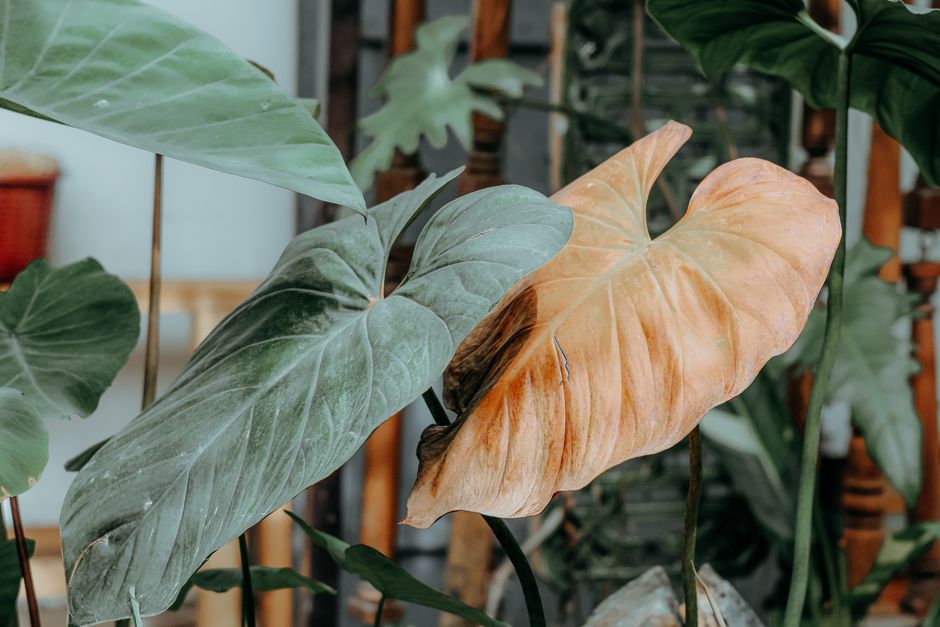
Two symptoms told me when light was wrong. Too little, and new leaves emerged pale, stayed pale, and drooped at the petiole within a week. Too much (I moved it into a south-facing bay for a month one summer), and the mature leaves bleached to a flat sage and developed dry brown patches near the midrib. Neither damage reverses; you just wait for the next leaf.
Humidity and airflow: the pairing that matters
Every care sheet I read said “70% humidity.” I ran mine at a steady 80% inside a converted display cabinet for six months and got beautiful leaves and a mild case of bacterial edema, where the underside of a fresh leaf blistered and then scabbed. The fix was not lower humidity but a small clip fan set to a low, constant flow across the top of the plant. Since adding that fan I have held humidity between 65 and 75% without a single edema mark.
A short checklist of what I now watch:
- Humidity between 60 and 75%, measured next to the plant, not across the room
- Constant slow air movement, not blasts from an oscillating tower
- Night temperature no lower than 65 F, day 72 to 82 F
- No cold windowpane contact in winter (I learned this by watching a leaf brown along one edge only)
- Water at room temperature, never straight from a cold tap
The pole is the whole game
This is the section I wish someone had written for me. A gigas on a bare bamboo stake will limp along. A gigas on a moss pole that is kept genuinely damp will jump a leaf size roughly every third leaf. My progression looked like this once I switched from a dry cocoa pole to a sphagnum-stuffed pole that I water separately from the substrate:
| Leaf number after repot | Blade length | Notes |
|---|---|---|
| 1 | 7 inches | Last leaf on old bamboo stake |
| 2 | 9 inches | First leaf after moving to damp moss pole |
| 3 | 11 inches | Aerial roots gripping the pole |
| 4 | 14 inches | Pole extended by 12 inches |
| 5 | 18 inches | Petiole thickened noticeably |
| 6 | 22 inches | Current leaf; velvet fully developed |
How I keep the pole wet: a plastic bottle at the top drips slowly into the sphagnum core, and I hand-mist the outside of the pole once in the morning. The substrate below stays on its own watering schedule.
Substrate: chunky, forgiving, and reused
My current mix, by volume, has held up through two repots:
- 40% medium orchid bark, soaked overnight before mixing
- 25% coco chips, rinsed to lower the salt content
- 15% perlite, the coarse grade sold for hydroponics
- 10% horticultural charcoal in roughly pea-sized pieces
- 10% worm castings, sifted so no clumps remain
The mix drains a full pot of water in under 20 seconds and holds moisture in the bark for four to six days depending on the season. I fertilize at about a quarter of the label rate on a balanced 3-1-2 formula every second watering during active growth, and I flush the pot with plain water once a month to keep salts from creeping up. When new roots start circling the drainage holes I pot up one size, no more. Gigas resents oversized pots and will sulk for a full growth cycle in one.
What went wrong, and what I did about it
These are the three failures worth naming, because each taught me a rule I still follow.
The winter stall
The first winter I panicked at the lack of new leaves and moved the plant closer to the window. Within ten days the newest leaf yellowed from the tip. I had not changed the light so much as I had exposed the leaves to a cold draft from the sash. Moving it back solved it. I now do nothing in winter except keep the pole damp and the light on for 12 hours.
The pest I did not see
Thrips found the gigas before I did, and I only noticed the silvery stippling when I photographed a leaf in raking light. I treated with a spinosad drench on a seven-day cycle for three applications, wiped leaves with a soft cloth, and increased airflow. The University of Florida IFAS has good guidance on thrips on ornamentals that helped me confirm what I was seeing.
The repot I rushed
I repotted a stressed plant into fresh mix hoping the change would perk it up. It lost two leaves over the next month. Now I only repot a healthy, actively growing gigas, and I wait at least two weeks after any move or environmental change.
Propagation notes from a small sample
I have taken three cuttings from my mother plant over two years. Two rooted in sphagnum inside a clear deli cup with the lid cracked open, on a heat mat set to 78 F. The third rotted, which I trace to a cutting taken from a node that had no visible aerial root. My working rule now: only cut where there is a plump aerial root already forming, seal the mother-plant wound with cinnamon or leave it to callus in still air for 24 hours, and never bag the cutting so tight that condensation puddles on the leaf.
Roots showed on both successful cuttings between day 18 and day 25. I moved them to my standard substrate at about two inches of root length, and both produced their first new leaf within six weeks.
Frequently asked questions
Why are my new gigas leaves smaller than the old ones?
Nine times out of ten this is a climbing problem, not a nutrition problem. Gigas increases leaf size when its aerial roots grip a consistently damp support. A dry pole, a short pole, or no pole at all caps the leaf size regardless of how well you fertilize. Extend the pole before the top leaf reaches within four inches of the top, and keep the moss genuinely wet, not misted.
Is Philodendron gigas the same as Philodendron melanochrysum?
No. They are close cousins with velvet leaves, but gigas leaves are heavier, wider at maturity, and lack the pronounced pale veining of melanochrysum. Juvenile gigas can look confusingly similar to a young melanochrysum, which is one reason mislabeled plants circulate at collector prices. Check the petiole in cross-section: gigas petioles are rounder and thicker relative to leaf size.
How often should I water a Philodendron gigas?
I water when the top two inches of my chunky mix feel dry to a wooden skewer, which works out to every four to seven days in summer and every eight to ten days in winter in my apartment. Frequency is the wrong question; substrate moisture is the right one. A cheap moisture meter or a bamboo skewer will beat any calendar.
Can I grow gigas without a grow light?
You can, if you have a bright east or west window with unobstructed sky and you accept slower growth. Mine lived on window light alone for the first year and produced three modest leaves. Under a grow light on a timer, the same plant produced six larger leaves in the following twelve months. The plant is not fussy about the source, only about the total daily light integral it receives.
Why do the new leaves emerge coppery and then darken?
That color shift is normal and one of the reasons collectors love this species. New leaves lack full chlorophyll development and often show anthocyanin pigments as a sunscreen. Over roughly two to three weeks the leaf thickens, greens up, and settles into the deep velvet color the plant is known for. If a leaf stays coppery and thin past a month, look at light levels first and humidity second.
Frequently asked questions
How big do Anthurium warocqueanum leaves get indoors?
With ideal conditions — high humidity, steady care, hanging position — indoor warocqueanum leaves can reach sixty to ninety centimeters over several years. Mature wild plants reach a meter or more.
Can warocqueanum be grown without a humidifier?
Not reliably in most homes. Warocqueanum requires sustained humidity above fifty percent, ideally sixty. In dry climates or heated homes, a humidifier is effectively required.
How often does Anthurium warocqueanum produce new leaves?
In good conditions, one leaf every four to eight weeks during the growing season. Slower in winter. Long pauses between leaves are normal and not necessarily a sign of distress.
Should I mount Anthurium warocqueanum on a slab?
Mounting works well for this species and mimics its natural epiphytic habit. A hanging pot also works if the leaves can extend freely downward. The key is allowing pendant leaves room to elongate without obstruction.