My first Strawberry Shake arrived on a Tuesday in a box that felt too light for what I had paid. I remember unwrapping it at the kitchen counter, three leaves of blushed cream and pistachio green, and thinking that this plant was going to teach me something about patience whether I liked it or not. Four years later I still keep the original pot on the shelf above my propagation station, and I can tell you that most of the fear around this cultivar is other people’s fear, borrowed and repeated until it sounds like fact.
Strawberry Shake is a variegated sport in the Philodendron erubescens family, cousin to Pink Princess and Painted Lady, and it behaves more like a well-mannered climber than the diva its price tag suggests. What follows is what I have actually learned keeping it, killing a cutting or two, and trading nodes with collectors who grow it in climates nothing like mine.
What you are actually buying
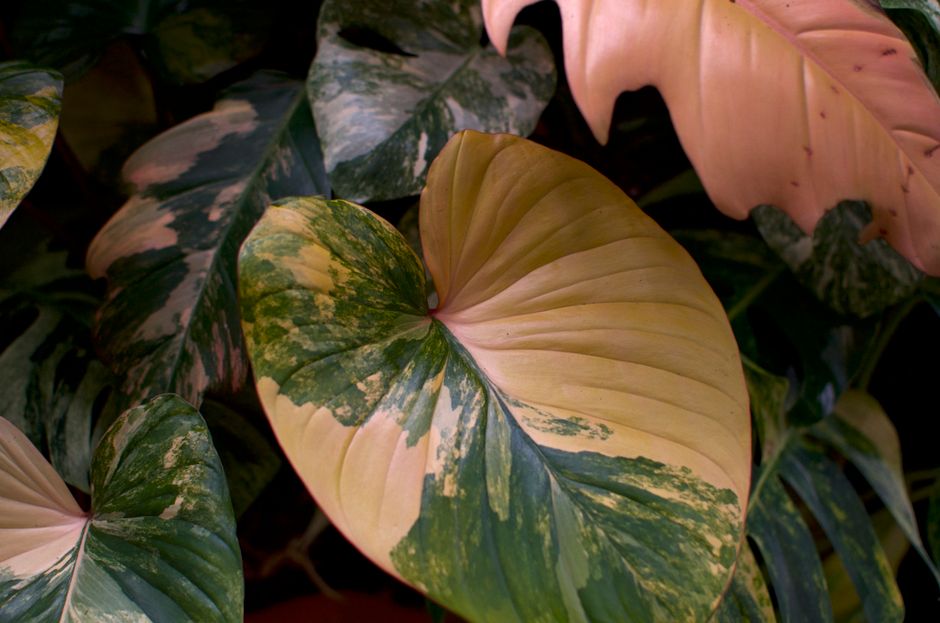
Strawberry Shake is not a species. It is a cultivated variety produced through tissue culture that expresses a blend of pink, cream, peach, and green pigment across a single leaf, often in the same painterly wash you see on a ripe strawberry milkshake. The variegation is chimeric, which means it lives in specific layers of tissue and can drift, revert, or intensify depending on how the plant grows. A node that produces a rose-pink leaf this month can throw an all-green leaf in six weeks and a cream half-moon after that.
This is the first thing to make peace with. You are not buying a fixed pattern. You are buying a genetic tendency, and your job is to give that tendency the light and stability to keep expressing itself.
Light: the single lever that matters most
If I had to pick one variable that governs Strawberry Shake more than any other, it is light. The pink and cream sectors contain almost no chlorophyll, which means they contribute nothing to photosynthesis and everything to leaf temperature and water loss. A leaf that is 60 percent cream is essentially living on the 40 percent that is green, so you need enough light to make that 40 percent work overtime.
In my apartment I keep mine about 60 cm from an east-facing window with a sheer curtain, which measures around 350 to 500 foot-candles through most of the day. Under grow lights I aim for 200 to 300 PPFD at leaf height, twelve hours on. When light drops below that range, new leaves come in greener and smaller. When it climbs past 600 PPFD without gradual acclimation, the cream sectors scorch to brown paper within a week.
A useful rule I picked up from a grower in Singapore: if you can comfortably read a paperback where the plant sits, without squinting, you are probably in the right zone. If the page is too dim to read, so is the plant’s environment.
Watering rhythm that respects the roots
Philodendron erubescens hybrids rot from below far more often than they die of thirst. Strawberry Shake in particular has a modest root system compared to the leaf mass it can push out, and cream-heavy leaves transpire less than green ones, so the pot dries more slowly than you might expect.
My routine, which I have not changed in three years:
- Wait until the top 3 to 4 cm of substrate feels dry to a finger, not just the surface.
- Lift the pot. If it feels light for its size, water. If it still has weight, wait 48 hours and check again.
- Water thoroughly at the sink until it runs clear from the drainage holes for a full 10 seconds.
- Let it drain for 15 minutes on a rack before returning it to its cachepot.
- Never leave standing water in the saucer overnight.
In a 15 cm nursery pot with my chunky aroid mix, that works out to roughly every 8 to 10 days in summer and every 14 to 18 days in winter. Your numbers will differ. The rhythm is what matters.
Substrate, humidity, and the boring middle
I mix my own aroid substrate in a 20 litre tub every few months. The recipe I keep coming back to is 40 percent coarse orchid bark, 25 percent coco chips, 15 percent perlite, 15 percent worm castings, and 5 percent horticultural charcoal. It holds moisture for two or three days without ever going anaerobic, and roots grow into it thick and white.
Humidity is where new keepers overcorrect. Strawberry Shake will hold ambient humidity between 45 and 70 percent without complaint. Below 40 percent for weeks on end you will see crispy new-leaf edges, especially on cream sectors. Above 80 percent with poor airflow you invite bacterial leaf spot, which shows up as translucent yellow halos that turn black overnight. A small clip fan on the shelf, run 8 hours a day, prevents more problems than any humidifier ever solved.
Feeding a slow, hungry plant
Variegated aroids grow more slowly than their solid-green counterparts, but they are not less hungry. They just process nutrients over a longer window. I feed with a balanced synthetic fertilizer at quarter strength every watering during the growing season, which for me runs March through October. In winter I drop to once a month at the same dilution.
| Season | Fertilizer | Frequency | Strength |
|---|---|---|---|
| Spring | Balanced 20-20-20 or 3-1-2 | Every watering | 1/4 label rate |
| Summer | Balanced 20-20-20 or 3-1-2 | Every watering | 1/4 label rate |
| Autumn | Same, tapering | Every second watering | 1/4 label rate |
| Winter | Same | Once monthly | 1/4 label rate |
Once a quarter I flush the pot with plain water until roughly three times the pot volume has run through, which pushes accumulated salts out of the substrate. If you skip this step you will eventually see brown leaf tips that no amount of humidity will fix.
Supporting the climb
Erubescens hybrids are hemiepiphytes. They want to climb, and when they climb their leaves get larger, their variegation tends to stabilize, and their internodes shorten. A moss pole or a slab of tree fern makes a visible difference within three months.
I run a 60 cm sphagnum pole in a 15 cm pot and keep the moss damp with a spray bottle every second day. Aerial roots grip within a couple of weeks and start pulling moisture directly from the pole, which also buffers the pot against my occasional forgetfulness. Without a pole, the same plant produces leaves about 30 percent smaller and reverts to green sectors more often. I have tested this on two identical cuttings side by side and the difference was not subtle.
Managing reversion without cutting first
Every Strawberry Shake will eventually push an all-green leaf or a heavily green cane. The instinct is to prune it immediately. Do not. Green sectors are the plant’s engine room, and cutting them off too aggressively starves the variegated growth you are trying to preserve.
- Wait until you have at least three consecutive fully green leaves before considering a chop.
- Cut back to a node that shows visible pink or cream in the stem or petiole, not just a random point.
- Root the green cutting separately. It will grow faster than the mother and can be traded or gifted.
- Increase light on the mother plant by 20 to 30 percent before the next leaf unfurls.
- Never chop during the darkest weeks of winter. The plant cannot recover the way it can in April.
The RHS growing guide for Philodendron is a decent baseline for the genus if you want to cross-check general culture, though it does not cover variegated cultivars specifically.
Pests, and what actually works
Thrips are the enemy. They love new soft growth and they love cream tissue in particular, and once they settle in they leave silver stippling that never grows out of the affected leaf. I inspect the undersides of new leaves every Sunday with a hand lens. If I see one adult I treat immediately with a systemic containing spinosad, followed by a foliar horticultural oil spray four days later, then a second systemic dose at day fourteen to catch the next hatch cycle.
Spider mites appear when humidity crashes below 35 percent for weeks. Fungus gnats appear when the substrate stays wet too long. Both are symptoms of a care variable that has drifted, not a bad plant.
A note on toxicity
All Philodendron species contain calcium oxalate crystals and are considered toxic if chewed by cats, dogs, or small children. The ASPCA toxic plant database lists the genus as toxic to both cats and dogs, with symptoms including oral irritation, drooling, and difficulty swallowing. Keep it out of reach and wash your hands after pruning.
Propagation that actually roots
I have rooted more than thirty Strawberry Shake cuttings over the years, and the method that has never failed me is this. Cut just below a node with sterile snips, leaving one leaf and any aerial root nub attached. Let the cut callous for two hours on a paper towel. Place the node in a jar of damp sphagnum moss inside a clear takeout container with the lid cracked 2 cm for airflow. Keep it at 24 to 26 C on a seedling heat mat under moderate light. Roots appear in 18 to 25 days. Pot up when the longest root is 4 cm.
Water propagation works too, but the roots it produces are structurally different and often melt when transitioned to substrate. Moss is worth the small learning curve.
Frequently asked questions
Why is my Strawberry Shake reverting to all green?
Almost always insufficient light. The plant prioritizes green tissue because green tissue feeds it. Increase light gradually over two weeks and watch the next three leaves before making any cuts.
Can Strawberry Shake produce a fully pink leaf?
Occasionally, yes. These are called sectorals or half-moons and they are beautiful but unstable. A fully pink leaf has no chlorophyll and will not survive on its own, which is why you cannot propagate a pink-only cutting successfully. The pink is a bonus on an otherwise green plant.
How fast does it grow compared to Pink Princess?
In my experience, Strawberry Shake pushes a new leaf roughly every 25 to 35 days in good conditions, which is a little slower than a healthy Pink Princess and noticeably slower than a solid-green erubescens. If you are pushing a leaf a month with stable variegation, you are doing well.
Is it worth the price?
Prices have dropped considerably since 2022 as tissue culture labs scaled production. A rooted cutting that once cost 400 dollars can now be found for 60 to 120 depending on leaf count and variegation quality. If you love the look and you can commit to the light requirements, it is a reasonable purchase. If you want a bulletproof houseplant, choose something else.
Should I mist the leaves?
No. Misting raises humidity for about eight minutes and leaves water sitting in leaf axils where bacterial infection starts. A room humidifier or a pebble tray does the job without the risk.
The long view
The collectors I trust most are the ones who talk about their plants in years, not weeks. Strawberry Shake is a plant that rewards that timeframe. Give it steady light, restrained watering, a pole to climb, and quarterly attention to the boring maintenance nobody photographs, and it will hand you leaves worth every rupee, dollar, or euro you spent. The variegation is not a promise the plant made to you. It is a conversation, and the conversation gets better the longer you stay in it.