My first Anthurium forgetii arrived from a small nursery in a cup barely wider than a shot glass, with two rounded, silver-veined leaves and one root that looked like a fishing line. I remember unpacking it, setting it on the kitchen counter, and thinking that this small, quiet plant was going to teach me something. Six years later, it still does. Almost everything I read about forgetii before I bought one turned out to be either half right or wildly optimistic, so I want to write down what I actually see in my own collection, without the marketing gloss.
What makes forgetii different from every other velvet Anthurium
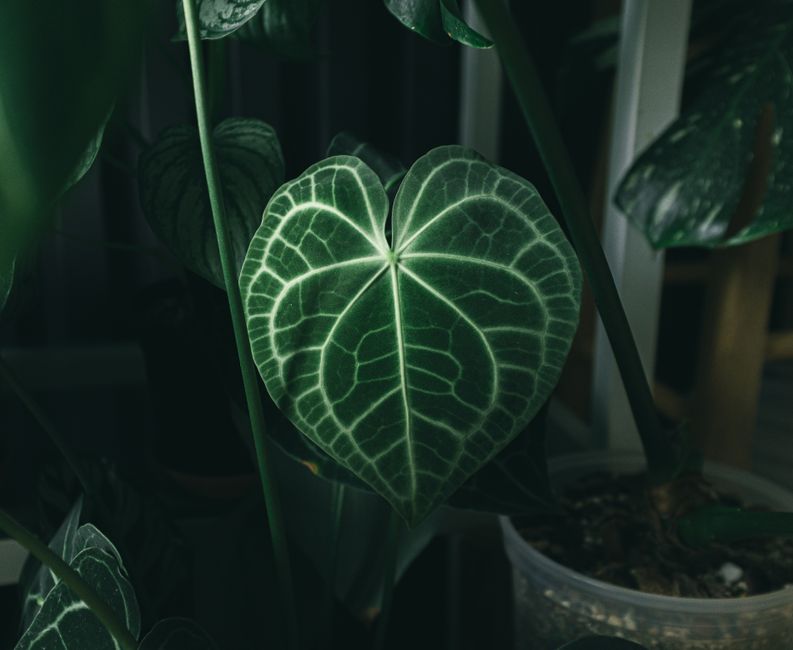
Most of the popular velvet Anthuriums (clarinervium, magnificum, crystallinum, regale) share one obvious feature: a heart-shaped leaf with a deep sinus at the petiole. Anthurium forgetii is the odd one out. Its leaves are peltate, meaning the petiole attaches to the underside of the leaf blade rather than at a notched edge. The result is a small, almost circular leaf that looks like a pale-veined coin held on a stem. In older plants the leaves grow to roughly 8 to 12 inches across, though mine took four years to break the 7-inch mark.
The species was described from the Antioquia region of Colombia and grows as a small terrestrial or low-climbing aroid in humid forest understory. That habitat matters. It explains why forgetii tolerates cooler nights than a lot of collectors expect, why it sulks in bone-dry apartments, and why it never wants to be baked in strong overhead light.
Light: bright, indirect, and honestly measured
I keep a cheap lux meter on my shelves because “bright indirect light” is meaningless without a number attached. Forgetii sits happiest for me between 800 and 1,800 foot-candles, which is roughly 8,600 to 19,400 lux. Below 600 foot-candles the petioles stretch and new leaves come in smaller than the last. Above about 2,500 foot-candles the silver veining starts to bleach and the blade thins.
Under artificial light I run a 30 watt full-spectrum bar about 14 inches above the top of the plant for 12 hours a day. If you want a starting point rather than a formula, place the plant where you can comfortably read a paperback without turning on a lamp, then keep it out of any patch of moving sun. For a broader breakdown of light thresholds for understory aroids, the International Aroid Society keeps useful species notes.
Substrate: the recipe I actually use
This is the single change that turned my forgetii from a stalled 3-leaf plant into something that pushes a new leaf every 6 to 8 weeks in the warm months. Forgetii wants a mix that holds moisture but drains within seconds, and it hates compaction. Store-bought aroid mixes are usually too fine and too peaty for it.
- 4 parts medium orchid bark (roughly 1/4 to 1/2 inch pieces)
- 2 parts coarse perlite or pumice
- 2 parts chunky coco chips, pre-rinsed to remove salts
- 1 part horticultural charcoal
- 1 part long-fiber sphagnum, teased loose, not packed
I moisten the mix before potting until it holds together when squeezed and falls apart when the fist opens. Repotting cadence for me is every 18 to 24 months, or sooner if the bark has broken down into fines. I have never once had a healthy forgetii in straight peat-based mix, and I have killed two trying.
Humidity and airflow: the pair that people separate
Humidity gets all the attention, and airflow gets almost none. Forgetii is comfortable at 65 to 80 percent relative humidity. Below 55 percent the new leaves emerge crinkled and often tear along the margin as they unfurl. Above 90 percent with stagnant air I have watched leaves develop black bacterial spots within 48 hours.
My cabinet runs a small 80mm computer fan on a low PWM setting, cycling 15 minutes on, 15 minutes off. That gentle movement is the difference between a plant that thrives and one that spot-rots. If you grow forgetii open-shelf in a dry climate, a pebble tray does very little, but a small ultrasonic humidifier aimed across the room (not at the plant) plus a slow fan will usually get you to 60 percent.
Watering: the mistake I made for two years
I used to water my forgetii on a schedule, and I lost roots every winter. What finally worked was watering by weight. I lift the pot. If it feels genuinely light, I water thoroughly until it runs from the drainage holes, then I let it drain for a full 10 minutes before it goes back on the shelf. In my conditions that ends up being every 5 to 7 days in summer and every 10 to 14 days in winter, but the interval is the output, not the input.
Water temperature matters more than most guides admit. Cold tap water below 60 degrees Fahrenheit shocks tropical roots and I have seen a single cold watering trigger a week of leaf droop. I keep a watering can filled the night before so it sits at room temperature.
Feeding: less than you think
Forgetii is not a heavy feeder. I use a balanced liquid fertilizer at roughly 1/4 the label rate, applied with every second or third watering during the growing season, and nothing at all from November through February. Twice a year I flush the substrate with plain water to move accumulated salts out of the pot. If your leaf tips turn brown and crispy while humidity is fine, salt buildup is usually the culprit, not dry air.
Temperature and seasonal rhythm
My plants sit between 65 and 80 degrees Fahrenheit year round, with a mild dip to about 62 at night in winter. That cooler night has, if anything, improved leaf size the following spring. Sustained temperatures above 85 degrees stress the plant unless humidity climbs to match. Below about 55 degrees the roots stop taking up water and rot risk climbs quickly.
Troubleshooting table: what the leaves are actually telling you
| Symptom | Likely cause | What I do first |
|---|---|---|
| New leaf emerges small and pale | Low light or depleted roots | Raise light to 1,200 foot-candles, check root mass |
| Crinkled or torn new leaves | Humidity dropped during unfurling | Tent loosely with clear plastic for 3 to 5 days |
| Yellowing older leaves, mushy petiole | Root rot from wet, compacted mix | Unpot, trim black roots, repot in fresh chunky mix |
| Silver veining fading to green | Too much direct light or heat | Move 2 feet further from the light source |
| Black spots spreading in humid cabinet | Bacterial infection, no airflow | Isolate, add a fan, remove affected leaves cleanly |
Propagation: patience over technique
Forgetii offsets rarely and slowly. The two reliable routes I have used are basal division of a mature plant with clearly separated growth points, and seed if you are lucky enough to get a pollinated spadix. Stem cuttings are not really an option in the way they are for climbing philodendrons, because forgetii has almost no visible stem for most of its life. When I have divided a mature plant I always leave at least three healthy leaves and two active roots on each division, and I keep the divisions in a humid propagation box at 75 degrees for four to six weeks before returning them to the shelf. The Missouri Botanical Garden’s Plant Finder is a good sanity check for related Anthurium habits if you are unsure what your particular clone will do.
What I wish I had bought differently
- A plant with at least 3 established leaves, not a single-leaf tissue culture starter
- Visible white or pale green root tips, not brown stubs
- A firm crown, no soft or discolored petiole bases
- Provenance notes from the seller, ideally a photograph of the mother plant
- A price that reflects the plant in front of me, not the hype cycle around the species
Frequently asked questions
Is Anthurium forgetii toxic to cats and dogs?
Yes. Like other Anthuriums it contains insoluble calcium oxalate crystals, which cause oral irritation, drooling, and vomiting if chewed. I keep mine on a high shelf away from my cat, and I would treat any chewing incident as a call to the vet rather than something to wait out.
How is forgetii different from Anthurium clarinervium?
Clarinervium has a heart-shaped, deeply lobed leaf with a pronounced sinus, and it is generally faster growing and more forgiving. Forgetii has a rounded, peltate leaf with no sinus, grows more slowly, and demands better airflow. If you are choosing between them as a first velvet Anthurium, clarinervium is the gentler introduction.
Why is my forgetii pushing tiny leaves after a beautiful large one?
Usually this means the plant spent a lot of stored energy on that big leaf and the root system cannot yet support the same size again. It also happens after a repot or a move. Give it steady conditions for three months, feed lightly, and the next leaf will typically recover in size.
Can I grow forgetii outside a humidity cabinet?
Yes, in the right climate or with the right setup. I know collectors in coastal areas who grow it open-shelf year round at 65 percent ambient humidity. In a dry apartment you will fight for every leaf without at least a humidifier and a grouping of other tropical plants to buffer the local air.
Is it worth the money?
That depends entirely on what you enjoy. If you want a plant that rewards fussing and observation with slow, sculptural leaves, yes. If you want fast fill for a room, no. I have never regretted the space forgetii takes on my shelf, but I would not pretend it is a beginner plant.
Frequently asked questions
How often should I repot a rare philodendron?
When the substrate has visibly broken down, when the plant is heavily root-bound, or when there is a root health problem. There is no fixed schedule — let the plant tell you. For many philodendrons that is every two to three years, not annually.
What size pot should I move my philodendron into?
One size up — typically two to five centimeters wider than the current pot. Going up too much creates a large reservoir of damp substrate around small roots, which encourages root rot.
Can I repot in winter?
Avoid it unless it is an emergency. Plant growth slows in winter, root development is slower, and the plant takes longer to adjust. Emergency repots — for root rot or severe pest issues — are exceptions.
Should I trim roots when I repot?
Trim only damaged or dead roots — those that are brown, soft, or hollow. Healthy roots, even if circling, should be loosened with your fingers but not cut.