My first Thai Constellation arrived in a wet sphagnum plug, one fenestrated leaf, and a shipping box that had clearly spent a night in a cold truck. I nearly returned it. Six years later, that same plant is climbing a moss pole in my north-facing living room, throwing leaves the size of a dinner plate with the creamy galaxy pattern that made this cultivar famous. The reputation for fragility is half-earned. Thai Constellation is genuinely stable in the home once you understand what the tissue culture origin actually gives you, and what it takes away.
The short version: this is a lab-produced, stable-variegated Monstera deliciosa. The variegation is baked into every cell, so it will not revert the way an albo cutting can. What it can do is throw a mostly-white leaf that never photosynthesizes properly, or a sector that browns and tears. The difference between a plant that steadily gains size and one that stalls at four leaves is almost entirely about light quality, root oxygen, and a keeper who resists the urge to fuss.
Why this cultivar behaves differently from a green Monstera
Standard Monstera deliciosa is a rainforest bulldozer. Give it a corner and it will fill it. Thai Constellation runs at roughly 60 to 70 percent of that speed in my notes, because the cream sectors carry no chlorophyll and produce no sugar. Every leaf is essentially a partial solar panel. That single fact drives every care decision that follows.
The cultivar was developed at Kasetsart University in Thailand in the 1990s, propagated exclusively through tissue culture, and released commercially in small waves. Because every plant descends from that single mutation, the variegation pattern is genotypic rather than chimeric. You will not get a green cutting from a green node, and you will not get a fully white cutting either. The plant is genetically committed to being partly cream forever, which is the good news. The rest is horticulture.
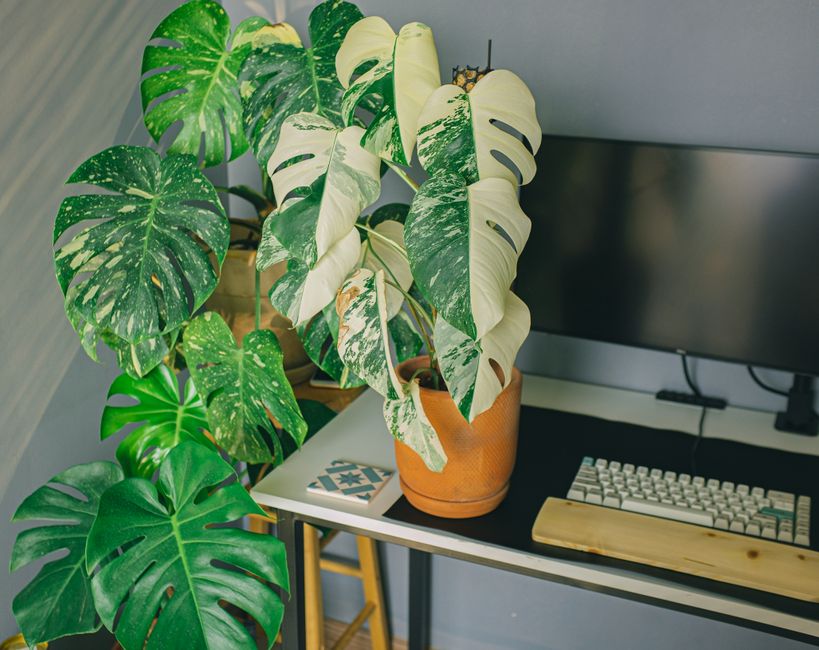
Light: the single variable that decides everything
I keep mine at roughly 400 to 600 PPFD on the leaf surface for about 10 hours a day. In footcandle terms that is bright indirect light within four feet of an east or west window, or two feet from a north window with a supplemental bar light. Direct midday sun through unfiltered glass will scorch the cream sectors within a single afternoon. I learned that in July 2020 with a leaf I still keep pressed in a notebook as a reminder.
Signs your light is wrong, in the order they appear:
- New leaves emerge smaller than the previous one, with no new fenestrations.
- Petioles stretch and lean toward the window at more than 30 degrees.
- Variegation shifts toward more cream because the plant cannot support green tissue metabolism.
- Older leaves yellow uniformly, starting from the oldest.
If you see items one and two together, add a small LED grow bar 18 inches above the plant on a timer. I use a 30-watt full-spectrum bar and it moved my plant from stalled to producing a leaf every five weeks. The University of Minnesota Extension has a readable primer on measuring indoor light if you want to move past guessing.
Watering by weight, not by finger
The finger-in-the-soil test fails on chunky aroid substrates because the top two inches dry days before the root zone does. I weigh the pot instead. When freshly watered and drained, my 8-inch nursery pot with plant weighs about 4.2 pounds. I water again when it drops to 2.8 pounds, which is roughly a 33 percent loss. That interval runs 7 to 10 days in summer and 14 to 18 days in winter in my apartment.
| Season | Approx. interval | Water temperature | Fertilizer |
|---|---|---|---|
| Spring growth push | 7-9 days | Room temp, dechlorinated | Weakly weekly, 150 ppm N |
| Summer peak | 6-8 days | Room temp | 200 ppm N every second watering |
| Autumn taper | 10-14 days | Slightly warm | 100 ppm N monthly |
| Winter rest | 16-21 days | Tepid, never cold | None |
Cold water on warm roots is the fastest way I know to trigger the black petiole rot that ends Thai Constellations. If your tap water sits below 60 degrees Fahrenheit in winter, fill a jug the night before and let it come to room temperature.
The substrate I keep coming back to
After trying pure sphagnum, LECA, and several premixed “aroid” blends, I settled on a coarse mix that holds moisture without going anaerobic. Six parts orchid bark, three parts coco chips, two parts perlite, one part horticultural charcoal, and a generous handful of worm castings per gallon of mix. It drains in under 15 seconds when I flush the pot, and the roots come out white and fat at repotting time.
- Orchid bark should be medium grade, roughly the size of a chickpea.
- Perlite must be coarse, not the dusty fine grade sold for seed starting.
- Charcoal is optional but I find it slows the substrate from turning sour between repots.
- Skip peat and potting soil entirely, both compact within six months.
The reversion question and what actually happens
People ask constantly whether Thai Constellation reverts. The answer is no, not in the sense that a variegated albo does. What you can get is a leaf where the variegation expression is unusually low, appearing almost fully green. The next leaf usually returns to a normal cream and green pattern. I have had exactly two nearly-green leaves in six years, and both were followed by textbook constellation leaves.
The failure mode to actually watch for is the opposite: a leaf that emerges more than 60 percent cream. That leaf will unfurl, look stunning for two months, and then brown from the tip inward as the sectors run out of stored sugar. If it happens once, do not cut it off. Let it feed what it can back into the plant, then remove it when it browns past the petiole. If it happens on three leaves in a row, your plant is under-lit and pushing variegation because it cannot sustain green growth.
Climbing support changes the leaves
Thai Constellation grown on a moss pole or a coco-wrapped totem produces leaves that are noticeably larger and fenestrate earlier than the same plant in a hanging basket or a stake. Aerial roots that make contact with a consistently damp pole trigger a hormonal shift that tells the plant it is climbing a tree in the wild. I keep my pole damp with a top-fed drip line from a small aquarium pump, but daily misting works if you are patient.
The jump from a 12-inch juvenile leaf to a 22-inch adult leaf happened on my plant within three months of adding a proper pole. Before the pole, I got fenestrations at leaf eight. After the pole, every new leaf fenestrated. The Missouri Botanical Garden plant finder notes similar behavior for climbing Monsteras generally.
What I paid, and what it is worth now
I bought my starter for $180 in 2020, which felt reckless. Prices have come down significantly as tissue culture labs scaled up production. A rooted 4-inch plant now runs about $60 to $110 in most North American markets, and imported juveniles from Thai and Indonesian nurseries have compressed the top end. That said, a mature specimen with three or more adult fenestrated leaves still fetches several hundred dollars because the growing time cannot be shortcut.
If you are buying, prioritize a plant with at least two fully expanded leaves showing balanced variegation (roughly 30 to 50 percent cream), visible new growth in the crown, and firm white roots. Skip anything with mushy brown petiole bases, curling leaf edges, or a suspiciously low price from a seller who cannot show recent photos of the actual plant.
Common failures and how I recover the plant
Three problems account for nearly every Thai Constellation death I have witnessed in collector groups: root rot from overwatering in dense substrate, cold shock from a drafty window in winter, and pest collapse from unnoticed spider mites on the cream sectors where they camouflage.
- Root rot: unpot immediately, rinse roots, cut anything brown or mushy back to white tissue, dust cuts with cinnamon or sulfur, repot in barely damp fresh substrate, withhold water for four days.
- Cold shock: move away from the window, do not water, wait. Damaged leaves will drop over the next two weeks but the growth point usually survives if the stem is still firm.
- Spider mites: shower the entire plant with room-temperature water, then treat with a horticultural oil spray weekly for three weeks to break the egg cycle.
Frequently asked questions
Is Monstera Thai Constellation hard to care for compared to a regular Monstera deliciosa?
It is not fundamentally harder, but it is less forgiving of low light. A green deliciosa will limp along in a dim corner for years. A Thai will stall, then decline, because it needs more light to power the same amount of growth with less chlorophyll. If you can give it a bright east or west window with a supplemental grow bar, the day-to-day care is nearly identical.
Why does my Thai Constellation have brown, crispy edges on the white sections?
Cream tissue is more sensitive to low humidity and mineral buildup than green tissue. Two fixes usually solve it: raise ambient humidity to 55 to 65 percent, and switch to filtered or rainwater if your tap water is heavy in dissolved solids. I saw the crisping stop within about six weeks of making both changes.
Can I propagate Thai Constellation from cuttings, and will the babies be variegated?
Yes to both. Because the variegation is stable and genetic, every rooted node will produce a variegated plant. Cut just below a node with a visible aerial root, root it in sphagnum or water at 75 degrees Fahrenheit, and pot it up once roots reach two inches. Expect the first few leaves to be small and less dramatically variegated as the young plant establishes.
How often should I repot, and what size pot should I move up to?
I repot every 18 to 24 months, moving up one nursery pot size at a time. Thai Constellation prefers to be slightly root-bound, and jumping from a 6-inch to a 10-inch pot creates a large volume of wet substrate the roots cannot dry out. Repot in early spring so the plant recovers into the growth season.
My new leaf came out completely white. What do I do?
Leave it alone. A fully white leaf will unfurl, look extraordinary for two to three months, and then brown from the tip as it depletes stored sugar. Cutting it off early denies the plant whatever it can pull back from the tissue. Once it browns past the petiole, remove it cleanly and treat the wound with cinnamon. Then look hard at your light: repeated white leaves are the plant asking for more of it.
Frequently asked questions
Will my anthurium's curled leaves recover?
Most lightly curled leaves unfurl within a few days of fixing the underlying problem. Heavily curled or crisped leaves are usually permanent and can be removed once the plant is putting out healthy new growth.
Should I mist my anthurium to fix curling?
Misting raises humidity only briefly and not enough to solve a real humidity problem. Use a humidifier or a pebble tray, group plants together, and aim for fifty to seventy percent ambient humidity for ornamental anthuriums.
How quickly should I water if I see curled leaves?
Check the substrate first. If it is dry, water thoroughly. If it is wet, do not water — the curling is from a different cause, likely humidity, root rot, or pests. Watering a wet plant with curled leaves usually makes things worse.
Can low light cause anthurium leaves to curl?
Yes, but less commonly than humidity or watering issues. Low light usually produces small, pale, or thin leaves rather than curled ones. If your plant has been in low light and you also moved it recently, the curl may be light-stress related.