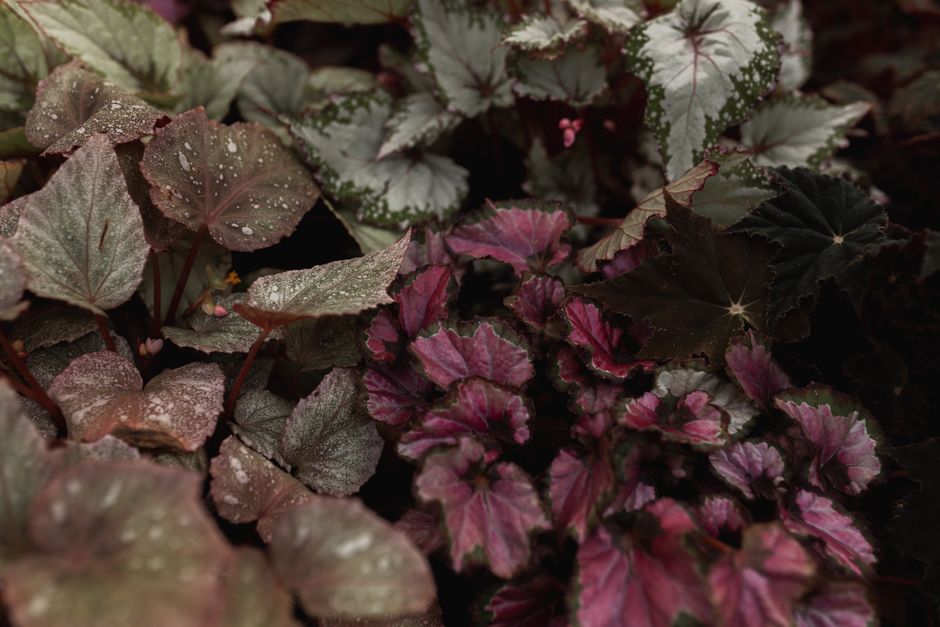
My first Begonia rex arrived in a padded box during a January cold snap, and I killed it within six weeks. It sat on a bookshelf a foot from a west window, near a radiator I thought I had accounted for. The leaves went crisp at the margins, then the whole plant collapsed into itself like a wet paper bag. I bought a second one anyway, because the leaf on that first plant, silver overlaid with a green so dark it read almost purple, had ruined me for ordinary foliage. The second one is still alive four years later, in a corner of my hallway I now think of as its private climate.
That corner is what this article is about. Not a greenhouse cabinet, not a glass terrarium, not a grow tent. A actual room corner with a hygrometer, a small fan, a pebble tray that mostly does nothing, and one dedicated shelf. If you have wondered why your rex looks polite in a nursery pot and then falls apart the moment you take it home, the mismatch is almost always the corner, not the plant.
Why the humid corner beats a whole humid room
Begonia rex wants relative humidity in the 60 to 70 percent range and hates the sudden swings that come with running a whole-house humidifier next to a forced-air vent. The plant reads change faster than it reads absolute numbers. A corner works because still air, plus a small localized moisture source, plus a nearby wall or two, creates a pocket that stays within a five or six percent band all day. My hallway corner reads 64 percent at 7 a.m. and 68 percent at 9 p.m., and the plant treats that variation as basically nothing.
A whole room, by contrast, will drift from 45 percent when the heat kicks on to 72 percent when it shuts off. Rex responds to that with edge burn on the newest leaves within about ten days. I learned this the slow way with a cheap Govee sensor logging every fifteen minutes for a month.
The corner I actually use
The setup is not clever. It is a narrow shelf about 30 inches off the floor, tucked between a plaster wall and a bookcase, roughly 4 feet from a north-facing window. Light on the leaf surface at midday in July reads about 180 foot-candles, which for rex is a comfortable middle. Winter drops it to around 90, and I compensate with a 12-watt clip-on LED for six hours a day, positioned 14 inches above the crown.
The humidity source is a small ultrasonic humidifier, the kind sold for desks, tucked behind the pot so the mist rises past the leaves and dissipates into the corner rather than blowing across them. A USB fan on its lowest setting runs 24 hours a day, aimed at the wall, not the plant. That indirect airflow is the single most important variable I ignored for two years. Without it, rex leaves develop powdery mildew or Botrytis inside a month, especially in the older, thicker foliage near the base.
Substrate: why the nursery mix has to go
Nurseries ship rex in dense peat because it holds moisture on a truck. In a home corner with steady humidity, that same peat stays wet for a week and rots the shallow rhizome. Every plant I have lost, I lost from the base up.
My working mix, refined over about a dozen repots:
- Two parts fine orchid bark, sifted to remove anything larger than a pea.
- Two parts coco coir, rinsed until the runoff is clear to strip excess salts.
- One part perlite, medium grade.
- One part worm castings for a gentle slow nitrogen source.
- A generous handful of horticultural charcoal per gallon of mix, which seems to keep the substrate smelling clean between waterings.
The mix drains within about 15 seconds when I pour water through it, and the pot feels dry to a chopstick pushed halfway down within four to five days. That is the target. If it takes seven days, the mix is too dense and I add more bark next time.
A week in the corner
The routine matters more than any single component. Here is what an average week looks like for the plant on that shelf.
| Day | What I do | What I check |
|---|---|---|
| Monday | Refill humidifier tank, wipe the shelf. | Hygrometer reading, any mist condensation on nearby books. |
| Wednesday | Chopstick test at 2 inches deep. | Water only if it comes out dry with no cling. |
| Friday | Rotate pot a quarter turn. | New leaf orientation, any leaning toward the light. |
| Sunday | Weak fertilizer at quarter strength, every second Sunday. | Rhizome color at the soil line, any softness or discoloration. |
Fertilizer is a balanced 20-20-20 diluted to a quarter of the label rate. Rex burns easily and shows it in bleached patches between the veins. Less feeding, more often, has been kinder than the monthly heavy dose I used to give.
What goes wrong, and how to read it
Rex is honest about its complaints if you learn its vocabulary. These are the signals I check for during the Friday rotation, in the order they usually appear.
- Crisp brown leaf margins on new growth: humidity dipping below 55 percent, usually because the humidifier ran dry midweek.
- Grey fuzz on older leaves near the soil: airflow has stopped, fan may have died or been unplugged.
- Pale patches between the veins: fertilizer burn or salt buildup, flush the pot with plain water three times through.
- Rhizome soft and darkening: overwatering, the mix has compacted and needs a full repot within a week.
- Sudden leaf drop with no other symptoms: temperature shock, usually a draft from a door opening onto a cold hallway.
- Reddish tinge on the leaf underside intensifying: too much direct light, move six inches deeper into the corner.
The Missouri Botanical Garden has a useful plant finder entry on Begonia rex-cultorum that confirms the general parameters, though in practice I trust the plant’s leaves over any published range.
The dormancy that surprised me
Around November, my rex usually stops pushing new leaves and may drop two or three older ones. For a while I panicked and adjusted things. Now I let it rest. Water goes to every ten days instead of every four, fertilizer stops entirely until February, and the grow light drops to four hours. In late winter the rhizome starts producing tightly furled new leaves at the growing tip, and by April the plant has three or four fresh full-sized leaves and looks almost embarrassed by how good it looks.
The North Carolina Extension has helpful notes on the rex-cultorum group that mention this rest period, though most care guides skip it entirely. If your plant looks tired in December, that is probably not a problem to solve.
When to divide, and when to leave it alone
A healthy rhizome will creep across the pot surface over two or three years and eventually loop back on itself. That is the moment to divide, ideally in early spring when the plant is waking up. I use a clean, sharp knife, cut through the rhizome so each section has at least two active growing points and a small root system, and let the cuts callus in open air for a full 24 hours before repotting into slightly barely-moist mix.
The first two weeks after division are the risky part. I keep divisions inside a loosely closed plastic bag on the same shelf, opened once a day for air exchange, and do not water at all until the bag comes off. Roughly eight out of ten divisions take. The failures are almost always ones where I hurried the callus step.
Frequently asked questions
Can I keep Begonia rex without a humidifier?
In most homes, no, not reliably. A pebble tray raises local humidity by maybe three or four percent, which is not enough to move the plant from stressed to comfortable. A bathroom with a shower running twice a day and a north window can work if the room stays above 60 percent most of the time. Otherwise a small cool-mist humidifier is the least-fuss solution, and the desk-sized ones run for about $25.
Why does my rex look great for a month and then collapse?
Almost always root rot from a mix that stayed wet. Nursery peat plus indoor humidity plus a decorative pot with no drainage is the classic sequence. Repot into a chunky mix within the first two weeks of bringing the plant home, and put it in a nursery pot with drainage inside the decorative one. The plant looks fine while the old roots are still coasting on stored energy, then crashes when they finally fail.
How much light is too much?
Anything above about 300 foot-candles for extended periods will bleach the leaf patterns. Direct morning sun for an hour is usually fine and can deepen the reds. Direct afternoon sun through untinted glass will scorch a leaf in a single day. If you can read a paperback comfortably at the plant’s location without a lamp on, that is roughly the right brightness.
Do I need to mist the leaves?
No, and I would actively discourage it. Standing water on rex foliage is an invitation to Botrytis, and misting raises humidity for about four minutes before the room absorbs it. A humidifier and a fan do the job without wetting the leaves.
Will my rex flower, and should I let it?
Most rex cultivars will send up small pink or white flowers on tall stalks in spring or summer. They are not particularly showy, and letting the plant flower diverts energy from foliage. I pinch the flower stalks off at the base as soon as I see them. The leaves get noticeably larger in the following month.
The quiet payoff
Four years in, my hallway plant has produced leaves the size of my palm in shades I did not know it was capable of when I bought it. The corner does not look engineered. Anyone walking past sees a plant on a shelf. The fan is behind a stack of books, the humidifier is behind the pot, the hygrometer is a small square tucked into the moss on the soil surface. What that corner is, really, is an agreement I made with the plant: I will hold the variables steady, and it will do the interesting work.
Frequently asked questions
Will hard water kill my plants?
Hard water rarely kills plants directly, but it slowly damages sensitive species. Calatheas, Marantas, and similar tropicals decline over 6-12 months with hard water. Tolerant plants like Pothos handle hard water fine for years.
Is rainwater really safe for plants?
Generally yes — rainwater is slightly acidic and very low in dissolved minerals. Use a clean collection container, store covered to prevent algae, and avoid the first few minutes of a storm (which may have atmospheric debris).
What's the cheapest way to soften my water for plants?
Rainwater (free) is the cheapest. Bottled distilled water ($2-5/gallon) is convenient. RO filter systems ($200-500) pay back over time for serious collectors.
How often should I flush my plant's substrate?
Once every 3-4 months. Water with plain (preferably soft) water at 3-5 times normal volume. This carries accumulated salts out of the substrate.