Somewhere between the show-stopping anthuriums on my top shelf and the fussy calatheas on the bottom sits a plant almost nobody in my collector circle talks about: Schefflera arboricola, the dwarf umbrella tree. I keep two of them, one variegated and one plain green, and they have quietly outlived several plants I paid ten times as much for. If you are looking for a tropical that tolerates apartment conditions without sulking, this is the one I would hand you before any philodendron.
What follows is not a repost of the care tag that came stapled to the pot. It is what I have written down over years of pruning, repotting, moving the plants between a bright east window and a north-facing office, and killing exactly one of them by overwatering in a plastic nursery pot. Consider this the version I wish someone had given me first.
Why this plant deserves a second look
Schefflera arboricola is native to Taiwan and Hainan, where it grows as a shrubby understory tree. The leaves fan out in whorls of seven to nine leaflets, which is where the umbrella name comes from. Compared to its larger cousin Schefflera actinophylla, the dwarf version tops out around 4 to 6 feet indoors and takes hard pruning without complaint. That last part matters. Most tropical foliage plants I own throw a fit if you cut them back. This one branches from the cut and thanks you for it.
The Missouri Botanical Garden lists it as hardy only to USDA zone 10, so for anyone north of coastal Florida it is a permanent houseplant. I treat mine as one of the workhorses of the collection, the plant I put in the corner nobody else can handle.
Light: brighter than you probably think
The single biggest mistake I made early on was believing the tag that said “tolerates low light.” It tolerates it the way I tolerate a middle seat on a long flight. The plant survives, but it stretches, drops interior leaves, and loses any variegation it had. My variegated ‘Gold Capella’ turned almost solid green during a winter behind sheer curtains on a north wall.
What actually works in my apartment:
- Place it within 3 feet of an east or west window, or 4 to 6 feet back from a south window with a sheer.
- Aim for 400 to 800 foot-candles for at least 6 hours a day. A cheap lux meter app on your phone will read roughly 4,000 to 8,000 lux, which is the same measurement.
- If you are supplementing with a grow light, 20 to 40 watts of full-spectrum LED at 12 inches above the canopy, run 10 to 12 hours, keeps variegation stable through winter.
- Rotate the pot a quarter turn every time you water. Otherwise it leans, hard.
When light drops below the threshold, the first sign is not yellow leaves. It is unusually long spacing between leaf whorls, called etiolation. Once you see it, the fix is not fertilizer. It is a better window.
Water and the pot problem
Root rot is the way most of these plants die, and it is almost never the water’s fault directly. It is the pot. Schefflera roots want oxygen between drinks. In a solid plastic nursery pot with dense peat mix, they suffocate long before the leaves tell you anything is wrong.
My current setup: an unglazed terracotta pot one size up from the root ball, filled with a mix I make from 5 parts standard indoor potting soil, 2 parts perlite, and 1 part orchid bark. This drains fast enough that I can water thoroughly without paranoia. I pour water until it runs from the drainage hole, wait 10 minutes, then dump the saucer.
Frequency depends on your home, not a calendar. In my apartment at around 68 to 72 degrees F and 45 percent humidity, that works out to every 7 to 10 days in summer and every 14 to 18 days in winter. I test with a wooden chopstick pushed to the bottom of the pot. If it comes up damp and dark, I wait.
Temperature, humidity, and the honest truth about misting
Schefflera arboricola is comfortable in the same range humans are. It does not need a humidity cabinet. Mine sit in ordinary room air, 40 to 55 percent relative humidity, and produce new leaves year round. Below about 30 percent for extended periods, I notice crispy leaflet tips. Above 70 percent with poor airflow, I have seen fungal spotting on older leaves.
Temperature-wise, keep it above 55 degrees F. A cold windowpane in January dropped one leaflet cluster on my plant last year within about 48 hours of contact. I moved it 6 inches inward and the damage stopped.
Misting does almost nothing for humidity, a fact the University of Minnesota Extension has been patiently repeating for decades. If you want to raise humidity around a plant, group it with others, use a pebble tray with actual standing water below the pot base, or run a small humidifier. Misting mainly wets the leaves, which can encourage exactly the fungal issues you were hoping to avoid.
Feeding, pruning, and shaping the plant you want
This is where Schefflera earns its keep. It responds to pruning better than any other tropical foliage plant I own.
Feeding: I use a balanced liquid fertilizer (roughly 10-10-10 or 20-20-20) diluted to half strength, every fourth watering during active growth from March through October. Nothing in November through February. Over-fertilized plants push weak, floppy growth that flops as soon as light drops in autumn.
Pruning technique that has worked for me:
- Wait until you see active new growth at the tip, usually late spring.
- Choose a stem and cut just above a leaf node, leaving 2 to 3 nodes below the cut.
- Within 3 to 5 weeks, the plant sends out 2 or 3 new branches from below the cut.
- Repeat on the tallest stem each season. A leggy plant becomes bushy in about a year.
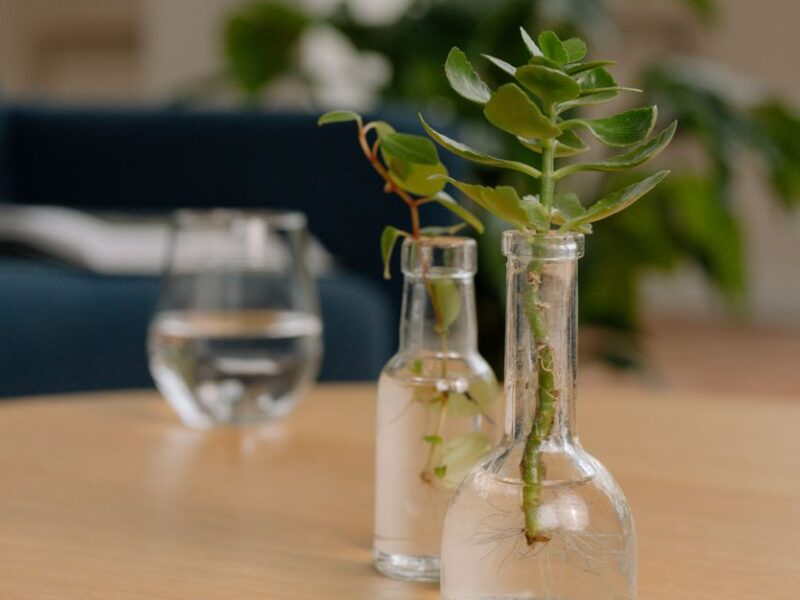
- Save the cuttings. They root in water in 4 to 6 weeks with reasonable warmth.
I keep a small journal note each spring listing which stems I cut and where. It sounds excessive, but knowing when a branch was pruned helps me predict where the next flush will appear.
Problems, in order of how often I have seen them
Almost every issue on this plant traces back to one of four causes. This is the table I check before I do anything reactive.
| Symptom | Most likely cause | What I actually do |
|---|---|---|
| Leaves drop from the base | Sudden light change or cold draft | Move it back, wait 2 to 3 weeks before judging |
| Yellow leaflets, soft petioles | Overwatering or compacted soil | Unpot, inspect roots, repot in fresh gritty mix |
| Sticky residue, tiny brown bumps | Scale insects | Wipe with 70 percent isopropyl on a cotton swab, weekly for 4 weeks |
| Fine webbing between leaflets | Spider mites, usually from dry air | Rinse in shower, raise humidity, repeat in 5 days |
| Brown crispy leaflet tips | Fluoride or salt buildup in tap water | Switch to rainwater or distilled for 2 months |
Scale is the one problem I would flag as a Schefflera specialty. Something about the ridged petioles gives scale insects a foothold. I check the undersides of leaves monthly, and I have never had an infestation get out of hand as long as I caught it in the first two or three insects.
Styling it in a real room
A well-pruned Schefflera reads as a small tree, which is a shape most collections lack. I use mine as a visual anchor at the end of a bookshelf run, where a trailing pothos would look flimsy and a fiddle-leaf fig would look like a magazine cliche. In a 10-inch terracotta pot on a low plant stand, it sits at about eye level from the couch, which is where I want the interesting foliage.
The variegated cultivars, especially ‘Gold Capella’ and ‘Trinette’, bring warm color into rooms with cool north light. The plain green form disappears into a dark corner in the best way, quietly filling space without demanding attention.
Frequently asked questions
Is Schefflera arboricola toxic to pets?
Yes. The ASPCA lists it as toxic to cats and dogs due to insoluble calcium oxalate crystals. Chewing causes mouth irritation, drooling, and sometimes vomiting. My cat has never shown interest in mine, but I keep the plant on a high stand anyway. If you have a chewer, this is not the plant for you.
Why is my Schefflera leggy and stretching upward?
Almost always insufficient light. The plant is reaching for a brighter source. Move it within 3 feet of an east or west window and prune the tallest stems back by a third. New branches will fill in below within a month or two, and the shape recovers faster than you expect.
Can I grow Schefflera arboricola in water permanently?
Cuttings root in water reliably, and I have kept one going in a glass jar for over a year. Long-term though, water-grown plants stall out because the roots that form are structurally different from soil roots. For a full-sized specimen, transfer to soil once roots reach 2 to 3 inches long.
How fast does it grow indoors?
In good light with regular feeding during the growing season, expect roughly 6 to 12 inches of new height per year, plus lateral branching wherever you prune. In low light, growth slows to 2 or 3 inches annually and looks stretched. Speed is a direct function of light intensity, more than anything else.
Do the flowers matter?
Indoors, they almost never appear. Outdoor specimens produce small red flower spikes, but I have kept these plants for years without seeing a single bud form inside. Grow it for the foliage and the tree-like habit, not for bloom.
If I had to name the most underrated plant in my collection, this would be it. Schefflera arboricola is patient, forgiving, and improves with attention rather than demanding it. Give it real light, a pot that breathes, and the occasional confident cut, and it will hold its corner of the room for as long as you want it there.
Frequently asked questions
How do I know when a pot is "light enough" to water?
Practice. Compare the weight just after watering to the weight a week later. With practice, you can distinguish these states reliably. Combine with a finger-test of substrate moisture for confidence.
What if I can't lift large pots?
Use the finger-test more heavily. Or tilt the pot slightly to feel the weight difference at the rim. Or check substrate moisture at the bottom (where some pots have small openings or with a moisture meter).
How do I water when I'm away for several days?
Water thoroughly before leaving. If you'll be away longer, set up self-watering systems or ask someone to check by feel. Most rare plants can go 1-2 weeks between waterings, so a few days away is fine.
Should I water in the morning or evening?
Morning is slightly better for most plants — gives substrate time to dry before night, when fungal issues are more likely. But timing matters less than thorough watering and proper rhythm.