My Philodendron mamei silver arrived in a soggy sphagnum plug the summer I finally gave up on trying to grow it like a regular philodendron. The leaf that unfurled two weeks later, silver-splashed and quilted along the veins, convinced me the plant deserved its own set of habits. Everything I do for it now is a small adjustment away from the “any philodendron, any pot” advice I started with, and those adjustments are what this piece is about.
Mamei is a creeping terrestrial from the western Andes, not a pole climber like a hastatum or a gloriosum-adjacent crawler that wants a mossy log. The silver pattern (sometimes marketed as “silver cloud”) is a stable trait of the species, not a chimeric variegation, so the care is really just good mamei care. Get the light, the substrate, and the rhizome orientation right, and the silver stays crisp leaf after leaf.
How I read the leaf before I do anything else
Before I water or move a mamei, I look at the newest fully hardened leaf. That leaf is the plant’s honest weather report from the last four to six weeks. On mine, a healthy new leaf is roughly 8 to 10 inches long, matte, with silver painting that runs between the primary veins and fades into the green margin. If the newest leaf comes in smaller than the one before it, something upstream is off, usually light or root health, rarely fertilizer.
Two specific signals I have learned to trust: silver that “washes out” toward pale mint usually means light is too low, and silver that goes chalky-bright with a faint yellow halo usually means the substrate stayed wet too long and the fine roots are stressed. Neither is a crisis on its own, but both are cheaper to fix at leaf number two than at leaf number five.
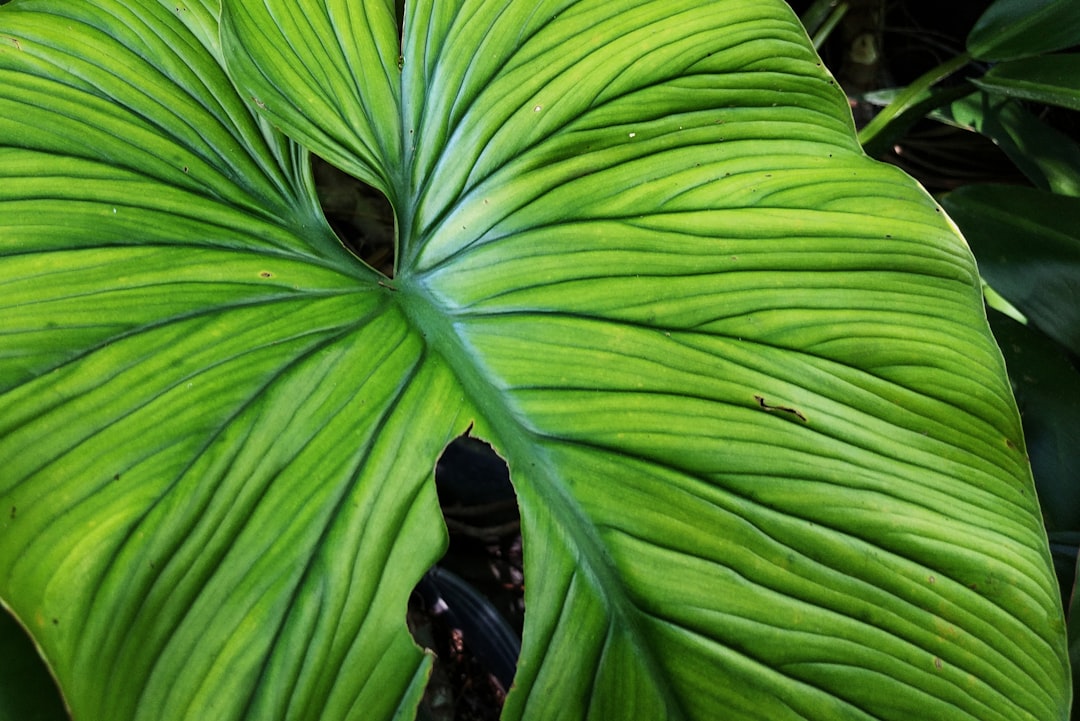
Light: bright, indirect, and boringly consistent
My mamei lives about 30 inches back from an east window with a sheer panel, and a Sansi 24W grow bulb tops it up from 8 a.m. to 4 p.m. on a plug timer. A cheap PAR meter reads 180 to 220 umol at leaf height at midday, which sits comfortably in the range most aroid growers quote for stable growth without bleaching (roughly 150 to 300 umol for 10 to 12 hours). The Missouri Botanical Garden’s Plant Finder is a good sanity check for genus-level light expectations if you are moving from a different philodendron.
What matters more than the exact number is that the light does not swing week to week. When I moved this plant six feet toward a brighter south window one January, the next leaf came in noticeably smaller with a rough, papery edge. It took two full leaves to recover after I put it back. Mamei will tell you it hates a shock; it just takes a month to finish the sentence.
The substrate mix I actually use
Mamei roots are thin and want oxygen. A dense peat-based mix will hold water against the rhizome and slowly rot the growth points from underneath. I use a chunky aroid mix that drains in under 20 seconds when I pour water through a bare-root sample in a colander.
| Component | Ratio by volume | Why it is in there |
|---|---|---|
| Fine orchid bark (1/4 to 1/2 inch) | 40% | Air channels; slow to break down |
| Perlite, coarse #3 | 25% | Drainage, prevents compaction |
| Coco chips, rinsed | 15% | Holds a little moisture near roots |
| Horticultural charcoal | 10% | Buffers salts, keeps mix sweet |
| Worm castings | 10% | Slow nitrogen, microbial life |
I rinse the coco twice in tap water before mixing because unrinsed coco can carry enough sodium and potassium to shift the feed ratio and stall new growth. The University of Florida IFAS has a useful primer on container substrate physical properties if you want to understand why chunky and airy actually holds more usable water than “moisture-retentive” peat does over a week.
Watering cadence, in real numbers
I water when the top 1.5 inches of the mix are dry to a bamboo skewer and the pot has lost about a third of its saturated weight. In my apartment (68 to 72 F, 55% humidity), that lands roughly every 8 to 10 days in summer and every 14 to 17 days in winter. I water until it runs freely from the bottom, wait 30 seconds, and water again to flush any accumulated salts.
- Lift the pot dry, then again right after watering, and remember the two weights in your hand.
- Skewer the mix down to the halfway point; pull it out and feel it against your wrist.
- If the skewer is cool and damp, wait 48 hours and check again.
- If it comes out warm and dry at the top but faintly cool at the bottom, water fully.
- Never water on a schedule alone in shoulder seasons, March and October fool me every year.
Humidity, temperature, and airflow
Mamei tolerates household humidity better than a lot of collector aroids, but the silver pattern is more vivid and the leaves are larger when I keep it above 60%. I run a small ultrasonic humidifier six feet away, aimed across the shelf, not at the plant. A clip fan on the lowest setting runs for eight hours a day; without airflow, I get fungus gnats within a month and the newest petiole tends to droop.
Temperature range on my shelf sits between 65 F at night and 78 F on a warm afternoon. Below about 55 F the plant sulks, and I have never risked seeing what happens below 45 F. The Royal Horticultural Society’s philodendron growing guide gives sensible general temperature guidance that lines up with what mamei seems to want.
Feeding without burning the fine roots
I feed at quarter strength every second watering during active growth (roughly April through September) with a balanced 3-1-2 ratio liquid fertilizer, and I flush thoroughly once a month with plain water. In winter I drop to a monthly quarter-strength feed. Mamei is not a heavy feeder, and the fine root system reacts badly to salt buildup, a chalky white crust on the pot rim is my cue to flush twice back to back.
Repotting and the rhizome trick
The rhizome creeps along the surface. If you bury it, it rots. When I repot (roughly every 18 to 24 months, or when roots circle the pot), I lay the rhizome on top of the fresh mix and only bury the roots hanging below it. I anchor the rhizome with two bent pieces of coated wire pushed into the substrate like tent stakes until new roots grip. Within about six weeks the plant is stable and I pull the wire out.
I use a shallow, wide pot rather than a tall one, a 6-inch azalea pot suits a plant with three to four active growth points better than a standard nursery pot. More surface area, less depth of soggy mix under the rhizome.
Common problems I have run into
- Silver fading toward pale green: increase light gradually, 10% brighter per week.
- New leaf emerges crumpled and stays crumpled: humidity dropped during unfurling; mist the cataphyll, do not force it open.
- Sudden yellow lower leaf: usually normal turnover if only one leaf; if two in a week, check for root rot.
- Brown crispy leaf edges: salt buildup or tap water with high chloramines; flush and switch to filtered water for a month.
- Rhizome soft at the growing tip: cut back to firm tissue, dust with cinnamon, replant with the cut end exposed to air for 24 hours first.
Frequently asked questions
Is Philodendron mamei silver the same as Philodendron plowmanii?
No, though they are often confused at nurseries. Mamei has a more rounded, quilted leaf with silver splashes between veins and a smooth petiole. Plowmanii has a longer, more elongated leaf shape and a distinctly winged, ruffled petiole. Buying from a seller who shows the petiole clearly is the easiest way to avoid a mislabel.
Can I grow mamei in pure sphagnum moss?
You can, and many growers do for propagation, but I find long-term sphagnum culture risky for the creeping rhizome because the moss compacts and holds water against the growth point. If you go this route, use loose New Zealand long-fiber moss, fluff it monthly, and expect to repot into a chunky mix once the plant has three or more established roots longer than four inches.
Why is my mamei producing smaller leaves than the one it came with?
Almost always a light issue, and occasionally a root issue. Nursery plants are grown under supplemental lighting at intensities most homes do not match. Give the plant two full leaf cycles (about three months) at your improved light level before judging. If the third new leaf is still smaller, unpot and check for firm, cream-colored root tips.
How often does mamei push a new leaf?
In my conditions, roughly one new leaf every five to seven weeks per active growth point during warm months, and one every 10 to 12 weeks in winter. A mature plant with three growth points can feel like it is always doing something, which is part of why it earns its shelf space.
Is Philodendron mamei toxic to pets?
Yes, like most aroids it contains calcium oxalate crystals that irritate the mouth and throat if chewed. I keep mine on a high shelf away from a curious cat. If a pet chews a leaf, rinse the mouth and call a vet; symptoms are usually uncomfortable rather than dangerous but should not be ignored.
Frequently asked questions
Do Calatheas really need seventy percent humidity?
No. Most Calatheas thrive at fifty-five to sixty-five percent humidity, which is achievable in a normal home with a humidifier in winter. The seventy-plus number circulating online is unnecessarily high for indoor cultivation.
Does misting Calatheas help with humidity?
No. Misting raises humidity for only seconds before it drops back to ambient. It does not provide the sustained humidity Calatheas need. Use a humidifier instead.
Where should I put my humidifier?
In the same room as your Calatheas, ideally a meter or two away from the plants — not directly under them. Use a hygrostat-equipped model so it maintains the target humidity automatically.
Will pebble trays raise humidity for Calatheas?
Pebble trays raise humidity only a few centimeters above the water surface. Calathea leaves are well above that height. Pebble trays mostly create water management chores without practical humidity benefit.