The first time I tied a Monstera deliciosa to a wooden dowel wrapped in twine, I thought I had solved the climbing problem. Six months later the plant was leaning sideways, the aerial roots were reaching past the pole into thin air, and the newest leaf was smaller than the one before it. That failure taught me more about aroid physiology than any care guide I had read. A moss pole is not a decorative crutch. It is a synthetic tree trunk, and if you treat it that way, the plant will treat it that way too.
This is the protocol I have refined across roughly a dozen climbing aroids in my own collection, from a modest Philodendron gloriosum crawler that resisted vertical growth for months to a Rhaphidophora tetrasperma that outpaced its second pole in a single summer.
Why aerial roots need something to grip
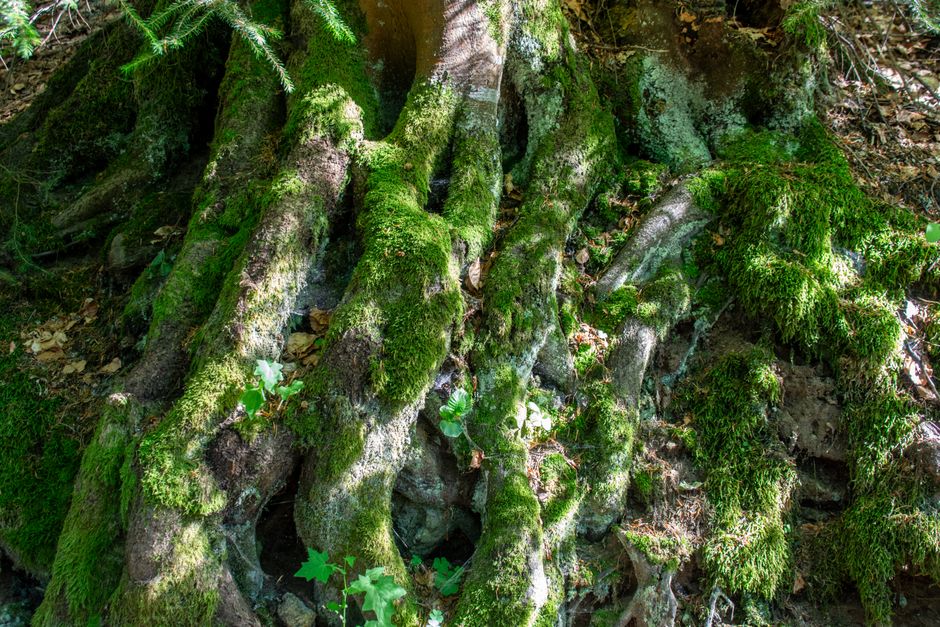
Climbing aroids in the wild grow up trunks that stay reliably damp under a layer of moss, bark, and leaf litter. The aerial roots along the stem are chemosensory: they detect moisture and secrete a glue-like substance that lets them attach and then thicken into anchor roots. Once attached, the plant reads its position as “supported” and starts producing larger, more fenestrated, more mature leaves. Botanists call this shift heteroblasty, and you can trigger it at home if you get the surface right.
A dry coir pole, a smooth PVC pipe, or a plastic-mesh tube stuffed with dry sphagnum will not trigger anything. The roots swing past it looking for damp bark. That is the single most common reason people report their moss poles “not working.”
Choosing the pole itself
I have tried five configurations. Only two consistently produce attachment within four to six weeks.
| Pole type | Attachment rate | Notes |
|---|---|---|
| Long-fiber sphagnum in plastic mesh | High | Holds moisture 3-5 days between waterings, roots penetrate the mesh readily |
| Sphagnum wrapped around wood dowel, bound with fishing line | High | Stable, rot-resistant core, my preferred setup for anything over 4 feet |
| Coco coir pole (commercial) | Low | Dries in hours, fibers too coarse for fine root hairs |
| Tree fern totem | Medium | Excellent surface but expensive and increasingly restricted in trade |
| PVC wrapped with jute rope | Very low | Cosmetic only, no meaningful moisture retention |
For sphagnum, I buy AAA-grade New Zealand long-fiber whenever I can find it. Chilean and Wisconsin grades work but break down faster. A pole I built with New Zealand moss in 2022 is still structurally sound; a Chilean equivalent needed repacking after fourteen months.
Building a pole that actually holds water
Here is the exact sequence I follow when I build one from scratch. The whole process takes about twenty minutes for a 36 inch pole.
- Soak a generous handful of long-fiber sphagnum in room-temperature rainwater for at least 30 minutes. Squeeze out only the free-running water; the moss should feel like a wrung sponge, roughly 70 percent moisture by weight.
- Cut a length of 1 inch square hardwood dowel (cedar or oak) or a stiff bamboo cane 4 to 6 inches longer than the finished pole to allow deep insertion into the pot.
- Lay the dowel on a strip of nylon window screen or plastic garden mesh cut to wrap once around the dowel with a 1 inch overlap.
- Pack a continuous cylinder of damp sphagnum around the dowel, aiming for a finished diameter of 2 to 3 inches. Denser packing holds more water.
- Roll the mesh around the moss and bind with 20 lb monofilament fishing line in a tight spiral, one wrap every inch. Fishing line is invisible, does not rot, and does not chafe the roots.
- Insert the pole into the pot before you plant, if possible, or slide it against the root ball on the trunk side away from the growth point.
A pole built this way, in a room at 65 percent humidity, needs a top-down watering roughly every three days. In a dry winter apartment I water daily using a small pump sprayer with the nozzle pushed into the top of the pole so water travels down through the fibers.
How I actually train the plant onto it
This is where most guides go vague. Tying a plant to a pole is not the same as training it.
I use soft plant tie tape (the stretchy green kind sold for tomatoes) and place ties above every second node, snug enough to hold the stem flush against the moss but loose enough to slide a fingernail underneath. The critical detail: I press each aerial root physically into the wet moss at the moment I tie, and if the root is stubborn I make a small pocket in the surface with a chopstick and tuck it in. Contact plus moisture triggers attachment within about 10 to 20 days on a healthy Monstera, longer on slower philodendrons.
Every two weeks I check ties. As the stem thickens, tight ties will girdle it. I loosen or replace anything that has started to indent the tissue. New growth gets tied within a week of unfurling, never before, because young stems are too soft and bruise where the tie sits.
Species behave differently and it matters
Not every climbing aroid climbs the same way, and treating them identically is why some collectors never get the leaf-size progression they were promised.
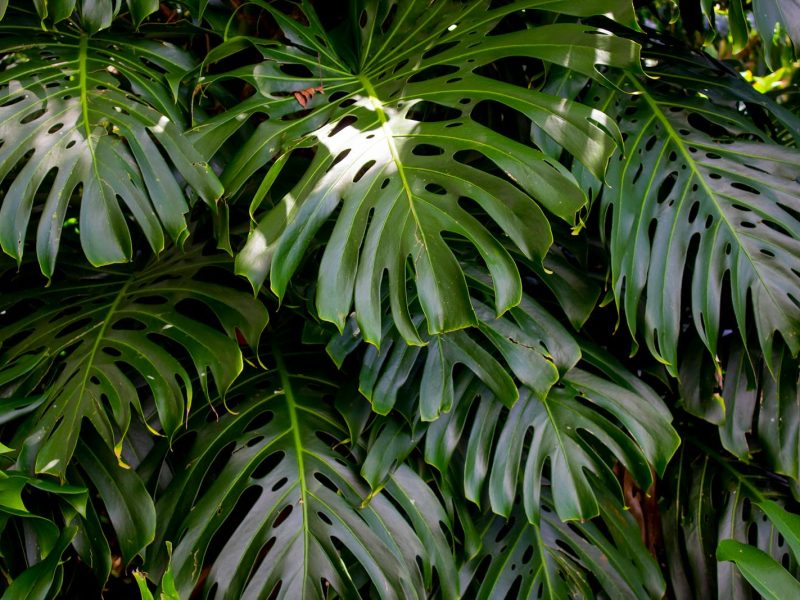
- Monstera deliciosa and M. adansonii – fast, aggressive attachers. Will latch within two weeks if the pole is properly wet. Reward attachment with dramatically larger, more fenestrated leaves.
- Philodendron gloriosum, P. mamei, P. plowmanii – crawlers, not climbers. Do not force them vertical. They want to run horizontally along a shallow, wide tray of substrate.
- Philodendron verrucosum, P. gigas, P. melanochrysum – true climbers, but slower. Expect attachment in 4 to 8 weeks and give them higher humidity, 70 percent and above, or aerial roots simply desiccate before they grip.
- Rhaphidophora tetrasperma and R. decursiva – fast climbers with weak stems. They need pole support earlier than you think or the leader flops and stops producing.
- Epipremnum pinnatum aurea and other pothos types – will climb readily but only mature (splitting) leaves if the pole is tall enough, typically 5 feet plus.
- Anthurium warocqueanum, A. veitchii – not technically climbers in the same way. A short mounted slab suits them better than a full pole.
Extending a pole without disturbing the plant
Eventually your plant reaches the top. This is the moment most collections stall, because repotting a heavily attached aroid is genuinely difficult. I extend rather than replace, using a technique I learned by trial and error after breaking two mature leaders trying to swap poles.
I cut a second pole 2 inches shorter than the first, sharpen one end of its interior dowel to a point, and drive it directly down into the top of the existing pole so the two dowels overlap by about 4 inches. I bind the joint with fishing line and pack fresh damp moss over the seam. The plant continues upward without ever leaving its attachment points. I have stacked three poles this way on a single Monstera that now sits at nine feet.
Common problems and how I read them
| Symptom | Likely cause | What I do |
|---|---|---|
| Aerial roots reach past the pole into air | Pole surface too dry | Water pole daily for 2 weeks, mist roots directly, tuck roots into moss |
| New leaves smaller than previous | Plant reading itself as unsupported, or root system stressed | Improve pole contact, check root health, raise humidity above 60 percent |
| Attached roots turning black and hollow | Pole staying wet without airflow, fungal rot | Reduce watering frequency, add a small clip fan, unwrap any plastic sleeve |
| Ties cutting into stem | Missed a two-week check | Cut and replace with looser tie above and below the wound |
| Whole pole leans in pot | Anchored too shallow at planting | Brace top of pole to a wall hook temporarily, reset at next repot |
What honest results look like
A well-trained Monstera deliciosa I potted as a three-leaf cutting in early 2021 now has leaves 22 inches across with full fenestrations and a stem thickness at the base of about 1.4 inches. The same plant off a pole, in the same conditions, produced its previous leaf at 11 inches. That is the payoff, and it takes roughly 18 months of consistent moss moisture to see it.
For deeper botanical background on aroid climbing behavior and heteroblasty, the International Aroid Society publishes species profiles that go far beyond hobbyist care sheets, and the Missouri Botanical Garden Plant Finder is my usual first stop for confirming mature-form leaf sizes before I decide how tall a pole to build.
Frequently asked questions
How wet should a moss pole feel to the touch?
Squeeze the surface. If a drop of water beads at your fingertip, that is right. If your finger comes away only faintly damp, it needs water within the hour. If water runs down your wrist, you have overwatered and should let it drain before it starts to smell sour. In practice I aim to water enough that the top 4 inches stay in that “damp sponge” zone continuously.
Can I train a philodendron onto a moss pole after it has already grown sideways for a year?
Sometimes, but not always successfully. Older aerial roots that have hardened in air rarely reattach. What I do is prune back to a node with fresh, plump, still-active aerial roots and let the new growth from that node train upward. Trying to bend a mature woody stem onto a pole usually just cracks it.
Do I need to fertilize through the pole?
I do, lightly. Once a month during active growth I water the pole with a dilute balanced fertilizer at roughly a quarter of the label rate. Aerial roots absorb some nutrients directly, and I have seen visibly greener leaves after adding this step. Do not go stronger; salt buildup in the moss will burn the tender root tips.
Should I use plastic wrap or a bag over the pole to hold moisture?
I have tried it and stopped. The moss stays wet longer but the lack of airflow encourages fungal growth on the aerial roots, and I lost a valuable Philodendron verrucosum this way. Raise ambient humidity with a room humidifier instead.
How long before I see bigger leaves after the plant attaches?
Usually two full growth cycles, which in a warm bright room means about four to six months. The first new leaf after attachment is often only marginally larger. The second is noticeably bigger. By the fourth, the difference is unmistakable and other collectors start asking what you changed.
Frequently asked questions
Can fungus gnats hurt my houseplants?
Adult fungus gnats don't damage plants. Larvae can damage seedlings and stressed plants by feeding on roots. Mature, healthy plants tolerate fungus gnats but the underlying wet substrate is a concern.
How long does it take to get rid of fungus gnats?
With consistent BTI treatment and reduced watering, typically 2-4 weeks. Severe infestations or persistent cases may take 4-6 weeks of treatment.
Are mosquito dunks safe for indoor plants?
Yes. BTI is a soil-dwelling bacterium that targets only fly larvae. It's safe for plants, pets, and humans. Use as directed in substrate drenches.
Will yellow sticky traps alone eliminate fungus gnats?
No. Sticky traps catch adults but don't address larvae in substrate. New adults will emerge to replace those caught. Combine traps with BTI treatment and reduced moisture.