The first time I noticed salt burn on one of my anthuriums, I blamed the light. Then the humidity. Then the fertilizer brand. It took a cheap TDS meter and about twenty minutes of honest observation to figure out the real problem: I had been feeding weekly with tap water in a peat-heavy mix that was quietly turning into a salt sponge. The tips were crisping from the inside out, and no amount of misting was going to fix it.
Salt buildup is one of the most under-diagnosed problems in collector-grade houseplant care. It looks like a dozen other things, it accumulates invisibly, and by the time you can see it on the leaf margins, the root zone has already been sitting in a stressful chemical soup for weeks. This is the walk-through I wish someone had handed me back then.
What “salt” actually means inside a pot
When I say salt, I do not mean sodium chloride from the kitchen. I mean the accumulated residue of every soluble mineral you have ever added to the pot: nitrates, phosphates, sulfates, calcium, magnesium, potassium, chlorides, and yes, some sodium from tap water. Fertilizer is a salt. Hard tap water is a salt delivery system. Even organic amendments release ionic compounds as they mineralize.
Roots absorb water through osmosis, which depends on a gradient: the water in the soil solution needs to be less concentrated than the water inside the root cells. When dissolved salts in the substrate climb past a certain threshold, that gradient flattens or reverses. Water starts flowing out of the roots instead of in. The plant looks thirsty in wet soil, which is exactly the paradox that used to confuse me.
How I recognize a salt problem before the tips brown
Leaf tip burn is the last symptom, not the first. By the time I see brown crescents on my Alocasia frydek, the roots have already been struggling for a while. The earlier signals I have learned to trust:
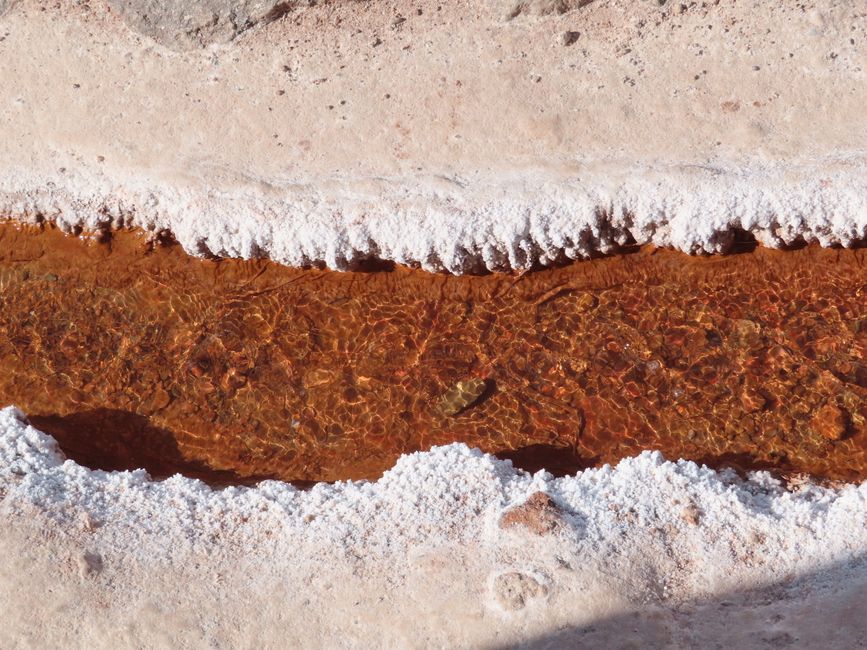
- A white or yellowish crust forming on the soil surface, on the pot rim, or weeping through terracotta walls.
- Slower drying between waterings, even though the plant is not obviously overwatered.
- New leaves emerging smaller than the previous flush, with slightly cupped or puckered margins.
- A faint chemical or sour smell when I press my nose to the drainage holes.
- Root tips that look tan or grey instead of the crisp white you expect on a healthy specimen.
The single most useful tool I own for this is a $15 TDS/EC meter. I stick it in the drainage water after a normal watering and read the number. For most tropical foliage and aroids I keep the runoff between 400 and 800 ppm (roughly 0.8 to 1.6 mS/cm EC). Anything creeping above 1200 ppm is a flush signal. Anything above 1800 ppm and I stop whatever I am doing and deal with it that afternoon.
The three-step flush I actually use
A flush is not the same as a normal watering. The point is to move a large volume of low-mineral water through the root zone fast enough to carry accumulated ions out the bottom, without drowning the roots or destroying the substrate structure. Here is the sequence I follow, in order.
- Pre-soak. I water lightly with room-temperature, low-EC water (rain, RO, or distilled if I have to). This wakes the substrate up, rehydrates any dry pockets, and dissolves the crystallized salts that would otherwise sit there ignoring the flush. I wait 15 to 20 minutes.
- The main pour. I move the plant to the sink or shower and pour a volume of water equal to roughly 3 to 5 times the pot’s volume through it, slowly, over about 5 minutes. For a 6 inch pot that is about 3 to 4 liters. I aim the stream at the substrate surface, not the leaves, and let it drain freely the whole time.
- Confirm and drain. I test the last runoff with the TDS meter. If it is still above 400 ppm I keep pouring. Once it reads clean, I let the pot sit tilted for an hour so gravity can pull the last of the water out. I do not water again until the top third of the substrate has dried.
I do not fertilize for at least two weeks after a full flush. The plant needs to rebuild its root chemistry, and I want to reset the baseline before I start adding anything back.
How often, honestly
The internet loves to say “flush every three months.” That is a starting point, not a rule. What actually determines flush frequency is the combination of your water, your fertilizer schedule, and your substrate. My own rhythm, refined over about four years of note-taking:
| Situation | My flush interval | Notes |
|---|---|---|
| Rainwater + weak weekly feed + chunky aroid mix | Every 4-6 months | Barely accumulates; a good rinse is often enough. |
| Tap water (250 ppm) + monthly balanced feed + peat mix | Every 8-10 weeks | My most common baseline. The peat holds ions stubbornly. |
| Tap water + weekly feed at label rate | Every 4-6 weeks | You are essentially in a hydroponic-density feeding schedule; treat it that way. |
| Semi-hydro (LECA, pon) | Every full reservoir change | Passive systems concentrate salts fast; measure often. |
| Recovering plant with visible tip burn | Immediately, then again in 2 weeks | One flush rarely resets a badly loaded substrate. |
When flushing is the wrong answer
Not every crispy tip is a salt problem, and pouring 4 liters of cold water through a root-rotted plant is a good way to finish it off. I skip the flush and troubleshoot elsewhere when:
- The substrate is already saturated and the plant has been sitting wet for days.
- The roots smell sour or feel mushy when I unpot a corner to check.
- Tip burn is on only one side of the plant, suggesting a light-scorch or draft issue.
- The plant was just repotted into fresh mix in the last month.
- The runoff reads under 400 ppm, in which case my problem is almost certainly something else.
Root rot masquerades as salt stress often enough that I always do a quick root check on any plant I have flushed twice without improvement. If the roots are compromised, no amount of water quality management will save it.
Prevention beats correction
Since I started paying attention to input water, I flush maybe half as often as I used to. A few habits that made the biggest difference:
- I collect rainwater on the balcony from October to April and use it for everything sensitive. My city tap water sits around 280 ppm, which is fine short-term but compounds over months.
- I feed at roughly a quarter of the label rate, more frequently, instead of full-strength doses spaced out. The plant gets a steady trickle and the substrate never sees a spike.
- I water to runoff every single time. Small “top up” waterings that never drain are the fastest way to build a salt profile.
- For anything in terracotta, I scrub the rim crust off once a month with a stiff brush. It is not just cosmetic; that crust is a wick pulling salts up and out.
- I keep a small notebook with each plant’s last flush date and last measured runoff EC. It sounds obsessive; it takes 20 seconds.
The University of Vermont extension has a solid primer on soluble salts in container plants if you want the horticultural chemistry in more depth, and the RHS has a good overview of water quality for indoor plants that helped me think about my inputs more carefully.
Frequently asked questions
Can I flush with tap water if that is all I have?
Yes, and it is better than not flushing at all. Even 250 ppm tap water is dramatically less concentrated than the 1500 ppm soup building up in a neglected pot, so it will still pull ions out. That said, if your tap runs above 400 ppm or is heavily chlorinated, at least let it sit uncovered for 24 hours so the chlorine can dissipate, and consider RO water for your most valuable specimens.
Does flushing wash out all my fertilizer and starve the plant?
It removes the fraction that was dissolved in the pore water, which is a small part of what is actually stored on the substrate’s cation exchange sites and inside any slow-release granules. The plant will not starve from a single flush. If you are using pure slow-release pellets, you may want to top-dress lightly two weeks after flushing, but a normal liquid-fed plant just resumes its schedule.
Should I flush right before or right after repotting?
Neither, in most cases. If I am repotting into fresh mix, the fresh substrate itself resets the salt profile, so a pre-flush is redundant. Post-repot, the roots are already stressed and disturbed, and I want them recovering, not being pushed through another water event. I wait 4 to 6 weeks after a repot before considering a flush.
Why does my LECA plant keep showing salt symptoms even though water flows through freely?
Semi-hydro systems concentrate salts in the reservoir faster than most people expect, because evaporation removes water but leaves the minerals behind. A LECA pot with a 200 ppm feeding solution can read 900 ppm in the reservoir after two weeks. The fix is complete reservoir changes (not top-ups) and periodic rinses of the LECA itself under running low-EC water.
Can I overdo it and flush too often?
You can. Every flush temporarily disrupts beneficial microbes in the substrate, cools the root zone significantly, and can compact peat-heavy mixes if you pour too aggressively. Once every 6 to 10 weeks is plenty for most collections. If you find yourself flushing monthly, the real problem is upstream: your water, your feeding rate, or your substrate is out of balance and needs adjusting instead.
Frequently asked questions
How long does it take to develop a personal plant styling aesthetic?
Typically 2-5 years of active collecting and styling. Initial choices reflect external influences; over time, your own preferences emerge through experience and trial.
Should I follow specific styling rules?
Use principles, not rules. Rules are rigid; principles are flexible. Pay attention to what works in your space and adjust accordingly.
How can I tell if my plant arrangement is working?
Visual harmony, plant health, ease of care, and your own enjoyment of the space. If all four are positive, the arrangement is working.
Can plant styling improve my home's overall feel?
Yes, significantly. Plants add life, color, texture, and presence to spaces. Thoughtfully styled plants can transform how a home feels to live in.