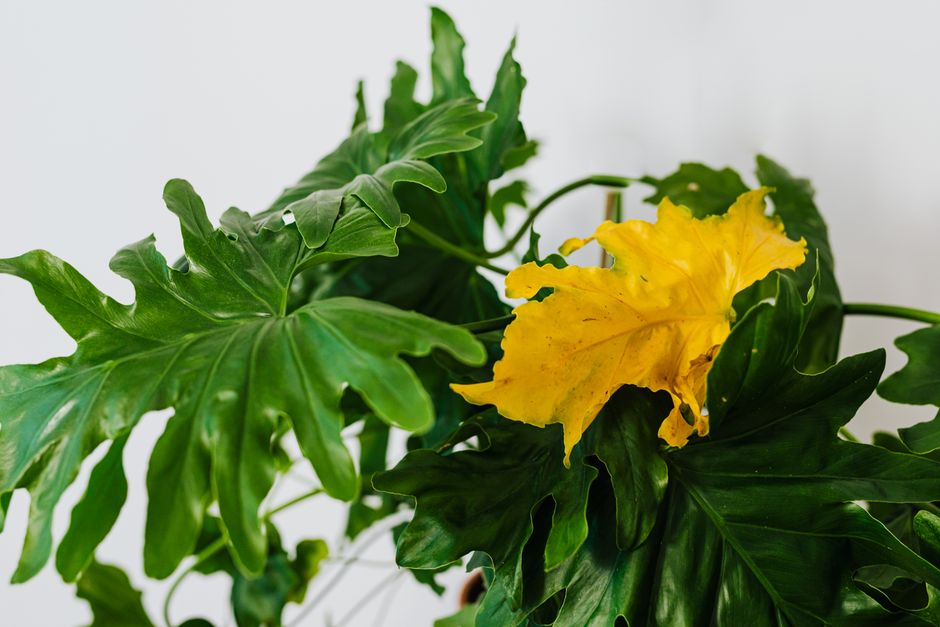
A yellow leaf on a prized plant sends most collectors into a small panic, and I have watched myself do it more times than I want to admit. The mistake I made for years was reacting to the color before I read the leaf. Yellow is a symptom with at least a dozen upstream causes, and treating the wrong one (usually by watering less, then watering more, then repotting in a fit of guilt) is how a manageable issue becomes a dead philodendron. What follows is the walkthrough I actually use now, in the order I use it, when a leaf on the shelf turns.
Read the leaf before you touch the plant
Before I do anything, I stand in front of the plant with my hands behind my back. The single most useful minute in this whole process is spent looking, because the leaf’s position, pattern, and timing narrow the cause faster than any moisture meter. Is it the oldest leaf at the base, or a new one at the growth point? Is the yellow uniform, blotchy, or veinal (yellow between green veins)? Did it turn overnight or fade over two weeks? Are one, two, or six leaves involved?
Those four questions eliminate roughly half the possible causes on their own. A single old lower leaf yellowing evenly on a mature Philodendron is almost always benign senescence. Six new leaves going chlorotic between the veins is almost never a watering problem, no matter what the internet insists.
Rule out the boring answer first: normal leaf drop
Houseplants shed old leaves. Mine drop one every 4 to 8 weeks on average, more during the shorter days between November and February when the plant is reallocating energy. A single lower leaf yellowing uniformly, with no other symptoms and no change in the new growth, is the plant recycling nitrogen out of tissue it no longer needs. The move here is to do nothing. Cut it off at the petiole once it detaches easily, and forget about it.
I mention this first because I have watched collectors overhaul an entire care routine over a single senescing leaf, and the overhaul is what actually kills the plant.
Check the roots and the substrate, in that order
If more than one leaf is involved, or if newer growth is affected, the next thing I do is lift the pot. Weight tells me more than any meter. A pot that feels much heavier than it did a week ago at the same watering interval is holding water it should have used or drained. I then slide the root ball out and look.
Healthy roots on most aroids and tropicals are firm and pale (white, cream, or light tan depending on species). Rotted roots are brown to black, hollow, and pull apart between your fingers with a wet-paper texture. That smell (sour, faintly sulfurous) is unmistakable once you have met it. If more than a third of the root mass is compromised, the yellowing you are seeing is the plant trying to shed leaves it can no longer support.
- Rinse the root ball under lukewarm water and remove every soft root with sharp, sterilized snips.
- Repot into a chunky, fast-draining mix. My default is roughly 40% orchid bark, 30% perlite, 20% coco coir, 10% worm castings, with a handful of horticultural charcoal.
- Drop the pot size if you removed a lot of roots. A shrunken root system in a too-large pot stays wet and rots again within weeks.
- Water thoroughly once, then wait until the top inch is dry before watering again. Do not fertilize for 3 to 4 weeks.
- Keep humidity above 55% and light bright but indirect during recovery.
When the yellow is between the veins
Interveinal chlorosis (green veins on a yellowing leaf) is the pattern that finally taught me to stop blaming water for everything. It is almost always a nutrient story, and the specific nutrient depends on which leaves are affected.
| Pattern | Where it appears | Most likely cause | First move |
|---|---|---|---|
| Uniform yellowing, old leaves first | Bottom of the plant | Nitrogen deficiency or natural senescence | Balanced feed at half strength; if only one leaf, ignore |
| Interveinal chlorosis, old leaves | Older growth | Magnesium deficiency | Epsom salts, 1 tsp per gallon, monthly for 2 months |
| Interveinal chlorosis, new leaves | Growth tip | Iron deficiency, usually pH-locked | Flush substrate; check tap water pH (aim 5.8 to 6.5) |
| Yellow with brown crispy edges | Any leaf | Fertilizer burn or hard water | Flush pot with 3x its volume of distilled water |
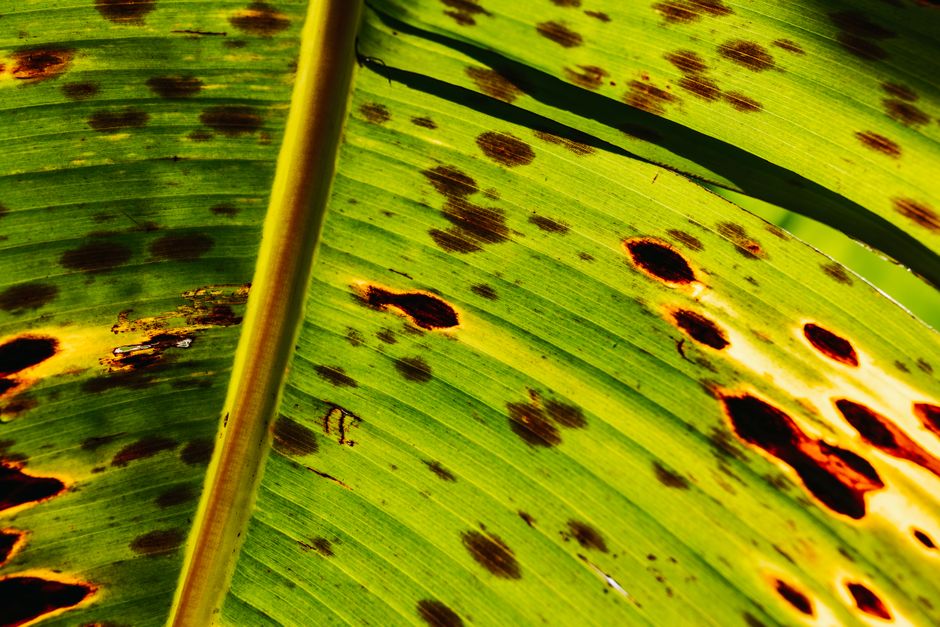
| Yellow halo around brown spot | Scattered | Bacterial or fungal leaf spot | Isolate, remove affected leaves, improve airflow |
| Pale yellow, whole plant, leggy | Everywhere | Insufficient light | Move closer to window or add a 20 to 30W grow light |
The tap water point deserves a second sentence. I run mine at 220 ppm on a cheap TDS meter, which is fine for pothos and monstera but slowly locks out iron on my Alocasias if I never flush. A quarterly flush with distilled or filtered water solved a chronic new-leaf chlorosis I chased for two years with fertilizer changes.
Light: the cause I underestimated the longest
A plant grown 8 feet from a north window will yellow slowly no matter how correctly you water it. Photosynthesis stops paying its own bills, and the plant sheds leaves to reduce demand. The tell here is uniform pale yellowing across many leaves, often with elongated internodes and small new growth.
I measure light with a free lux app on my phone, and I aim for 800 to 1500 foot-candles (roughly 8,000 to 15,000 lux) at leaf level for most aroids. Anything under 400 fc will eventually cause the plant to decline, even if you are doing everything else right. The University of Florida IFAS extension has a solid primer on light levels for interior tropicals worth reading if you are new to lux measurements.
Temperature swings and cold drafts
Yellowing that appears within 24 to 72 hours of a cold night, especially on plants near a window in winter, is almost always chill damage. Most tropical houseplants suffer below 55°F, and species like Anthurium warocqueanum start dropping leaves below 60°F. My rule from November through March is that no leaf touches a windowpane, and no plant sits directly under a supply vent. A single overnight dip to 48°F yellowed three lower leaves on my Philodendron gloriosum in one week, and the plant took a full month to stabilize.
Pests hide in plain sight
Spider mites, thrips, and mealybugs all cause yellowing before you see the pest itself. Spider mite damage looks like fine stippling that coalesces into pale patches, usually on the undersides of leaves; a white sheet of paper tapped under the leaf will show you the mites moving. Thrips leave silvery scarring alongside the yellow. Mealybug damage tends to be more localized, with sticky residue and cottony masses in leaf axils.
- Inspect the undersides of the three newest leaves with a 10x loupe once a week.
- Wipe leaves monthly with a damp microfiber cloth (removes mite eggs before they hatch).
- Quarantine every new plant for a minimum of 3 weeks in a separate room.
- If you see webbing, treat with a horticultural oil or insecticidal soap at label rates, then repeat at 5-day intervals for three cycles to catch the hatching eggs.
- Discard heavily infested growing medium; pests overwinter in soil more often than collectors expect.
The 72-hour rule
After I intervene (repot, treat, move, flush), I stop touching the plant for at least 72 hours. Every rescue attempt I have watched fail was a case of the collector doing three things in three days and then not knowing which one caused the next symptom. Pick the single most likely cause based on the pattern, act once, and wait. If the plant is stable and no new leaves are yellowing after a week, the diagnosis was right. If it keeps declining, move to the next most likely cause on your list.
What I keep on the diagnostic shelf
Almost every plant issue I diagnose gets solved with the same short tool kit: a cheap TDS meter, a lux app, a 10x jeweler’s loupe, sharp snips sterilized with 70% isopropyl, a bag of orchid bark and perlite for emergency repots, and a small bottle of hydrogen peroxide 3% for soaking rotted roots. Under $40 total, and it has saved plants I paid ten times that for. The Missouri Botanical Garden’s plant finder is my second reference when I want species-specific tolerances quickly; their plant finder database is more careful than most hobbyist sources.
Frequently asked questions
Should I cut off yellow leaves immediately?
Not usually. A leaf that is still partly green is still moving sugars and nitrogen back into the plant. I wait until the leaf is more than 70% yellow or begins to detach on its own, then cut at the petiole with sterilized snips. The exception is bacterial or fungal spotting, which spreads and should be removed as soon as it is confirmed.
Can a yellow leaf turn green again?
Once chlorophyll is gone from a section of leaf, it will not come back. What you can save is the rest of the plant and any leaves that are only beginning to pale. If a leaf is 30% yellow when you correct the cause, that same 30% will still be yellow in six months. Judge success by whether new leaves come in fully green, not by whether existing damage reverses.
Why does my new leaf come out yellow and then green up?
That is normal for many aroids. New Philodendron and Monstera leaves emerge chartreuse to pale yellow and darken over 2 to 3 weeks as chlorophyll accumulates. If the leaf hardens off yellow, that is a problem; if it deepens to green within a fortnight, it is just development.
Is bottom watering better for preventing yellow leaves?
Bottom watering does not prevent yellowing on its own, but it encourages roots to grow downward and reduces the surface saturation that fungus gnats and some root rots exploit. I alternate: bottom water three times, then a thorough top water to flush accumulated salts. That single rhythm change reduced chronic edge browning across my collection more than any fertilizer switch.
How long should I wait before deciding a rescue worked?
Give it 3 to 4 weeks. Yellowing already in progress will finish; the metric that matters is the next new leaf. If it emerges normally sized and fully green, the plant has stabilized. If new growth is smaller, paler, or malformed, the underlying cause is still active and needs a second look.
Frequently asked questions
What's the most important consideration in choosing pots?
Proportion. Pot height should relate to plant height (1.5-2x typically). After proportion, consider color relationship and material to ensure the pot complements rather than competes.
Should I use plastic or ceramic pots?
Both work. Plastic is functional and lighter (use as cachepot inserts). Ceramic is heavier and more decorative. Many growers use ceramic cachepots with plastic inner pots.
How do I know if a pot is too big?
It should fit the plant's root system — generally one size up from previous, not several sizes. Too big creates excess substrate moisture and root problems.
Can I use vintage or antique pots for plants?
Yes, often beautiful. Use as cachepots (without drainage holes) if they're fragile or have sentimental value. Add inner plastic pot with drainage.