I found my first serious scale infestation on the underside of an Anthurium veitchii petiole, and I only noticed because a sticky drop landed on the leaf below it. That drop, honeydew, is usually how these insects announce themselves. By the time you see the bumps, they have already been feeding for weeks, sometimes months. What follows is the routine I built after losing part of a Philodendron gloriosum crown to a soft brown scale colony I missed for a full season.
Why scale is the pest collectors underestimate
Spider mites move. Fungus gnats fly. Thrips leave silver scars you cannot miss. Scale insects, by contrast, glue themselves to a stem or midrib, grow a waxy or armored shield, and sit still for the rest of their adult life. To a distracted eye they read as bark flecks, latex scars, or harmless bumps. That camouflage is the entire problem.
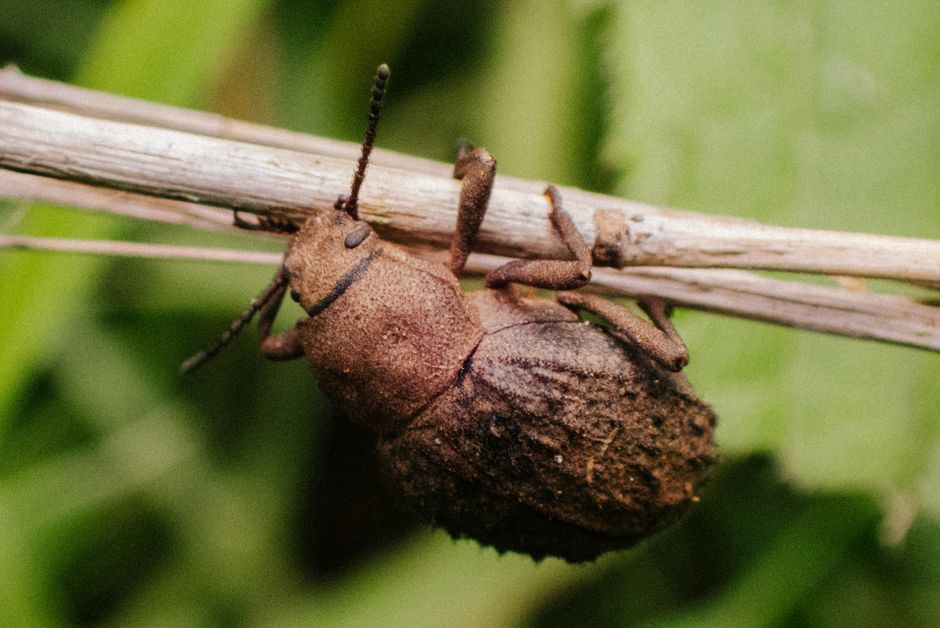
There are two broad groups you will meet indoors. Soft scales (family Coccidae) secrete honeydew, which then feeds sooty mold and attracts ants. Armored scales (family Diaspididae) build a hard detachable cover and do not produce honeydew, which makes them even easier to miss. Both feed by inserting a threadlike stylet into the plant’s vascular tissue and draining sap for weeks at a time. The UC IPM scale insect guide is the clearest reference I have found for identifying which group you are dealing with.
The tells I look for during weekly rounds
Every Sunday I do a slow pass through the humidity cabinet with a headlamp and a jeweler’s loupe. It takes about 25 minutes for 40 plants. I am looking for six specific signals, in this order:
- Shiny patches on lower leaves, which is honeydew dripping from feeding above.
- Black sooty mold, which is the fungus that grows on that honeydew.
- Ants trailing up a pole or stem when there is no obvious food source.
- Slightly convex, matte bumps along petioles, midribs, and leaf axils.
- Yellowing that starts as vein-adjacent mottling rather than a whole-leaf fade.
- New growth that emerges smaller, crinkled, or off-color while old growth still looks fine.
The loupe matters. At 10x magnification a soft brown scale (Coccus hesperidum) looks like a flattened brown lentil with a faint keel. An armored scale like Hemiberlesia lataniae looks like a tiny gray-white barnacle. I keep a note in my plant journal each time I find one, because reinfestation almost always starts from the same plant, sometimes the same node.
The treatment schedule that finally worked for me
The mistake I made early on was treating once, seeing dead adults, and declaring victory. Scale has a mobile juvenile stage called a crawler, and crawlers are what you actually need to kill. Adults are largely protected by their wax or shield. If you do not repeat treatment on the crawler cycle, you get a second wave in 14 to 21 days that looks identical to the first.
Here is the exact cadence I now run whenever I find scale on a plant:
| Day | Action | Notes |
|---|---|---|
| 0 | Isolate plant, physically remove visible adults with a soft toothbrush dipped in 70% isopropyl alcohol | Adults come off with light pressure; do not scrape hard on tender petioles |
| 1 | Full foliar spray with horticultural oil at label rate (usually 1 to 2%) | I use it in the evening at 68 to 72°F, never in direct sun |
| 7 | Inspect with loupe; spot-treat any new bumps with a cotton swab of alcohol | Focus on nodes and the underside of leaf bases |
| 10 | Second full oil spray, covering stems and both leaf surfaces | This catches the first crawler wave |
| 21 | Third full spray, oil or insecticidal soap | Rotating classes reduces the chance of resistance |
| 35 | Final inspection, then reintegrate if clean for two consecutive weekly checks | I still tag the plant and check it twice weekly for another month |
Horticultural oil works by smothering, not by chemistry, which is why coverage matters more than concentration. I decant into a fine-mist trigger sprayer and hold the plant over a tray so I can hit the underside of every leaf without soaking the substrate. The Penn State Extension overview and the RHS both note that timing sprays to the crawler emergence window is the single biggest factor in success.

Choosing between oil, soap, and systemic
People ask me constantly whether to use a systemic like imidacloprid. My honest answer is that I keep one bottle for emergencies and reach for it maybe once a year. Systemics have real trade-offs and, for most home collections, contact treatments are enough if you actually follow the schedule.
- Horticultural oil, my default. Cheap, smothers all life stages, low residue. Skip on ferns, some succulents, and anything with pubescent leaves like Anthurium warocqueanum, which can scorch.
- Insecticidal soap, good rotation partner. Works on soft-bodied crawlers only, so useless against adult armored scale. I dilute to about 2% and rinse leaves 4 hours later on velvety-leaved species.
- 70% isopropyl alcohol, my scalpel. Perfect for spot-treatment on 1 or 2 visible adults. Do not spray it as a whole-plant treatment; it will damage thin cuticles.
- Systemic (imidacloprid granules), reserved for heavy infestations on a plant I cannot rinse, like a mounted Philodendron. I apply at the low end of the label rate, water in, and wait 3 weeks for uptake. Never on flowering plants a pollinator can reach.
Quarantine, the step almost no one respects
Every new plant that enters my house now spends 30 days in a separate room, on a separate shelf, with its own tools. I made this a rule after a Philodendron I bought at a well-known specialty nursery introduced a scale population that jumped to three neighbors within six weeks. That was a $340 mistake I did not want to repeat.
The 30-day window matters because a light infestation of armored scale can hide during a casual pre-purchase inspection and only reveal itself when the next crawler generation emerges. During quarantine I inspect the plant twice a week with the same loupe, and I do a single preventive horticultural oil spray around day 10 whether I see anything or not. It costs me about 4 minutes per plant per week and has caught two hidden infestations in the last 18 months.
What I stopped doing
Two things I used to do made scale problems worse, not better. First, I used to wipe leaves with neem oil straight from the bottle, assuming stronger meant faster. It did not; it burned tender new growth on my Alocasia zebrina and did nothing extra against the pest. Concentration matters, and label rates exist because someone tested them.
Second, I used to trust that a plant looked clean because the leaves were clean. Scale hides on stems, in leaf axils, on the underside of aerial roots, and inside the sheath where a new leaf is unfurling. Now I inspect structure, not surface. A plant with immaculate leaves and a colony of 60 crawlers tucked into a moss pole is a plant that will crash in about 8 weeks.
Frequently asked questions
Can I use dish soap instead of insecticidal soap?
I would not. Modern dish detergents contain degreasers and fragrances that strip the leaf cuticle and cause slow chronic damage you will not notice for weeks. Purpose-made insecticidal soaps use potassium salts of fatty acids at tested concentrations. A bottle costs around $12 and lasts a year in an average collection.
Why did scale come back three weeks after I treated?
Almost always because the first treatment killed adults but missed the next crawler wave. Scale eggs sit under the adult female’s shield and hatch on their own schedule, typically 10 to 21 days after the initial spray. If you treat once and stop, you are essentially clearing the room for the next generation. A minimum of three timed sprays is what actually breaks the cycle.
Is scale contagious between plant species?
Yes, most indoor scale species are not host-specific. Coccus hesperidum, the soft brown scale I see most often, feeds happily on aroids, ficus, citrus, hoyas, and orchids. Assume that any plant within about 2 feet of an infested one has been exposed and inspect it accordingly.
Do beneficial insects work indoors?
They can, but the room has to be closed and the population large enough to sustain them. I have released Chilocorus nigritus (the twice-stabbed lady beetle) into a sealed grow tent with good results, but they do not thrive in an open living room. For most home collectors, contact treatments and rigorous inspection beat biological control on cost and reliability.
How long before I can trust a plant is truly clean?
Two clean weekly inspections after the last treatment is my minimum, and I still mark the pot with a small dot on the tag for another 90 days. Scale is patient. So is anyone who has fought it before and lost.
Frequently asked questions
How many plants should I have?
Depends on your care capacity. 8-15 for casual collectors, 15-30 for serious collectors with good conditions, 30+ requires significant time investment and infrastructure.
Should I rehome plants that aren't thriving?
Yes, often. If a plant has struggled for 6+ months despite your efforts, it may be better in conditions that suit it better. Give to friends, donate, or compost.
Is a large plant better than several small ones?
Often yes for impact and ease of care. One mature plant has more presence and is easier to maintain than several developing plants.
How do I know if I have too many plants?
Watering takes excessive time, you have struggling plants you can't identify causes for, you feel overwhelmed by care, or you can't name every plant in your collection.