Two Novembers ago I walked into the north bedroom and found my Alocasia Amazonica with one crumbling leaf left and a stem the colour of wet cardboard. I nearly binned the whole pot. Instead I tipped it out, rinsed the substrate off, and felt a corm the size of a hazelnut that was still stubbornly firm between my fingers. Six months later that same corm sent up a leaf bigger than my hand. That single save taught me more about alocasia dormancy recovery than any care card ever did, and it is the reason I now treat a bare-stemmed alocasia the way a bulb grower treats a tulip in July: quietly, patiently, and without watering it to death.
Why a healthy alocasia goes to sleep in the first place
Alocasias are corm-forming aroids native to the seasonal understory of Southeast Asia and eastern Australia. In their range they experience a genuine cool-dry period, and evolution wired them to shed foliage and retreat into the corm when conditions turn hostile. In a heated flat that hostile signal usually arrives as one of three things: a night-time window sill dropping below 60 F, a radiator ripping ambient humidity down to 25 percent, or a shortened photoperiod under 10 hours of usable light. Any two of those together and a stressed plant will start ejecting leaves on purpose. It is not failing. It is doing exactly what the species does.
The important shift, and the one that took me years to internalise, is that a dormant alocasia is a plant with a plan. Root activity slows to almost nothing. The corm begins storing starch. Water demand collapses to maybe a tenth of summer levels. If you keep watering on a summer schedule you are, in effect, drowning a hibernating animal.
Dormant, dying, or already dead: the three-minute test
Before you plan any recovery you need to know which of the three you are looking at. I do this on a sheet of newspaper at the kitchen table and it takes less time than making coffee.
- Unpot the plant and shake, do not scrub, the substrate off the root ball.
- Find the corm. It sits where the stem meets the roots and looks like a small brown potato, sometimes with pale nodes.
- Squeeze it gently between thumb and forefinger. A viable corm resists like a raw carrot. A rotted corm collapses like a soaked marshmallow and often smells faintly sulphurous.
- Slice a sliver off the base with a clean blade. Living tissue is white to cream, sometimes faintly pink. Grey, brown, or translucent tissue is dead.
- Check for offset cormlets. A stressed parent often has three to eight pea-sized babies clinging to its side. Those are your insurance policy.
If the main corm is firm and pale inside, you have a dormant plant and full recovery is realistic. If the main corm is mush but you have firm cormlets, you can still rebuild the collection from those. If everything is soft and smells bad, the plant is gone and no amount of coaxing will change that.
The environmental triggers, mapped
I keep a small notebook of ambient readings for each shelf in the plant room, and after three winters the pattern is unmistakable. Alocasias in my care start showing dormancy behaviour whenever any two of the following conditions hold for more than ten consecutive days.
| Variable | Comfort zone | Dormancy trigger | Damage threshold |
|---|---|---|---|
| Night temperature | 65-72 F | Below 60 F | Below 50 F |
| Relative humidity | 60-75% | Below 45% | Below 30% |
| Photoperiod (usable) | 12-14 hours | Under 10 hours | Under 8 hours |
| Substrate moisture | Even, drying top inch | Bone dry for over 2 weeks | Waterlogged in cool temps |
| Airflow | Gentle constant | Stagnant | Cold draft on foliage |
Notice that the damage threshold and the dormancy trigger are not the same line. A plant that goes dormant at 58 F is not injured. A plant that sits at 48 F for a night can suffer chilling injury the corm may never come back from. Knowing which side of the line you are on decides whether you are recovering a sleeper or nursing a casualty.
The seven-step wake protocol
Once I have confirmed a firm corm I move into a protocol that has now worked on Amazonicas, Polly, Silver Dragon, Regal Shields, and one very stubborn Zebrina. The whole thing takes six to fourteen weeks and the biggest mistake, every time, is trying to rush it.
- Clean the corm. Rinse under lukewarm water, trim any soft roots and any mushy patches back to firm tissue with a sterilised blade, and dust the cuts with cinnamon or a light sulphur powder.
- Callus for 24 hours. Rest the corm on a paper towel in a warm shaded spot. Skipping this step is the number one reason repotted corms rot in the second week.
- Choose a small pot. I use a 3 to 4 inch nursery pot for a hazelnut-sized corm. Oversized pots hold moisture the dormant corm cannot use and invite rot.
- Mix a lean, airy medium. Two parts coarse perlite, two parts fine orchid bark, one part coco coir, one part worm castings. It should drain in under 10 seconds when you pour water through.
- Plant with the growth point up. Bury the corm so the top sits just at the surface. Water once, lightly, until the medium is just damp.
- Warm the bottom, not the top. Set the pot on a seedling heat mat regulated to 75 to 78 F. Bottom heat is the single strongest trigger I have found for pushing a corm out of dormancy.
- Wait, and only mist the surface. Do not water again until you see either a new root at the drainage hole or a green shoot at the crown. This usually takes three to six weeks. Watering an unrooted corm is how people kill the plant they just saved.
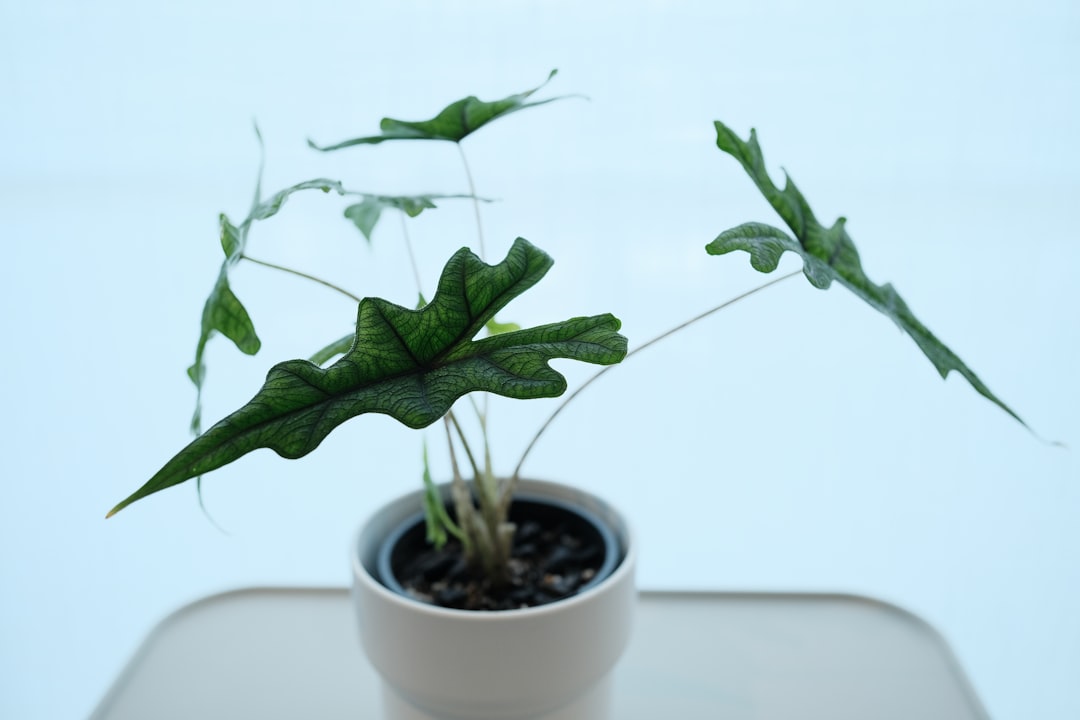
What the recovery actually looks like, week by week
The timeline below is stitched together from four different rescues I logged in the same notebook, so treat the dates as typical rather than promised. My Silver Dragon was the slowest at nine weeks to first leaf. The Amazonica from the opening story was the fastest at 22 days.
- Week 1: No visible change above ground. Corm may firm up slightly as it draws in trace moisture.
- Week 2 to 3: A single white root often appears at the base. Do not repot. Do not celebrate loudly. Just add a light watering, maybe 30 ml for a 4 inch pot.
- Week 3 to 6: A pale green or purple-tinged shoot pushes through the surface. It will look nothing like a mature leaf, more like a rolled cigar.
- Week 6 to 9: The first leaf unfurls. It is usually smaller than any leaf the plant had before dormancy. This is normal, not a defect.
- Week 9 to 14: Second leaf, larger than the first. At this point I move the plant off the heat mat and back onto a normal shelf with 12 hours of grow-light exposure.
- Week 14 onward: Regular feeding at quarter strength resumes. From here the plant behaves like a small, freshly potted alocasia rather than a recovering one.
The mistakes I keep watching people make
The single most common failure I see in group chats and forum threads is well-meaning overwatering during weeks one to three. The plant looks pitiful, the substrate looks bone dry, and the instinct is to soak the pot. Do not. A dormant corm without active roots cannot lift that water, and it will sit around the corm and cause exactly the rot the whole exercise was designed to avoid.
The second is cold-window syndrome. People move the recovering pot to a bright winter window because it looks like a good spot. In many climates that glass is 15 degrees colder than the room at 3 am. A single freezing night beside a single-pane window has ended more of my rescues than any pathogen. If your only bright spot is a cold window, use a small grow light on a shelf instead. The Penn State Extension guide to houseplants is a sensible primer on winter light and heat trade-offs if you want a second opinion.
The third is fertilising too early. Dormant and recovering corms have no capacity to metabolise nutrients, and salts build up in the medium and burn the emerging roots. I do not feed anything until the second true leaf is out.
When dormancy is a choice you make on purpose
Not every dormant alocasia is an accident. Once you understand the mechanism you can use it deliberately. I now induce dormancy on purpose for two of my larger Regal Shields every winter, because I do not have the shelf space or the humidity budget to keep them in full growth from November to March. In late October I gradually withhold water, drop the ambient temperature to around 62 F at night, and let them shed their leaves over about a month. The bare corms then sit in barely-damp coir at 60 F until late February, when the wake protocol above brings them back with almost no losses.
This is closer to how a bulb grower thinks than how a typical houseplant owner thinks, and it changes the relationship with the plant. You stop resenting winter and start using it. For more background on the genus’s natural rhythms, the International Aroid Society genus overview is a good starting point.
Frequently asked questions
How long can an alocasia corm stay dormant before it dies?
In my experience a firm, properly stored corm can hold viability for eight to twelve months at 60 to 65 F in barely-damp medium. I have brought back corms that sat forgotten in a drawer of coir for seven months. Beyond a year the odds drop sharply because the corm’s stored starch is finite, and without a growth flush to replenish it the tissue eventually collapses.
Should I keep watering my alocasia if all the leaves have dropped?
Almost never on the old schedule. If the corm is firm and the medium is completely dry, a light watering of roughly one tablespoon per inch of pot diameter every two to three weeks is enough to prevent the corm from desiccating. If the medium still feels cool and damp, skip the watering entirely and check again in a week.
Why is my alocasia dropping leaves in summer, not winter?
Off-season leaf drop usually points to root damage rather than dormancy. Common culprits are overwatering, a substrate that has broken down into a dense mush, or a spider mite infestation that has been running long enough to defoliate the plant. Unpot and inspect the roots before you assume it is a dormancy event.
Can I speed up the wake by using a stronger heat mat or brighter light?
Not really, and pushing either variable tends to backfire. Bottom heat above about 80 F cooks the fine new roots. Very bright light on a corm with no leaves has nothing to power and just heats the substrate. The rate-limiting step is the corm’s internal signalling, and it runs on its own clock regardless of what you throw at it.
Do all alocasia species go dormant, or only some?
All of them can, but the threshold differs. Small hybrids like Polly and Bambino tend to enter dormancy easily under mild stress. Larger species such as Macrorrhizos and Portora are more reluctant and often just slow down rather than fully shedding. Silver Dragon and Dragon Scale sit in the middle, and in my flat they lose about half their foliage most winters before rebounding in March.
Frequently asked questions
How tall should a moss pole be?
Plan for at least three years of plant growth. For a small Monstera, start with 60-90 cm. For a vigorous climber, 1.5 meters or more, or use an extendable system.
Do moss poles need to be misted daily?
Most do — moss should always feel slightly damp. In high-humidity environments or cooler rooms, every other day may suffice. Bone-dry moss does not work.
Why aren't my plant's aerial roots attaching to the moss pole?
Almost always because the pole is too dry. Aerial roots attach only to consistently damp surfaces. Mist daily and check after a few weeks.
Should I water the pot more often if the moss pole is wet?
No — the pole and the pot are separate. The plant still draws water from substrate through ground roots. Water the pot based on substrate dryness, and keep the pole damp independently.