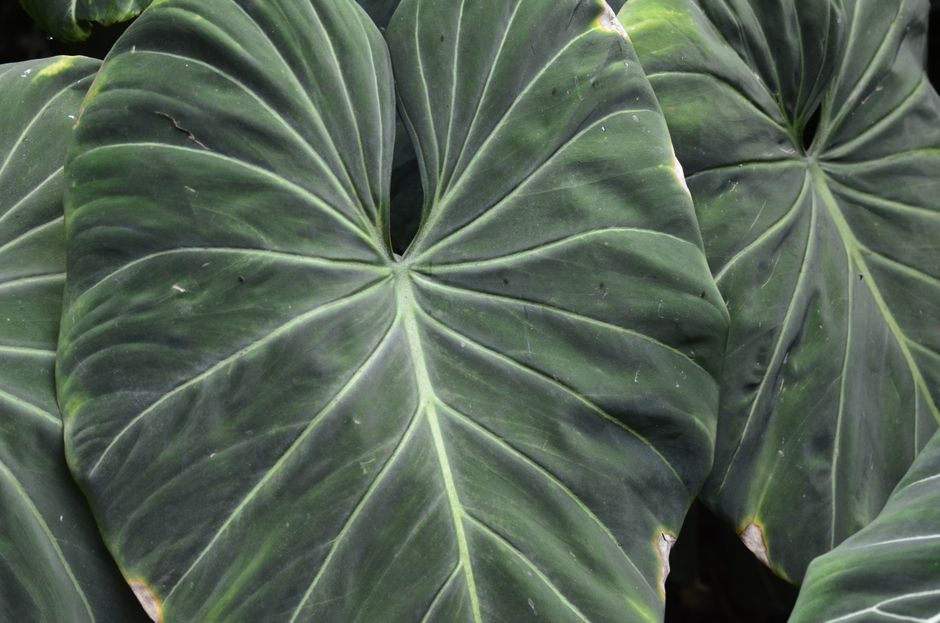
My first Philodendron luxurians arrived in November as a rooted cutting with two juvenile leaves the size of playing cards, both a dull olive with none of the promised velvet. For six weeks I watched it do absolutely nothing while I second-guessed my humidity, my light, and my life choices. Then, sometime in early January, a sheath pushed out from the growth point and the plant I had actually paid for finally started to appear. That first fully mature leaf, deep bottle-green with a matte nap that swallowed light like fabric, is the reason I keep growing this species and the reason I write about it now with a bit more calm than I felt at the time.
Luxurians is one of those Chocoan-region philodendrons that photographs like a piece of theatre and grows like a slow bureaucrat. Anyone selling you a fast-growing luxurians is either mislabelling something else or hoping you will not know the difference. What follows is what I actually do to keep mine putting out one respectable leaf every seven to ten weeks, which is roughly as good as it gets in an unheated living room.
What luxurians actually is, and why the label matters
Philodendron luxurians was described from lowland rainforest in the Choco region of Colombia, where it hemi-epiphytically climbs slender trees in dense shade with humidity that rarely dips below 85 percent. The mature leaves are broadly cordate, up to 60 cm long in habitat, with a thick velvety texture and pale silver-green primary veins. Juveniles look nothing like this. They are smaller, thinner, and often confused with P. gigas, P. verrucosum, or P. mamei by hopeful sellers.
Before I paid a serious price for mine I cross-checked the seller against the description in the International Aroid Society Philodendron pages and asked for a photo of the petiole cross-section, which in luxurians is subterete with a distinctive channel. That single question filtered out two of three sellers I contacted. If a seller cannot answer basic morphology questions, walk away.
Light: bright, indirect, and further from the window than you think
The most common mistake I see in collector groups is treating luxurians like a low-light plant because it grows in shade in the wild. Rainforest understory shade is still brighter than the corner of most apartments. I use a PAR meter borrowed from a friend who keeps reef tanks, and I aim for 100 to 200 PPFD at leaf height for 12 hours a day. In practical terms that means:
- About 1.2 to 1.5 metres back from an east-facing window with a sheer curtain
- Under a 24W bar-style LED grow light set 45 cm above the canopy, on a 12-hour timer
- Never in a spot where a hand shadow on the leaf has hard edges at midday
Leaves that develop under too little light come in thin, pale, and with widely spaced veins. Leaves that develop under too much light bleach at the centre and lose the deep chocolate cast entirely. I lost one lovely mature leaf to a two-hour sunbeam I did not notice, and the crisp bronze patch never recovered.
Humidity: the number that actually matters
Luxurians will survive at 55 percent humidity. It will not produce the velvet you paid for. My working target is 75 percent minimum, 85 percent preferred, measured with a calibrated hygrometer at plant level rather than at the ceiling. I keep mine in a glass-fronted IKEA Milsbo cabinet with a small ultrasonic humidifier on a hygrostat, drawing filtered water so the leaves do not get mineral spots.
When new leaves emerge below 70 percent humidity, they often stick inside the cataphyll and tear as they unfurl, or they open with corrugated damage along the margin. Both are cosmetic but permanent, and mature leaves of this species last two to three years, so a cosmetic flaw is one you look at for a long time.
Substrate and pot: airy, chunky, never soggy
I have killed one luxurians with rot and nearly killed a second, both because I trusted a bagged aroid mix that packed down within a month. The mix I use now stays open for at least a year and drains within about three seconds of watering.
| Component | Volume | What it does |
|---|---|---|
| Orchid bark, fine grade | 40% | Structure, slow decomposition |
| Perlite, chunky #3 | 25% | Air pockets, drainage |
| Coco chips, rehydrated and rinsed | 20% | Water retention without sog |
| Sphagnum moss, long fibre | 10% | Root contact, moisture buffer |
| Horticultural charcoal | 5% | Odour, minor filtration |
I use plastic nursery pots with side slits, never terracotta. Terracotta wicks moisture away from the roots too fast in a warm cabinet, and luxurians roots are fussy about drying completely.
Watering: by weight, not by schedule
I lift the pot. Freshly watered it weighs about 780 grams for my current specimen. When it drops to around 520 grams I water again. In my cabinet that works out to roughly every 5 to 6 days in summer and every 8 to 10 days in winter. I flush with rainwater or reverse-osmosis water because our tap water sits around 320 ppm and leaves crusty residue on the aerial roots.
- Water slowly around the base until it runs freely from the drainage slits
- Let it drain for a full 10 minutes before returning it to the cabinet
- Never let the pot sit in standing water, even briefly
- Skip a watering if the previous one has not fully drawn down by day 7
Feeding, climbing, and the patience curve
I feed with a balanced 3-1-2 liquid fertiliser at quarter strength every second watering from March through October, and nothing at all from November through February when growth stalls. Over-feeding a slow grower is one of the easier ways to burn root tips and stall the plant for another two months.
Luxurians is a climber, and it will not produce mature leaves until it has something to climb on. I use a 60 cm sphagnum-wrapped pole kept damp by a top-drip line from the humidifier reservoir. Within a growing season, aerial roots reach into the moss and anchor. The next leaf that emerges is usually 20 to 30 percent larger than the previous one. Without a pole, the plant tops out at juvenile-form leaves and sulks.
The University of Florida IFAS Extension has a useful overview of Philodendron culture in general that reinforces the climbing-support point across the genus.
Acclimation from import or nursery
Every new luxurians I have received has lost at least one leaf in the first month. This is normal. What matters is not preventing that loss but preventing a cascade. My acclimation protocol looks like this:
- Day 1 to 3: unbox, inspect roots, rinse in room-temperature water, pot into fresh mix
- Day 4 to 14: place in cabinet at 78% humidity, 80 PPFD, no fertiliser
- Day 15 to 30: raise light to 150 PPFD, begin quarter-strength feed if new root tips are visible
- Day 31 onward: normal rotation, expect first new leaf between weeks 6 and 12
If a leaf yellows uniformly from the petiole outward during weeks two or three, that is stress leaf-drop and generally fine. If two leaves yellow at once, check for root rot immediately.
Common problems I have actually run into
Corrugated new leaves are almost always a humidity issue during unfurling, not a pest or nutrient problem. Brown crispy margins on mature leaves point to hard water or fertiliser salt build-up, both fixed by a monthly flush with 3 litres of rainwater through the pot. Sticky residue on the underside of leaves in my cabinet turned out to be scale, caught early enough that a cotton swab of 70 percent isopropyl alcohol on each insect cleared it in two passes a week apart.
The one pest that genuinely frightens me on this species is thrips, because the velvet texture hides early damage until the leaf looks silvered and stippled. I inspect the newest two leaves every Sunday with a 10x loupe. Once a month I check the growth point itself, which is where thrips tend to hide.
Frequently asked questions
Is Philodendron luxurians the same as Philodendron gigas?
No. They are related and both from the Choco region, but gigas has larger, more elongated leaves with a bronzy new-leaf flush and a different petiole cross-section. Luxurians leaves stay more heart-shaped and the velvet is darker. Gigas is also easier to grow at slightly lower humidity, which is why it often gets mis-sold as luxurians to less experienced buyers.
Why is my luxurians producing smaller leaves than the one before it?
Almost always a climbing-support problem or a root-space problem. If it has been in the same pot for more than 18 months, check for circling roots and step it up one pot size. If the moss pole has dried out or the plant has outgrown it, extend or replace it. Leaves shrink when the plant loses upward momentum.
Can I grow luxurians without a humidity cabinet?
You can keep it alive in an open room at 60 percent humidity, but the leaves will come in with pebbly, less velvety texture and the plant will grow noticeably slower. A pebble tray does very little. If a cabinet is not an option, a large clear tote with vent holes and a small humidifier gets closer to what the plant needs for a fraction of the cost.
How long until my juvenile plant produces a mature velvet leaf?
In my experience, six to nine months on a moss pole with consistent conditions. The transition is not sudden. Each leaf is a little more velvety and a little more heart-shaped than the last, until one day you look at the plant and realise it has become the thing you were waiting for.
Is luxurians safe around pets?
No. Like all philodendrons, it contains calcium oxalate crystals that cause oral irritation and drooling if chewed. I keep mine inside a closed cabinet partly for humidity and partly because my cat treats every new plant as a personal challenge.
Frequently asked questions
Why is my Stromanthe triostar losing variegation?
Most often insufficient light. Variegated sections do less photosynthesis, so in lower light the plant favors green growth. Improve light gradually and watch the next three new leaves. If reversion has progressed, cut back to variegated nodes.
How often do triostar plants produce new leaves?
Generally every six to ten weeks in summer in good conditions, slower in winter. Long pauses are normal. Forcing growth with extra fertilizer or water produces stress, not more leaves.
Why does my triostar have crispy leaf edges?
Most likely low humidity, tap water sensitivity, or salt buildup from fertilizing. Address humidity first (target sixty percent), then water quality, then fertilizer rhythm. Each new leaf reflects the changes.
Can I propagate Stromanthe triostar?
Yes, by division when the plant is mature and clumping with multiple distinct stem groups. Tip the plant out, separate the clumps gently, and pot each division. Expect minimal new growth from divisions for several months.